
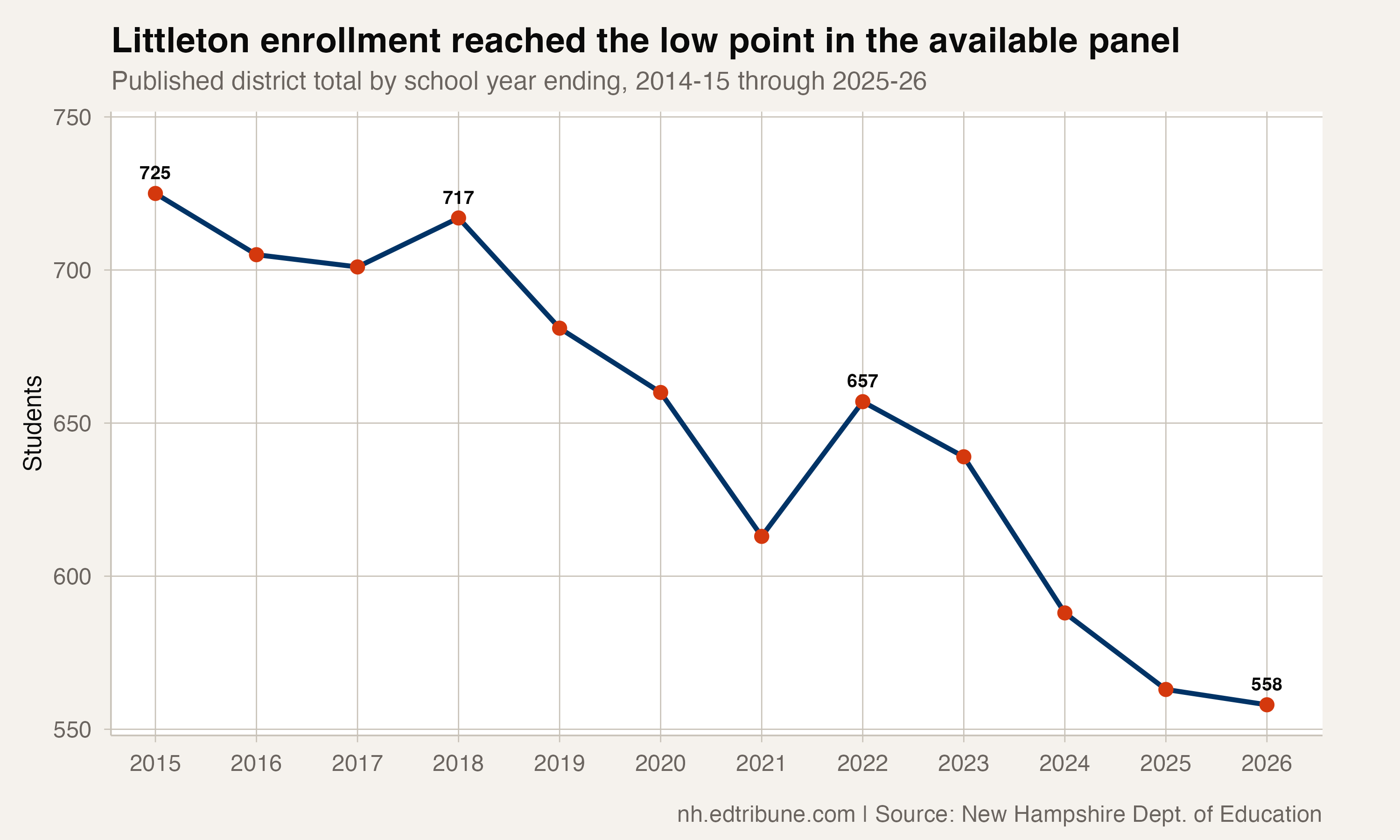
Dr. Marion Anastasia began leading the Littleton School District↗ET in early August with a promise to listen before prescribing. That approach arrives as the district weighs staffing, programs and taxpayer resources around 558 students in 2025-26, the lowest count in a complete state enrollment record that begins in 2014-15.
“My approach right now is really centered on listening, learning, and understanding,” Anastasia wrote in response to questions from The NHEdTribune. She said she is studying the systems already in place, speaking with staff and looking for both strengths and opportunities to improve. “I am not coming in with predetermined answers.”
The New Hampshire Department of Education's current superintendent list identifies Anastasia as Littleton's senior education official. She said she shadowed predecessor Steven Nilhas in the spring and now works a schedule that varies with district needs. The record supports a current superintendency, but it does not establish a permanent contract term.
Regional experience, without a false homecoming
Anastasia corrected an important premise at the start of her written answer: “I actually did not work in the Littleton School District previously.”
Her prior superintendency was at White Mountains Regional, where the New Hampshire School Administrators Association named her its 2025 Superintendent of the Year. The association's announcement traces an earlier career that included principal roles in Vermont, graduate study in education and leadership work with North Country superintendents.
That regional history is relevant to the Littleton role. Anastasia wrote that North Country districts have distinct communities and priorities, yet also face common realities. She said her established relationships give her a starting point for discussions about collaboration and shared services while keeping Littleton's needs at the center.
The distinction matters. Anastasia knows the region and its leaders, but she is learning Littleton as a new district. Treating the move as a return would erase the listening work she says comes first.
A long decline with a recent change in scale
Littleton enrolled 725 students in 2014-15. The latest count is 167 students lower, a 23.0% decrease. New Hampshire's statewide enrollment decreased 12.7% over the same endpoints.
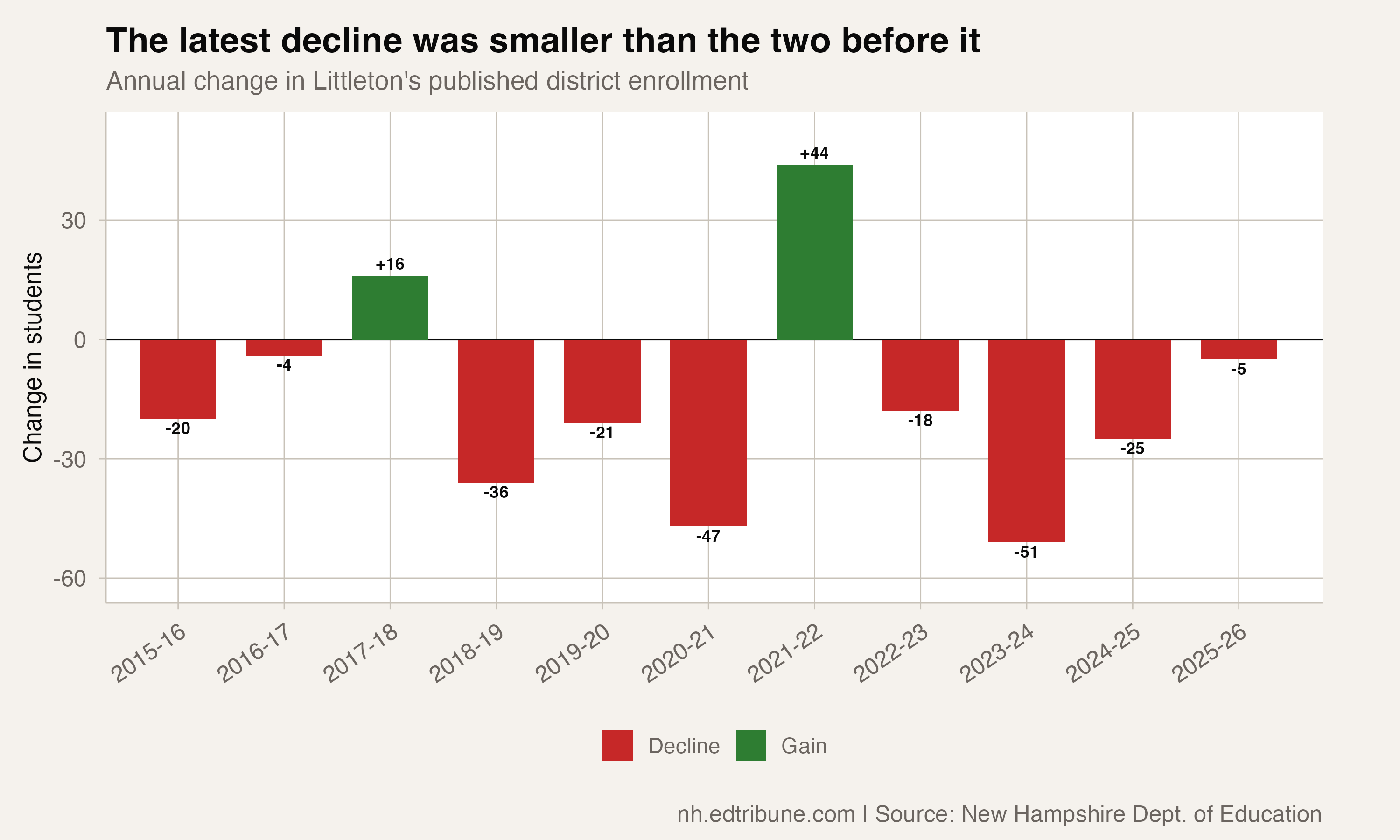
The district's path was not a straight line. Enrollment rose in two years and fell in nine across the 11 adjacent annual transitions in the available panel. Littleton reached 657 students in 2021-22 before beginning four consecutive annual declines across five reporting years. The change since that point is 99 students, or 15.1%.
The latest movement is smaller than the two that preceded it. Enrollment decreased by five students in 2025-26 after a decrease of 25 the year before. That comparison does not establish a plateau or predict the next count. It shows why a budget response based on one annual change would miss the longer record.
“The enrollment decline is something we need to understand carefully, particularly as we enter the upcoming budget season,” Anastasia wrote. She said the district needs to examine where changes are occurring, how enrollment relates to programs and staffing, and what students need before drawing conclusions from the overall number.
What the grade bands can and cannot show
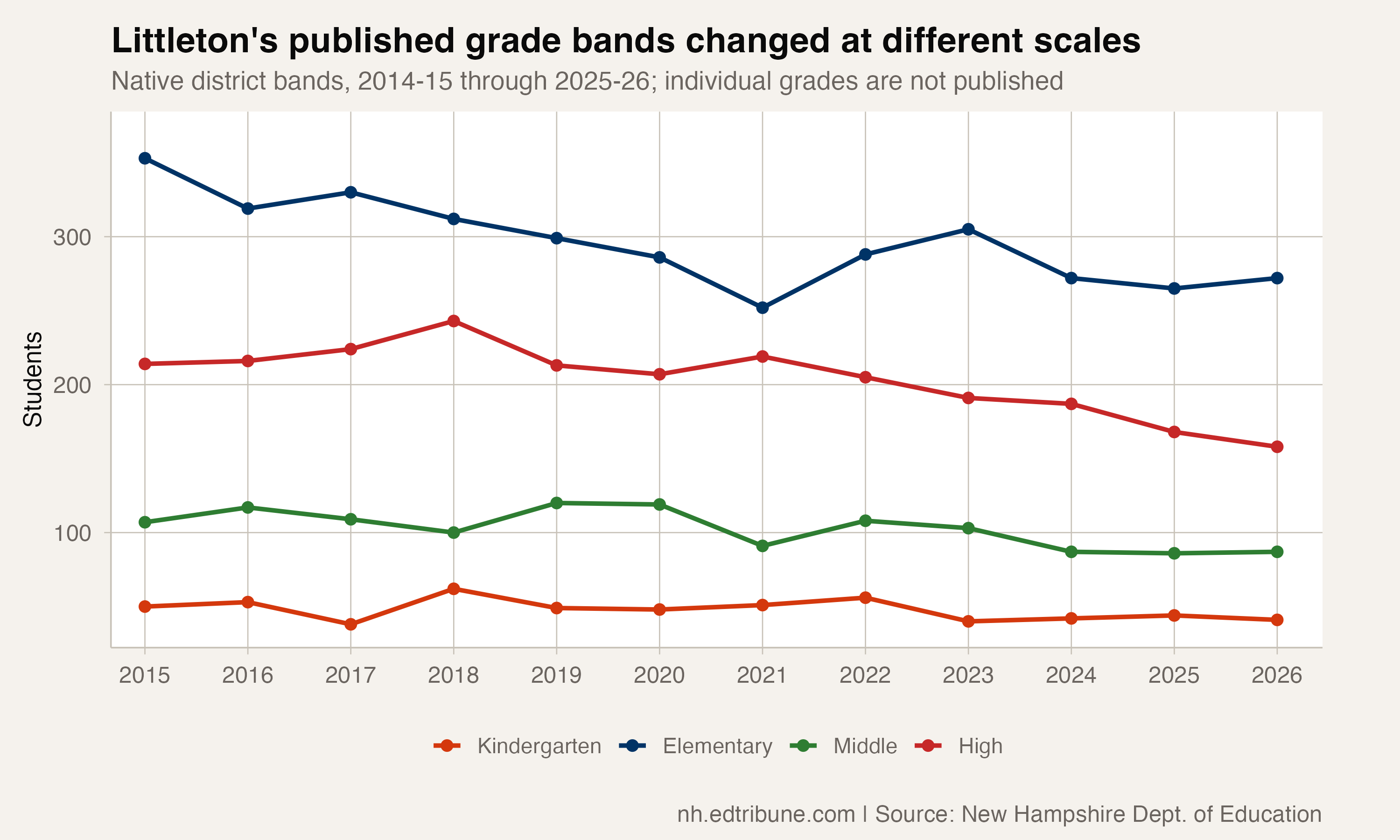
The state data support part of that inquiry, with an important limit. Littleton's published district panel contains elementary, kindergarten, middle, high, prekindergarten and postgraduate bands. It does not publish individual district grade rows, so it cannot show whether a particular elementary or high school grade accounts for the change.
Across the available endpoints, the elementary band has 81 fewer students, the high school band has 56 fewer, the middle school band has 20 fewer and kindergarten has nine fewer. Every native band is present in every year, and the bands reconcile exactly to the published district total. The pattern is broad enough to inform questions, but not specific enough to answer them without additional local records.
That boundary fits Anastasia's own caution. She wrote that course offerings, graduation requirements, class sizes and student-to-teacher ratios need context. Age, course content, developmental needs and individual student needs can make the same class size appropriate in one setting and wrong in another.
The current state record also shows how those decisions reach distinct buildings. Mildred C. Lakeway School enrolls 313 students, Littleton High School enrolls 158 and Daisy Bronson Junior High School enrolls 87. The three campus totals sum exactly to the district's 558 students. Those counts describe the footprint; they do not prescribe which positions, courses or services should change.
Turning a strategic plan into decisions
Anastasia identified several early assignments beyond enrollment. She said Littleton began a strategic-planning process with substantial stakeholder input before her arrival. Her next step is to connect that work to current data, clear goals and concrete action steps.
She also said the school board charged her with examining efficiencies and opportunities across the district. Alongside possible shared services, she is reviewing job descriptions that may no longer match the work performed in schools and preparing for a review of board policies and procedures.
Those projects create a practical test of the listening-first approach. Shared services can preserve opportunity or reduce duplication, but Anastasia's regional relationships do not prove that an arrangement will fit Littleton. A smaller enrollment base can change staffing and program choices, but the enrollment record does not identify which choices are educationally sound.
“The goal isn't simply to reduce because enrollment has declined,” Anastasia wrote. Her stated aim is to align programs, staffing and resources with the students Littleton serves now while using taxpayer dollars responsibly.
That leaves the new superintendent with a concrete sequence: understand the grade-band changes the state can show, gather the individual-grade and program context it cannot, and bring those findings into the budget and strategic-plan work. The quality of the next decision will depend on whether that listening produces choices the district can explain in educational as well as financial terms.
Enrollment counts come from the New Hampshire Department of Education's public reports. Appointment and career details come from Anastasia's written responses, the current state superintendent list, and the New Hampshire School Administrators Association biography.
Detailed code that reproduces the analysis and figures in this article is available exclusively to EdTribune subscribers.
Discussion
Sign in to join the discussion.
Loading comments...