
Catherine Masterson leads the New Hampshire school system where she once worked as a paraprofessional. A Merrimack Valley High School alumna, she became superintendent of SAU 46 this summer and now oversees the Andover and Merrimack Valley districts. In written answers to The NHEdTribune, she named student academic achievement, financial stability and community engagement as her priorities.
"I have lived or worked in SAU 46 for almost my entire life," Masterson wrote. "It is a privilege to lead a community that so strongly supports its youth and values public education."
The supervisory unit publishes the arrangement plainly: its two districts cover Andover, Boscawen, Loudon, Penacook, Salisbury and Webster, and its board is made up of members of both districts' school boards.
The record she took over holds a genuine achievement and a genuine problem, and they sit in different places.
Eleven years above the state
Merrimack Valley↗ET High School graduated 178 students out of a cohort of 195 in 2024-25, the most recent year in New Hampshire's published graduation record. That is a four-year cohort rate of 91.3 percent, against 87.5 percent statewide, a difference of 3.7 percentage points.
It is not a one-year result. The district has finished above the statewide rate in all eleven years the state publishes, from 2014-15 through 2024-25. The margin has never fallen below 1.3 points and has never risen above 6.4.
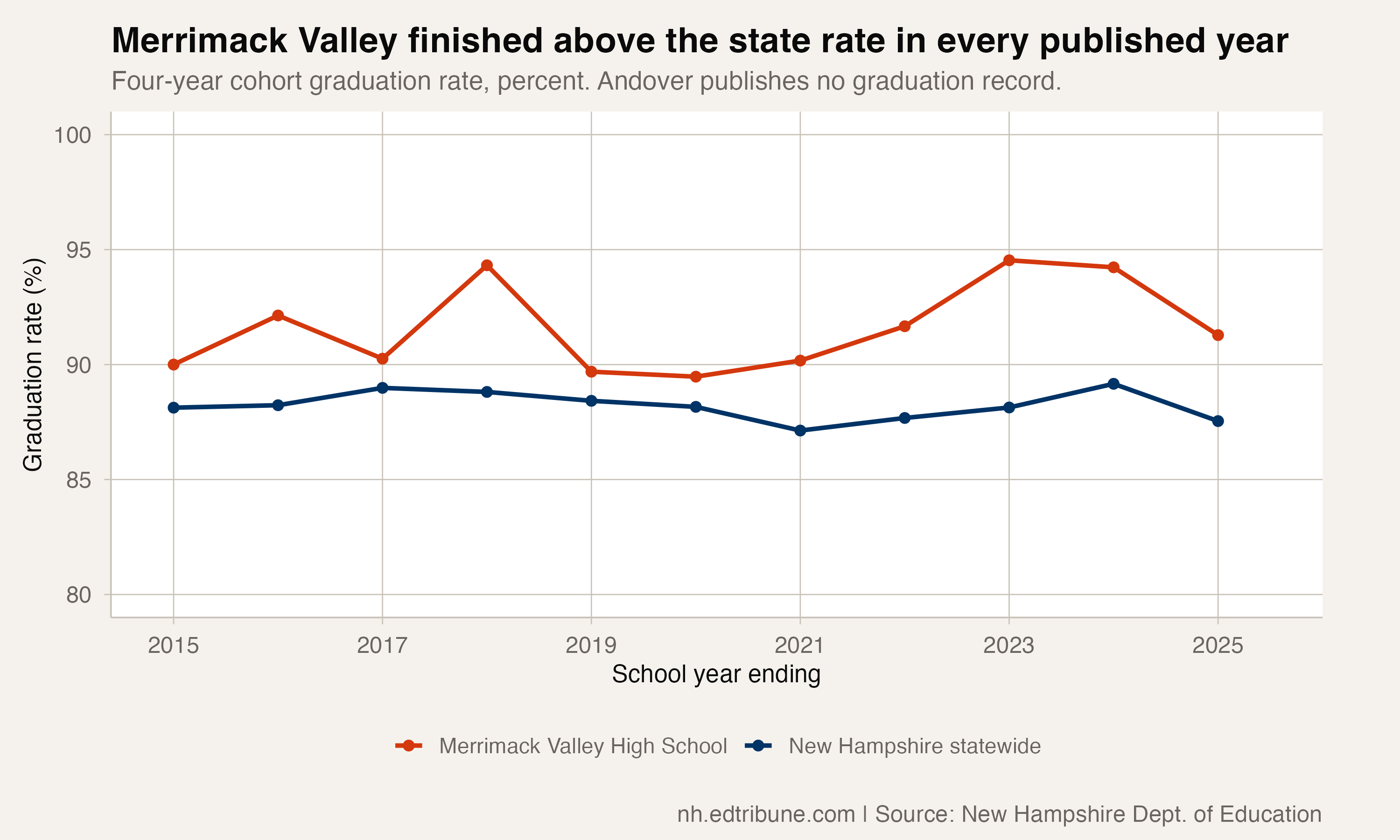
The published record does not say why. A district's completion rate moves with credit-recovery practice, with course requirements, with which students enroll and which leave, and the state's file separates none of them. What it does establish is that the result is durable rather than recent, and that whatever produces it predates the new superintendent by more than a decade.
That measure belongs to Merrimack Valley alone. Andover↗ET publishes no graduation record because it operates no high school. Its students attend Merrimack Valley High School under a tuition arrangement described by the Concord Monitor. The graduation rate therefore includes teenagers from both communities, even though only Merrimack Valley reports it.
Both districts are shrinking faster than the state
Merrimack Valley enrolled 2,097 students in 2025-26, the most recent school year in New Hampshire's published enrollment data. Andover enrolled 166. Current-year counts will differ once the state publishes 2026-27 figures.
Twelve years earlier, in 2014-15, those totals were 2,608 and 229. Merrimack Valley is down 511 students, or 19.6 percent. Andover is down 63, or 27.5 percent. New Hampshire as a whole fell 12.7 percent over the same years, which means Merrimack Valley shed students 6.9 percentage points faster than the state and Andover 14.8 points faster.
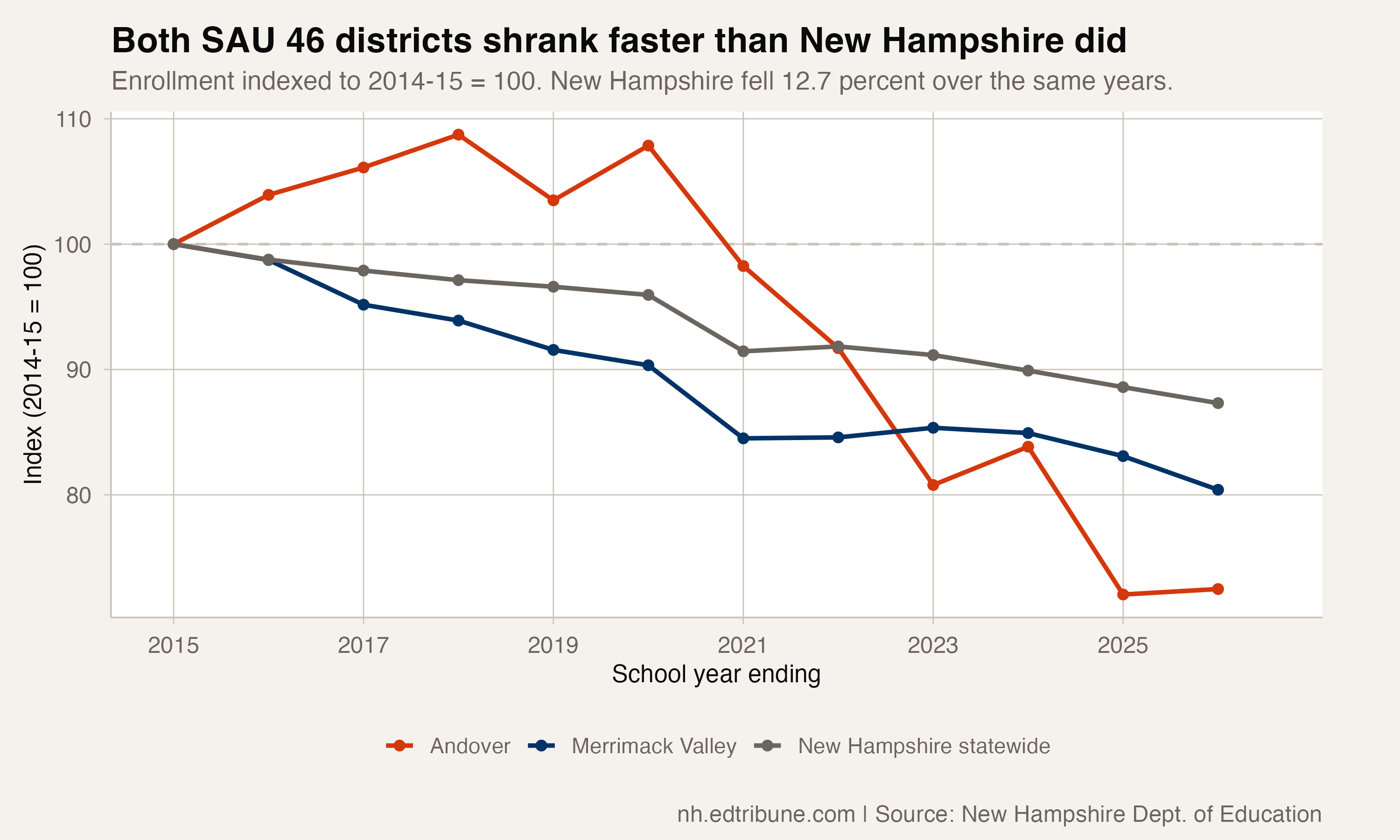
Added together, the two published district totals come to 2,263 students, 574 fewer than the 2,837 the same two districts enrolled in 2014-15, a decline of 20.2 percent. That sum is a measure of the superintendent's operating scale, not a merged district. Andover and Merrimack Valley keep separate boards, separate budgets and separate warrants.
Neither line is straight. Merrimack Valley fell in nine of the eleven annual transitions in the window and rose in two, in 2021-22 and 2022-23. Andover fell in five and rose in six, peaked at 249 students in 2017-18 rather than at the start of the window, and now sits 83 students below that peak. Its most recent move was upward, by a single student. A one-student gain in a district of 166 is not a turn, and nothing in the file makes it one.
The statewide decline gives context, but it does not explain the gap: both districts fell further than New Hampshire as a whole, and the enrollment file does not say why. Masterson's response points instead to how the districts are working within the numbers. "While Andover and Merrimack Valley are distinct districts, we operate as one community," she wrote. She said their boards coordinate long-range goals through a joint SAU board and their leadership teams work together on educational continuity.
Every school is smaller
The decline is not concentrated in one building. All eight schools the two districts publish enrolled fewer students in 2025-26 than in 2014-15.
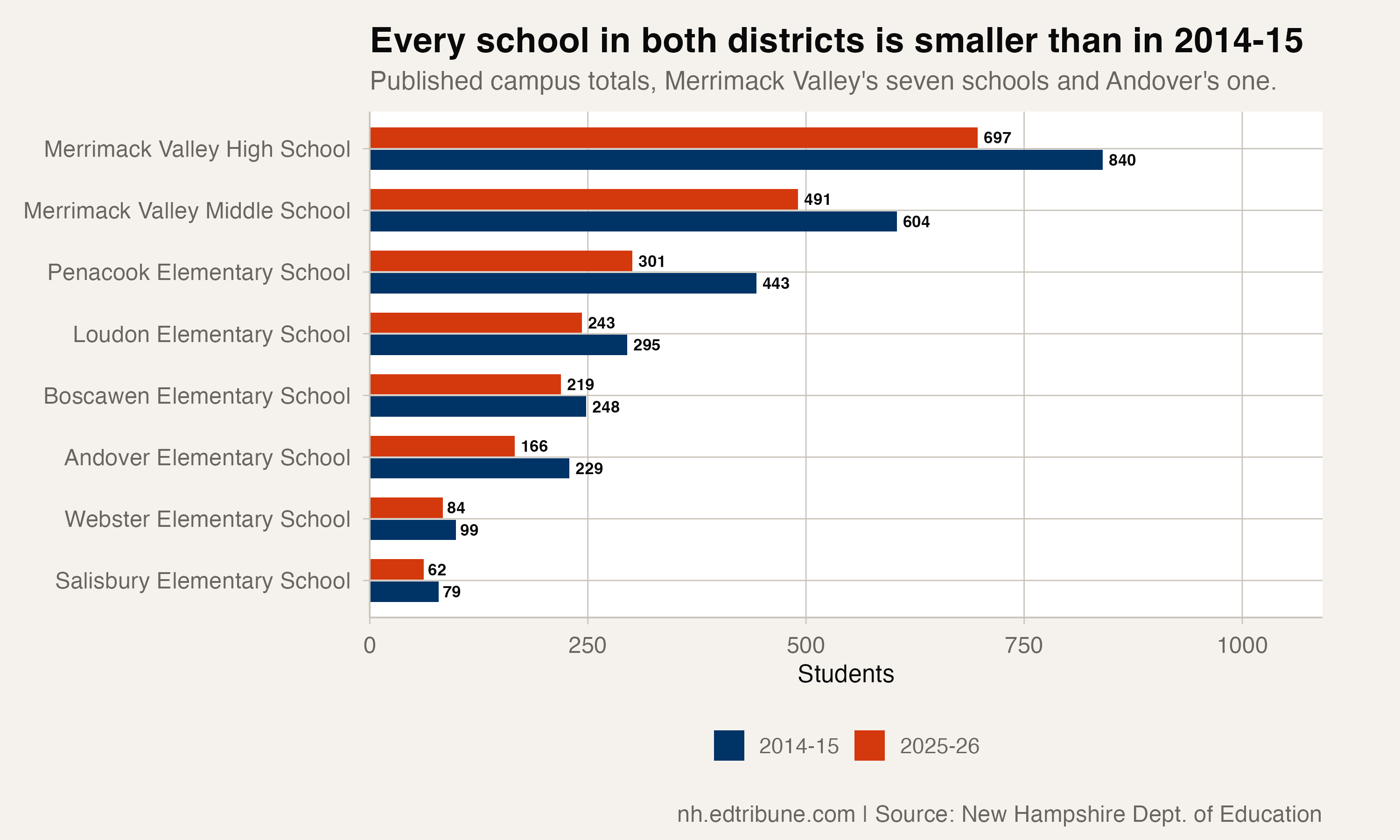
Merrimack Valley's seven campuses reconcile exactly to its district total: 697 students at the high school, 491 at the middle school, 301 at Penacook Elementary, 243 at Loudon Elementary, 219 at Boscawen Elementary, 84 at Webster Elementary and 62 at Salisbury Elementary. Andover's single school, Andover Elementary School in the state's file, accounts for all 166 of that district's students.
The two smallest buildings make the planning question concrete. Salisbury enrolled 62 students and Webster 84 last school year, while Merrimack Valley operated five elementary schools across a district that has lost 511 students. The figures alone do not settle a staffing or facilities decision, and Masterson did not propose one in her written response.
The youngest grades add another planning signal. Merrimack Valley's published kindergarten count fell from 165 in 2014-15 to 116 in 2025-26, a loss of 49 children. Andover's single school runs kindergarten through grade eight and enrolled 15 kindergartners in 2025-26 against 20 eighth graders. That is one year's cross-section, not a forecast.
Masterson described a practical response at Andover Elementary/Middle School: staff sometimes combine duties, including classroom instruction and building technology support. She also pointed to community support for the school. Those are her accounts of how the district operates; the state's enrollment rows cannot measure their effect.
The money runs in opposite directions
New Hampshire published per-pupil cost for 2024-25, and the two districts land on opposite sides of the state figure.
Merrimack Valley spent $19,767 per pupil, $2,933 below the statewide $22,700, and ranks 144th of the 162 districts with a published figure. Andover spent $23,660, $960 above the state, ranking 99th. The gap between the two partners in one supervisory unit is $3,893 a student.
The difference should not be read as a verdict on either board's efficiency. Andover operates one small school, while Merrimack Valley's published enrollment is 12.6 times as large. The state publishes one year of this cost measure, so there is no trend to read.
Set against enrollment, Merrimack Valley's position is the more unusual one: a district that finishes above the state on graduation while spending well below the state per student. The published data supports both statements and explains neither.
A leader who came through the schools
SAU 46 lists Catherine Masterson as Superintendent of Schools, with no interim or acting qualifier. The districts' annual report records the board's approval of her appointment. She succeeded Randy Wormald, whose retirement was reported by the Concord Monitor.
In her written answer, Masterson traced a path from paraprofessional to teacher, assistant principal, principal and assistant superintendent before taking this seat.
For Andover, she described a school with deep community support. "Andover is a close-knit community that deeply values its school," she wrote. At the same time, she said, the staff have stayed flexible as enrollment changes. The published state totals stop at 2025-26; they describe the landscape she inherited, not the results of her first school year.
The next public counts will show whether the enrollment lines move. For now, Masterson's answer is about keeping the two districts connected while protecting the experience of the students in them.
Enrollment, graduation and per-pupil cost figures come from the New Hampshire Department of Education's Bureau of Education Statistics, covering 2014-15 through 2025-26 for enrollment, 2014-15 through 2024-25 for graduation, and 2024-25 for per-pupil cost. Merrimack Valley is district 352 in the state's files and is a different district from Merrimack, district 351, which is not part of SAU 46. Masterson supplied the headshot used with this profile.
Detailed code that reproduces the analysis and figures in this article is available exclusively to EdTribune subscribers.
Discussion
Sign in to join the discussion.
Loading comments...