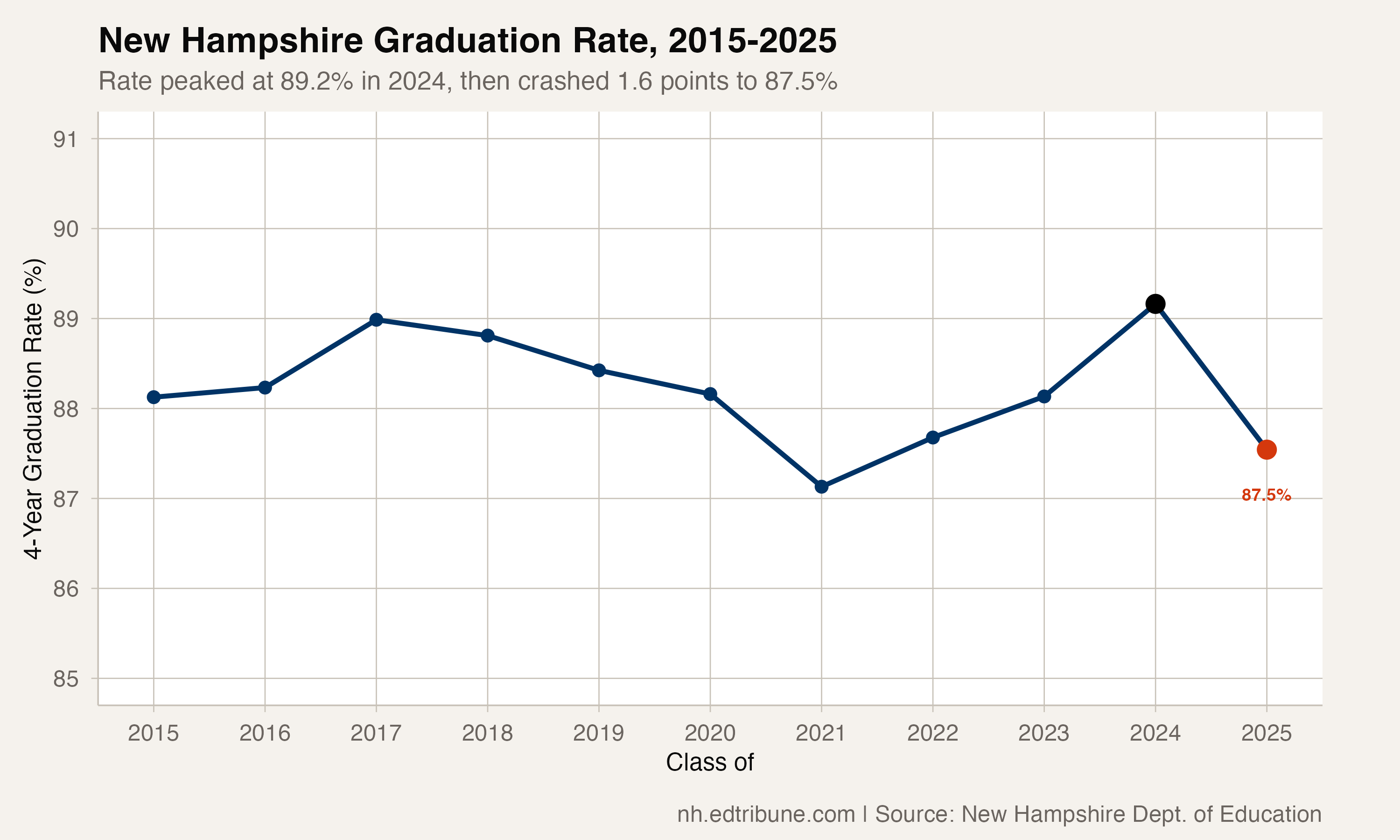
New Hampshire spent a decade inching its graduation rate upward, through a pandemic, through the nation's steepest enrollment decline, through chronic absenteeism rates that doubled. By 2024, the state had reached 89.2 percent — the highest four-year graduation rate in at least 11 years of available data, and the first time New Hampshire had cleared the 89 percent threshold.
Then the Class of 2025 happened.
The state's graduation rate dropped 1.6 percentage points in a single year, falling to 87.5 percent. It was the largest year-over-year decline in the dataset, wiping out three years of steady improvement and leaving New Hampshire barely half a point above the national average.
The Paradox: Fewer Dropouts, Fewer Graduates
The most striking feature of the 2025 reversal is what did not cause it. The state's dropout rate fell to 2.2 percent — the lowest on record. In a typical year, when graduation rates decline, dropout rates climb. In 2025, they moved in opposite directions.
The explanation lies in a category that rarely gets headlines: the students who neither graduate in four years nor formally drop out. In 2025, 10.3 percent of the cohort fell into this "unaccounted" category — students who were still enrolled beyond four years, who earned a HiSET equivalency diploma, or who transferred out of the system. That share is the highest in the 11-year dataset, up from a low of 6.1 percent in 2017.
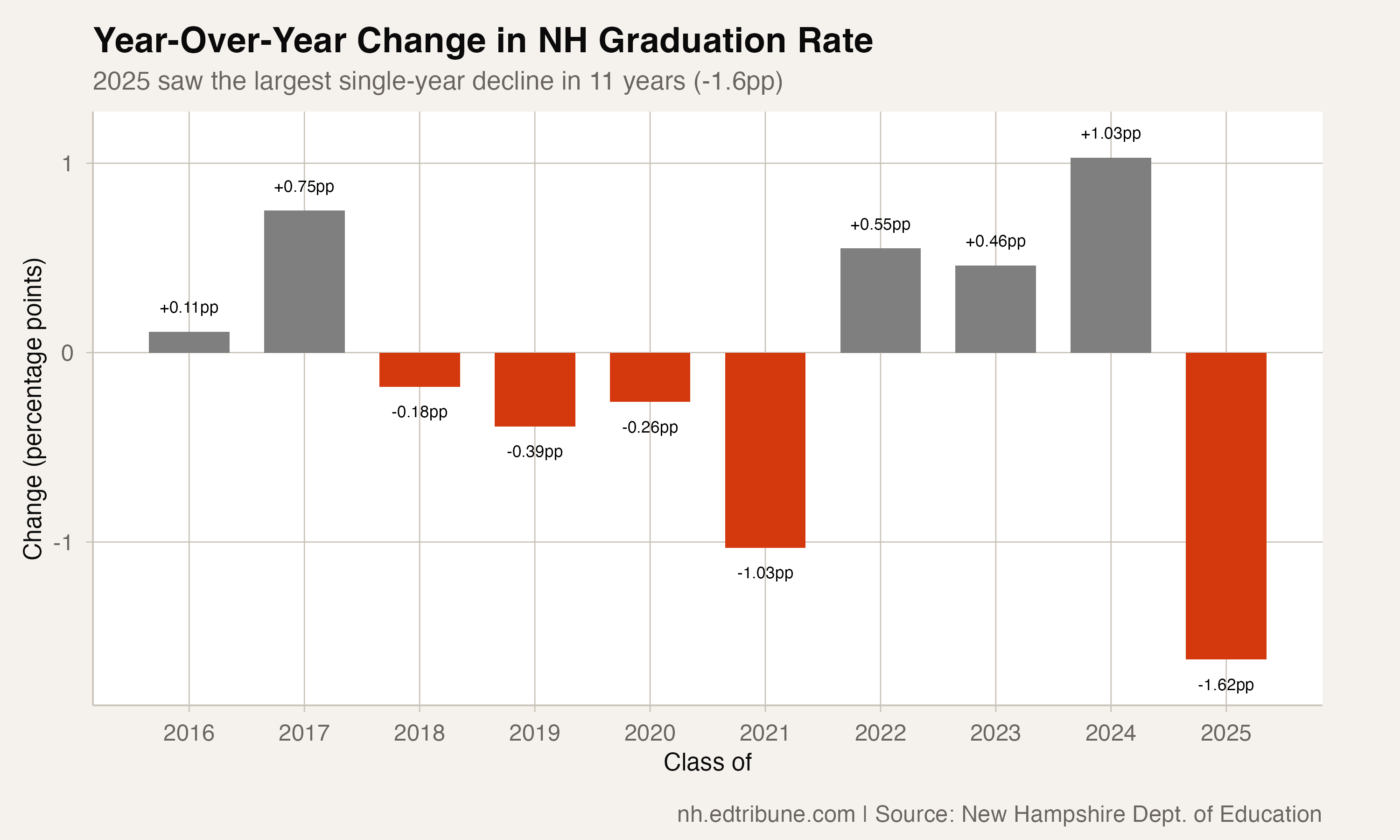
Put differently: the four-year timeline is becoming less relevant for a growing share of New Hampshire students. They are not leaving school. They are not dropping out. They are simply taking longer, or finding alternative pathways to completion.
A Shrinking Pipeline
The 2025 reversal came against the backdrop of a cohort that has been shrinking for a full decade. The Class of 2025 had 12,980 students — down from 14,780 in the Class of 2015, a 12.2 percent decline with no interruption. Every single year produced a smaller cohort than the one before.
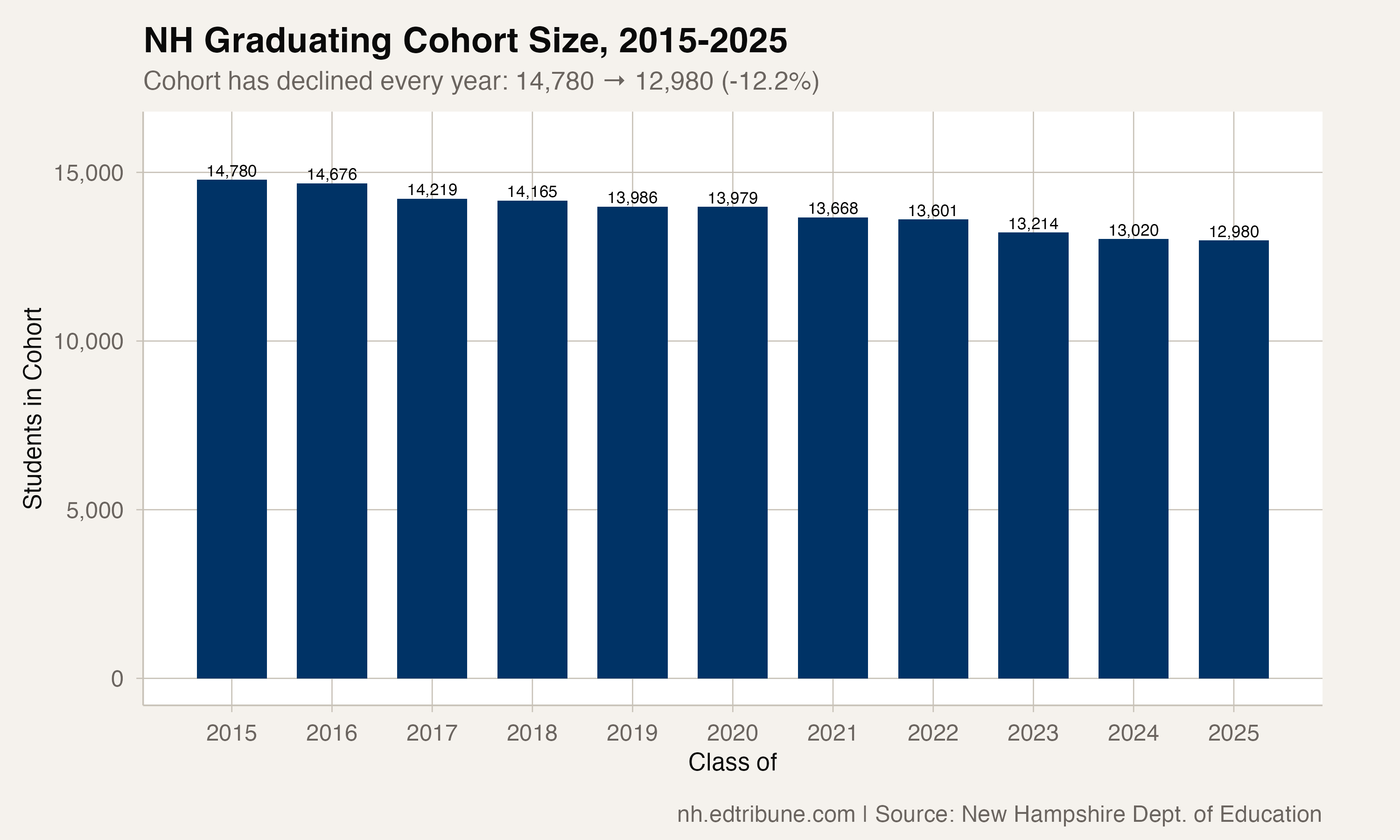
New Hampshire has experienced the largest enrollment decline of any state over the past two decades — 18.4 percent — driven by birth rates that fell from roughly 14,000 per year to 11,000-12,000. The shrinking pipeline means the state is producing 1,662 fewer graduates annually than it did a decade ago: 11,363 in 2025 compared to 13,025 in 2015, even though the graduation rate barely changed over that span.
The fiscal implications are real. Per-pupil adequacy funding reached a record $7,132 in fiscal year 2025, a 30 percent increase over the past decade, as fixed costs spread across fewer students.
Where the Damage Concentrated
The 2025 crash was not an urban phenomenon. Twenty districts hit all-time low graduation rates, including the state capital (Concord↗ET, 73.0 percent), the second-largest city (Nashua↗ET, 82.3 percent), and affluent suburbs like Bedford↗ET and Londonderry↗ET — both at 87.8 percent.
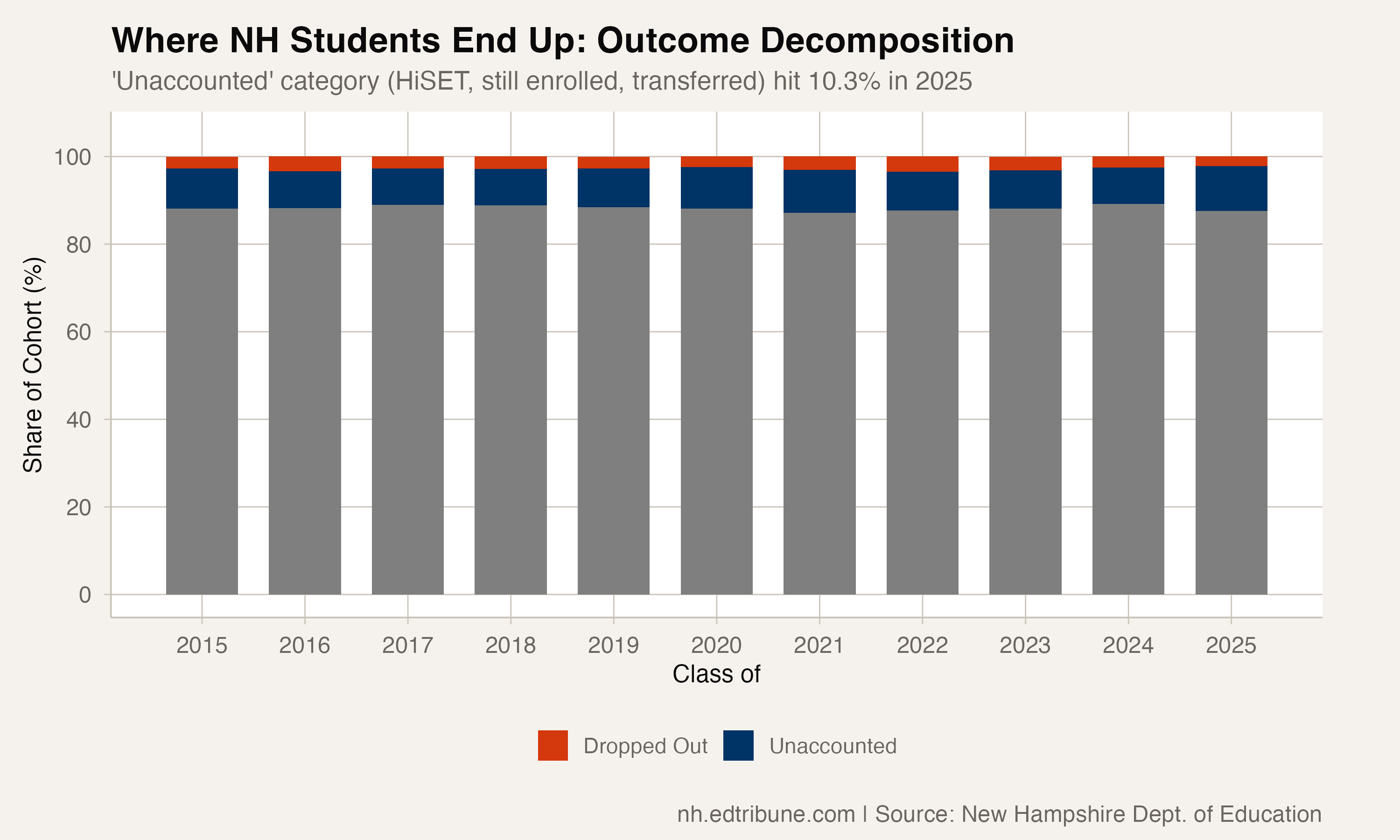
The breadth of the decline is what distinguishes 2025 from earlier dips. When the rate fell to 87.1 percent in 2021 during COVID, the damage was concentrated in urban districts. This time, the crash reached into communities where graduation had been virtually guaranteed for years.
What the Recovery Scorecard Shows
The Education Recovery Scorecard indicates that New Hampshire students remain roughly half a grade level behind 2019 performance in math and a third of a grade level behind in reading. Chronic absenteeism rates doubled from 13 percent to 24 percent between 2019 and 2023. These learning deficits may now be showing up in graduation rates — students who were in middle school during the pandemic disruptions are reaching their senior year without the credits or skills to finish on time.
Looking Ahead
The 2025 crash leaves New Hampshire at a crossroads. Its graduation rate is essentially flat over the decade — 88.1 percent in 2015, 87.5 percent in 2025 — despite enormous investment in recovery programs and a dropout rate that has been cut significantly. The growing "unaccounted" population suggests the challenge is no longer keeping students from leaving, but helping a rising share finish within the four-year window.
With the cohort projected to continue shrinking as lower birth rates work through the system, the state faces a compound challenge: fewer students entering the pipeline, and a declining share emerging with a diploma on time.
Data Source
This analysis uses four-year adjusted cohort graduation rate data from the New Hampshire Department of Education, covering the graduating classes of 2015 through 2025. The "unaccounted" category includes students who earned a HiSET equivalency, were still enrolled beyond four years, or transferred.
Detailed code that reproduces the analysis and figures in this article is available exclusively to EdTribune subscribers.
Discussion
Sign in to join the discussion.
Loading comments...