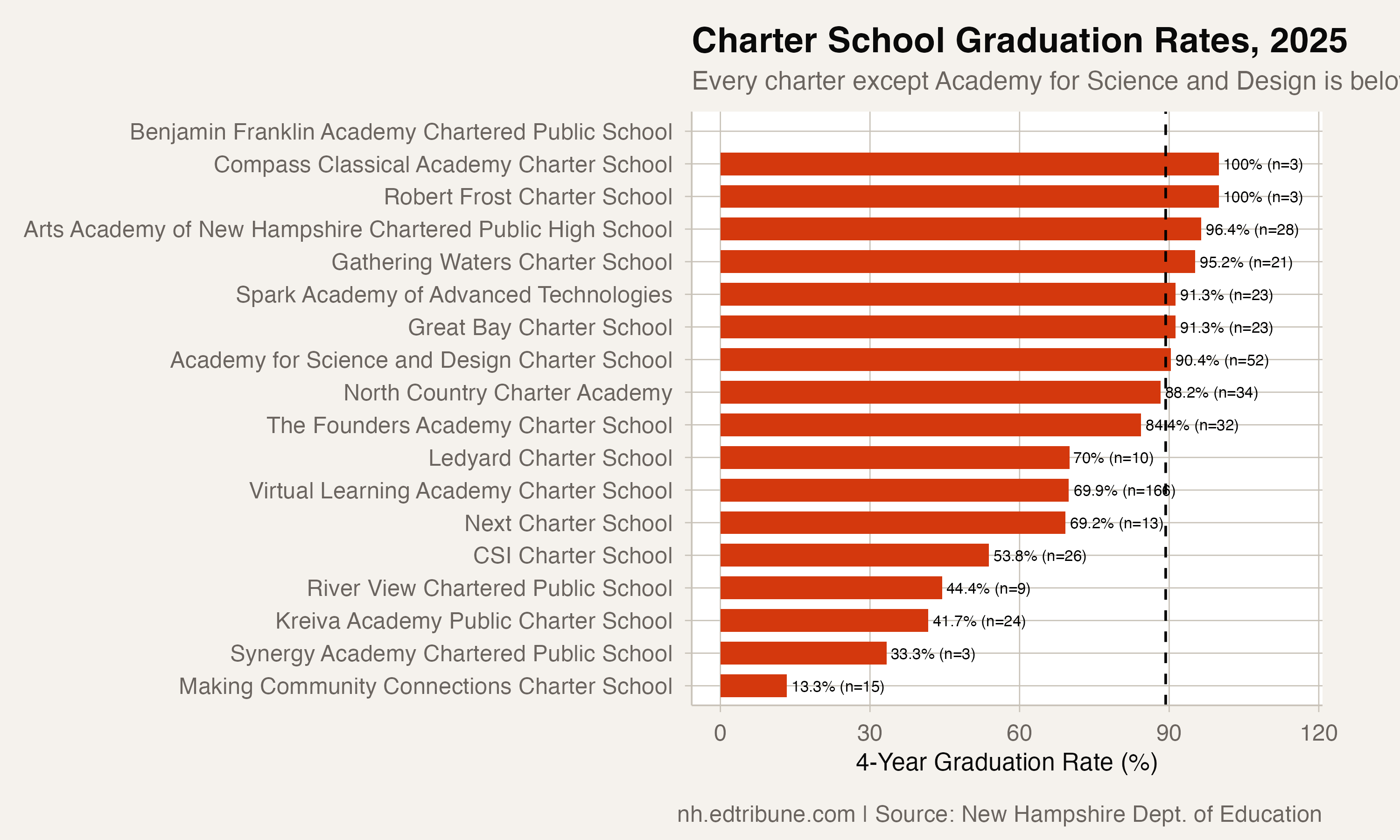
Every district in New Hampshire that graduates fewer than 70 percent of its students is a charter school.
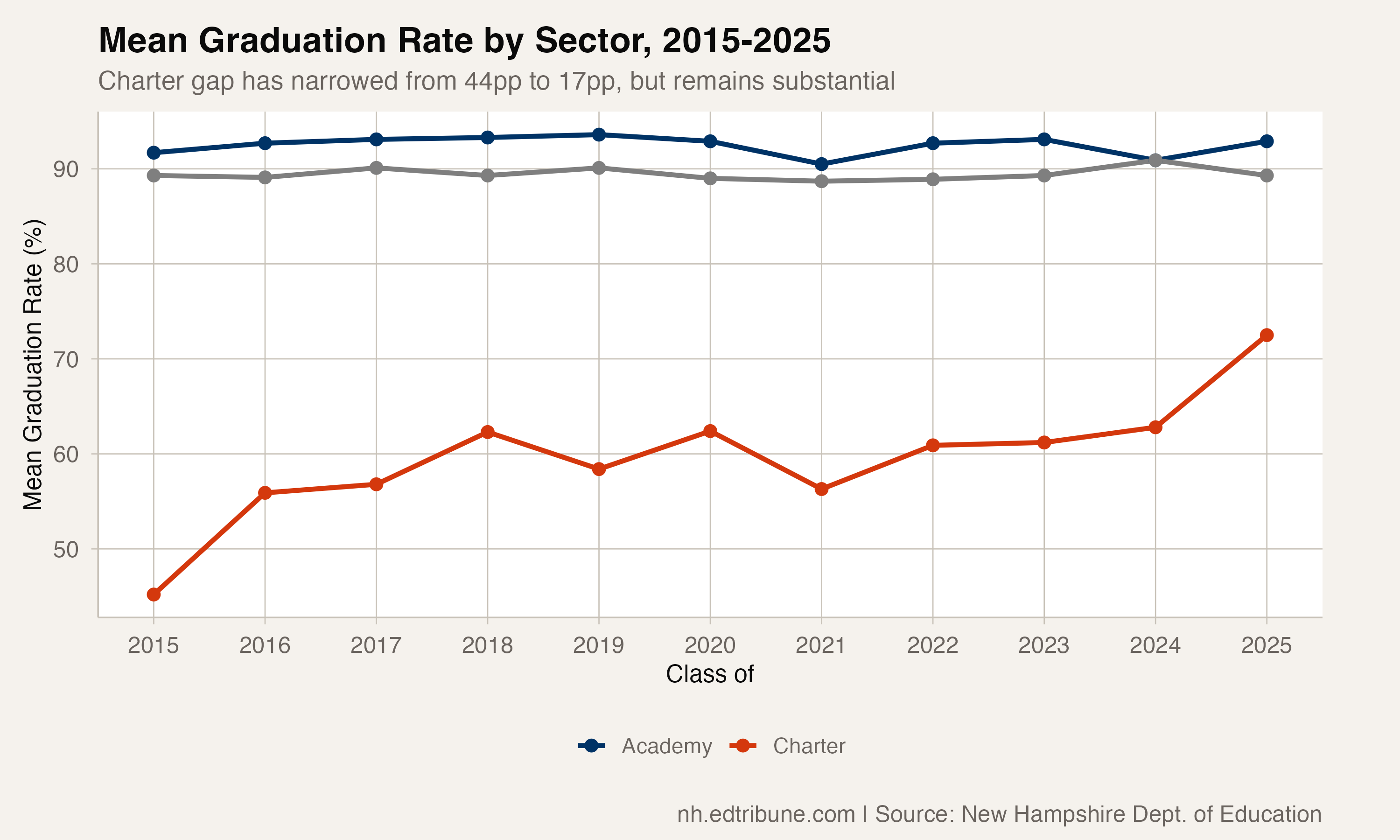
There are seven of them in 2025, led by Making Community Connections Charter School at 13.3 percent and Synergy Academy at 33.3 percent. Together, they form the low end of a sector that averages a 72.5 percent graduation rate — 17 percentage points below the traditional district mean of 89.3 percent.
The gap is one of the largest structural features of New Hampshire's education landscape, and it has existed for as long as the state has tracked graduation rates by sector.
A Gap That Has Narrowed
The charter sector's graduation rates have improved dramatically. In 2015, the mean charter rate was 45.2 percent — less than half of students graduated on time. By 2025, that figure had risen to 72.5 percent, a 27-point improvement. The traditional sector, by contrast, started at 89.3 percent and ended at 89.3 percent — essentially unchanged over a decade.
The narrowing is real, but the remaining 17-point gap is still enormous. A student entering a New Hampshire charter school is, on average, about half as likely to fail to graduate on time as a student in a traditional district — but the absolute probability of not finishing is still roughly three times higher.
Who Charters Serve
The headline comparison obscures a fundamental difference in population. New Hampshire's charter schools are not, for the most part, competing with traditional districts for the same students. The sector includes:
Virtual Learning Academy Charter School (VLACS), the largest charter by cohort with 166 students in 2025. VLACS is an online school with a 69.9 percent graduation rate that serves students across the state, many of whom are pursuing flexible scheduling.
Making Community Connections Charter School, with 30 students and a 13.3 percent graduation rate. This is an alternative program serving students who have already disconnected from traditional schooling.
Academy for Science and Design Charter School, with 87 students and a 97.7 percent graduation rate — the only charter that consistently outperforms the traditional mean.
The variation within the charter sector is wider than the variation across the entire traditional sector. The difference between Academy for Science and Design (97.7 percent) and Making Community Connections (13.3 percent) is 84 points. No two traditional districts are separated by anything close to that span.
A Growing Sector
Despite the lower average graduation rate, the charter sector has grown steadily. Charter cohorts expanded from 289 students in 2015 to 485 in 2025 — a 68 percent increase. Over the same period, traditional district cohorts shrank from 13,397 to 11,495, a 14 percent decline. Academy cohorts (Pinkerton, Coe-Brown Northwood, and Prospect Mountain) held relatively stable, declining from 1,094 to 1,000.
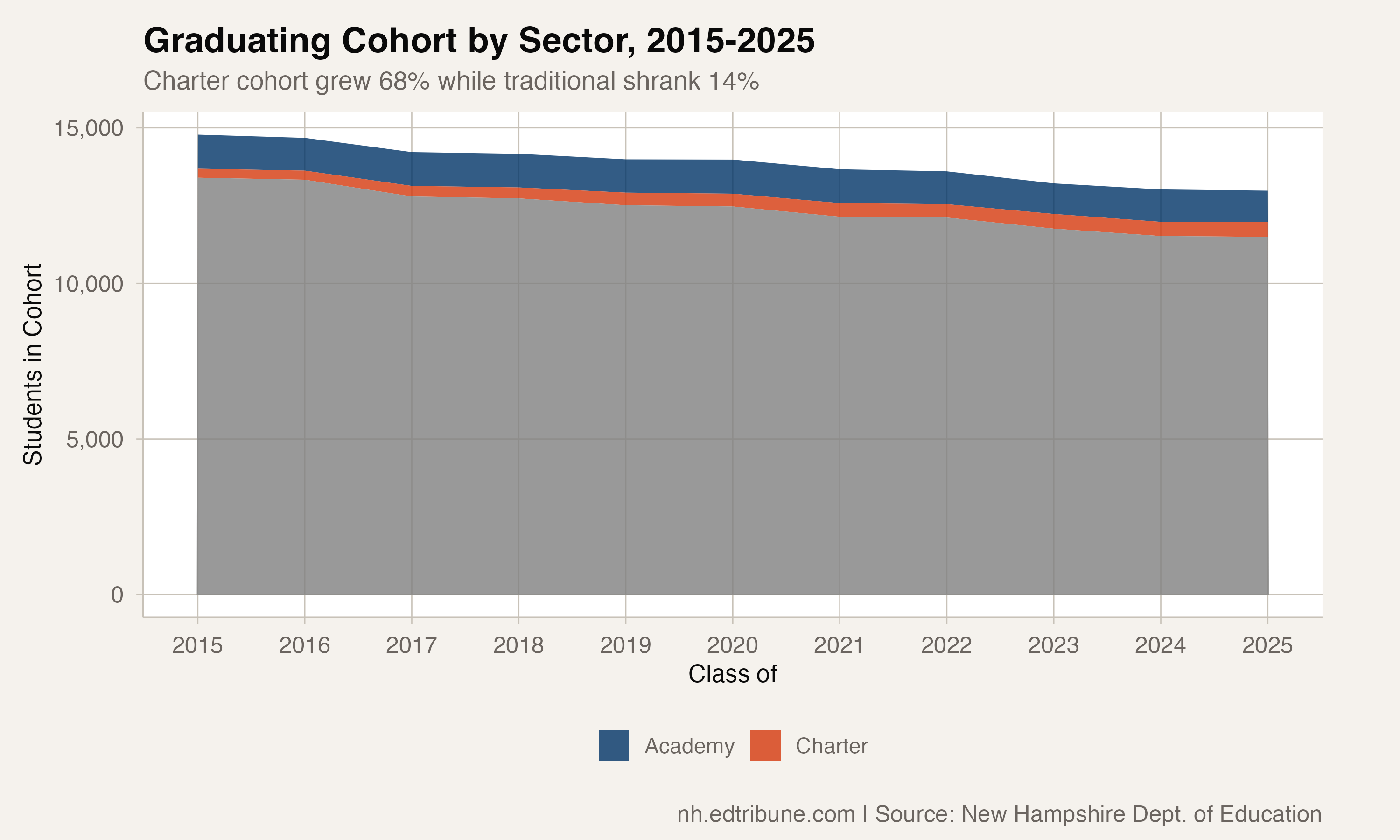
The charter sector now accounts for 3.7 percent of the graduating cohort, up from 2.0 percent in 2015. If charter enrollment continues to grow while the sector's graduation rate remains lower than the traditional average, it will exert increasing downward pressure on the statewide rate. The math matters: moving 200 additional students from a 89 percent sector to a 73 percent sector reduces the state's overall rate even if no individual school changes.
The Academy Model
New Hampshire's three public academies — Pinkerton Academy↗ET, Coe-Brown Northwood Academy, and Prospect Mountain — offer a third model worth noting. These publicly funded but independently governed institutions averaged a 92.9 percent graduation rate in 2025, outperforming both traditional districts and charters. Coe-Brown Northwood hit an all-time high of 98.8 percent.
Pinkerton Academy, with 742 graduates, is the single largest graduating institution in the state. Its 90.4 percent rate places it solidly above the traditional mean.
The academy model has maintained remarkably stable graduation rates — between 91 and 93 percent — through the entire 11-year dataset, barely dipping during COVID. Whether this reflects the academy governance structure, student selection patterns, or other factors, the consistency stands out in a year when volatility defined most of the state.
Data Source
This analysis uses four-year adjusted cohort graduation rate data from the New Hampshire Department of Education, covering the graduating classes of 2015 through 2025. Sector classification (traditional, charter, academy) is based on the state's institutional designations.
Detailed code that reproduces the analysis and figures in this article is available exclusively to EdTribune subscribers.
Discussion
Sign in to join the discussion.
Loading comments...