New Hampshire has 203 public school districts. In 2026, 134 of them lost students. Only 57 gained. And the single year in which the state's enrollment ticked upward over the past 14 years, 2022, produced a gain of just 711 students, a post-COVID bounce that evaporated by the following fall.
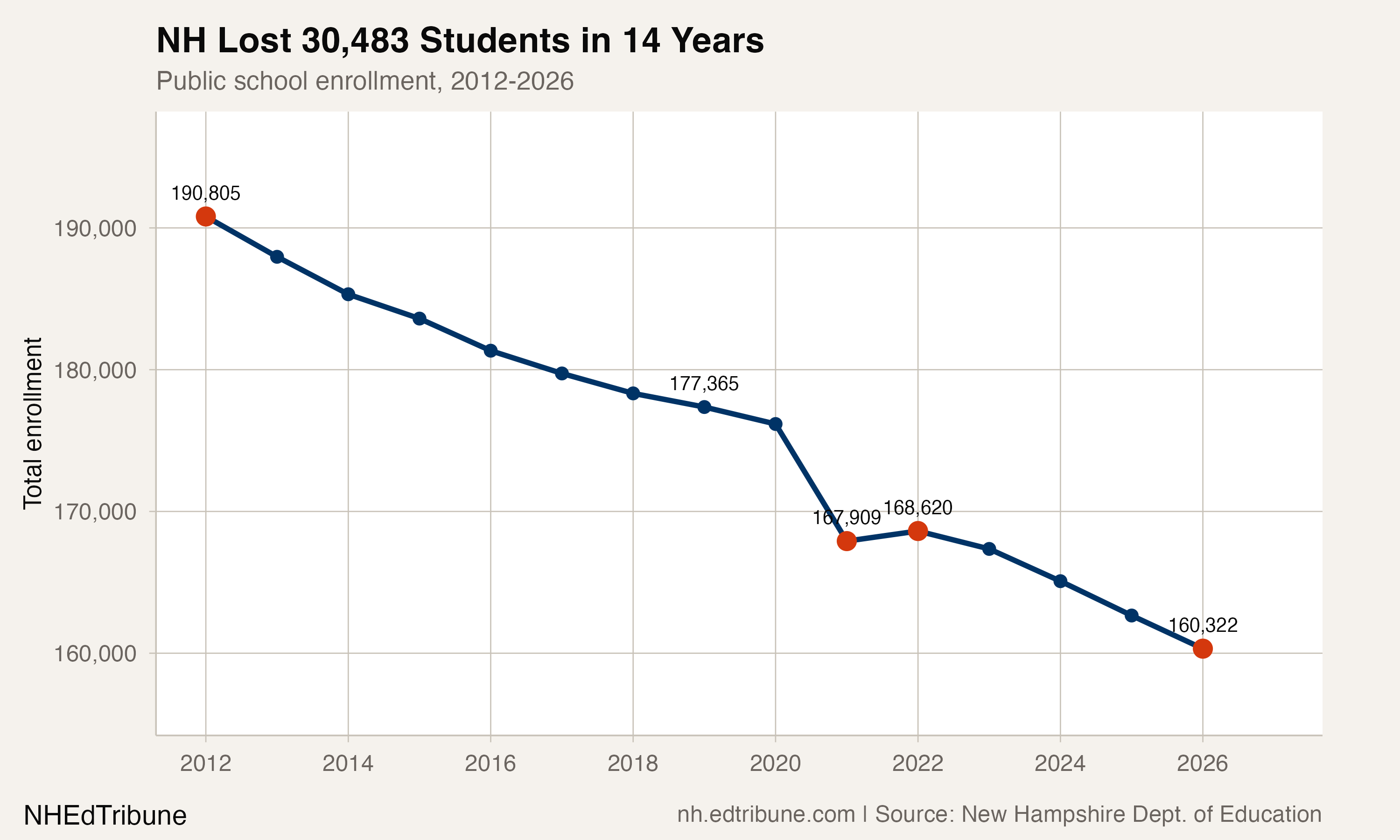
The state enrolled 190,805 students in its public schools in 2012. In 2025-26, the count was 160,322. That is a loss of 30,483 students, or 16.0%, compounding at -1.24% annually for 14 consecutive years. According to the Josiah Bartlett Center for Public Policy, New Hampshire posted the nation's largest K-12 enrollment decline over two decades, at -18.4%.
Thirteen red bars and one green one
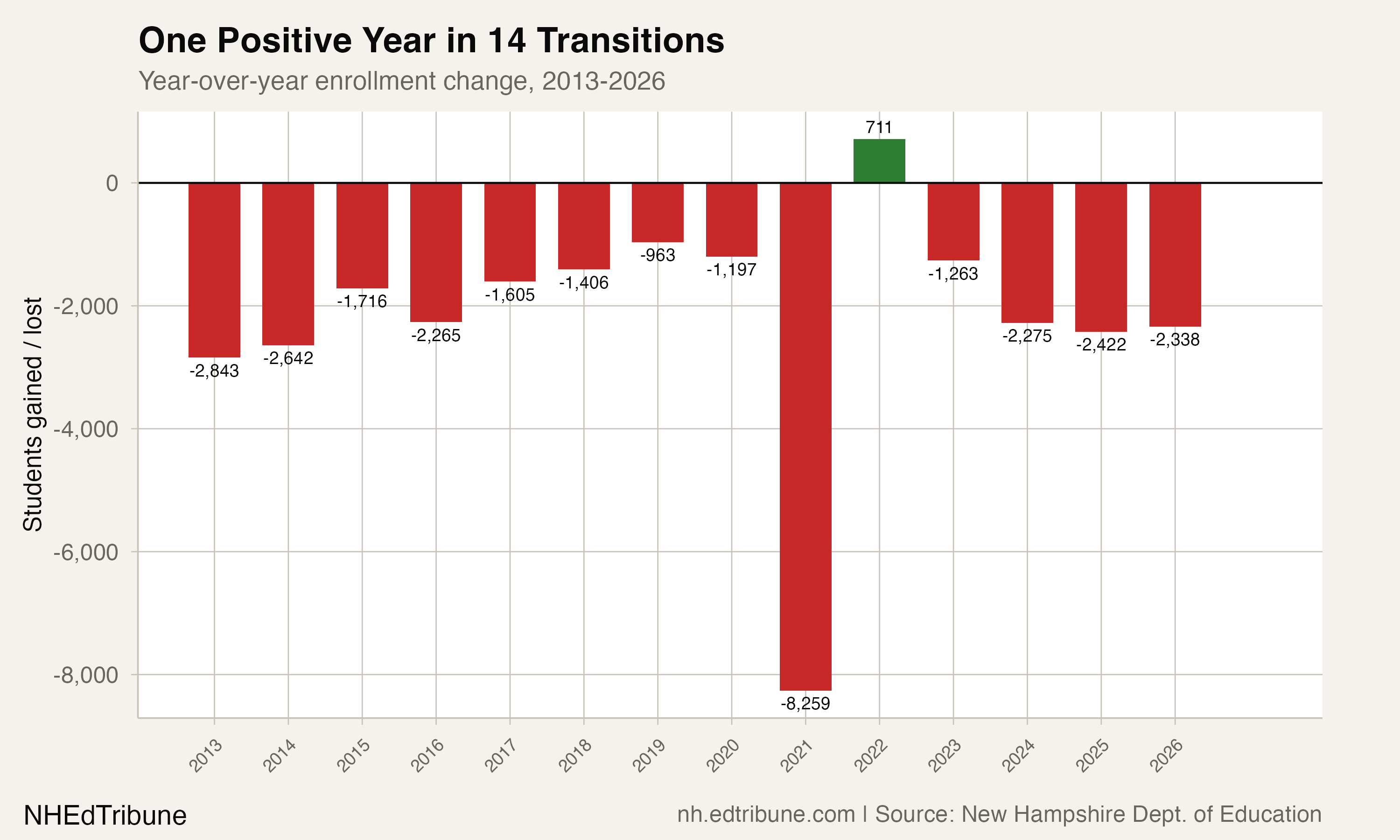
The year-over-year pattern is relentless. Before COVID, the state lost between 963 and 2,843 students per year, a slow bleed that appeared to be decelerating: losses shrank from -2,843 in 2013 to -963 in 2019. Then the pandemic erased 8,259 students in a single year. The brief 2022 bounce of +711 was the only positive transition in the entire 15-year dataset.
What followed the bounce is the most consequential part of the trend. Post-bounce losses have been running above pre-pandemic levels: -2,275 in 2024, -2,422 in 2025, -2,338 in 2026. The pre-COVID compound annual rate was -0.99%. Since 2022, it has been -1.25%. The pandemic did not cause the decline, but it accelerated it. New Hampshire never recovered the students it lost in 2021, and it has continued losing more on top of that deficit.
The oldest state in New England is running out of children
The primary driver is demographic. New Hampshire is tied with Vermont as the second-oldest state in the nation, with a median age of 43.4. The share of residents over 65 rose from 18.8% to 20.8% between 2020 and 2023. Meanwhile, the state experienced the fastest decline in its under-18 population of any state from 2010 to 2020, a 10.5% drop.
The pipeline into public schools keeps narrowing. New Hampshire recorded 11,761 births in 2024, a modern low, down 16% from three decades earlier, even as the state's total population grew by nearly 200,000. Kindergarten enrollment has tracked that decline: 11,904 in 2012, 10,727 in 2026, a 9.9% drop. The smaller cohorts entering kindergarten in 2025-26 will flow through elementary, middle, and high school over the next 12 years, locking in further losses.
"We are becoming grayer... birth rates and family sizes are way down." — Manchester Superintendent John Goldhardt, The 74
From 2020 through 2023, the state recorded roughly 39,525 births and 46,128 deaths, a gap of 6,603. New Hampshire's total population still grew during that period, but only because 30,472 people moved in from other states. In-migration sustains the tax base. It does not fill classrooms.
Manchester and the cities that hollowed out
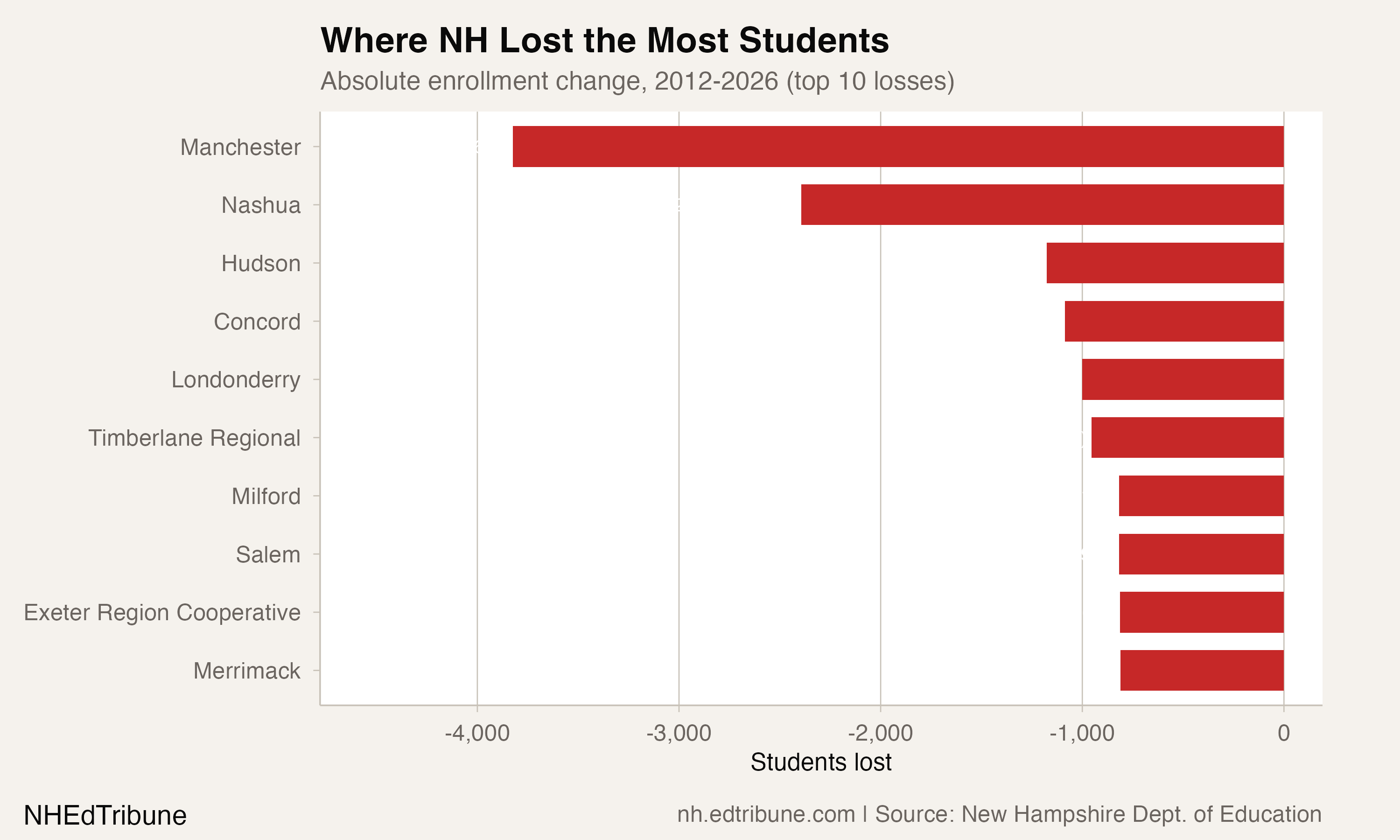
Manchester, the state's largest district, enrolled 15,536 students in 2012. It enrolled 11,712 in 2025-26, a loss of 3,824 students, or 24.6%. That is one in four students gone. Nashua, the second-largest, lost 2,393 (-20.1%). Together, the two cities account for 6,217 of the state's 30,483-student loss, just over 20%.
The losses are not confined to the two largest cities. Of the 172 districts with data in both 2012 and 2026, 146 declined. Hudson lost 29.0%, Milford 30.1%, Concord 22.4%.
In Claremont, the fiscal consequences have already arrived. The district closed Bluff Elementary less than a month into the 2024-25 school year, redirecting 147 students to other schools while facing a deficit that required cutting roughly 40 positions and eliminating extracurriculars. In Manchester, Hallsville Elementary closed after 130 years because the building was under-enrolled and the district faced $158 million in deferred maintenance. Berlin, the North Country mill city, has declined every single year in this dataset: 1,292 students in 2012, 959 in 2026, a streak of 14 consecutive years of losses.
Eighty-five districts, 42% of those with sufficient historical data, sit at their all-time enrollment low in 2026.
Charters grew, but not enough to matter
Charter enrollment quintupled during this period, rising from 1,097 students in 10 schools in 2012 to 6,242 in 35 schools in 2026, a gain of 5,145 students. Indexed to 2012, charter enrollment reached 569% of its starting point while traditional district enrollment fell to 81%.
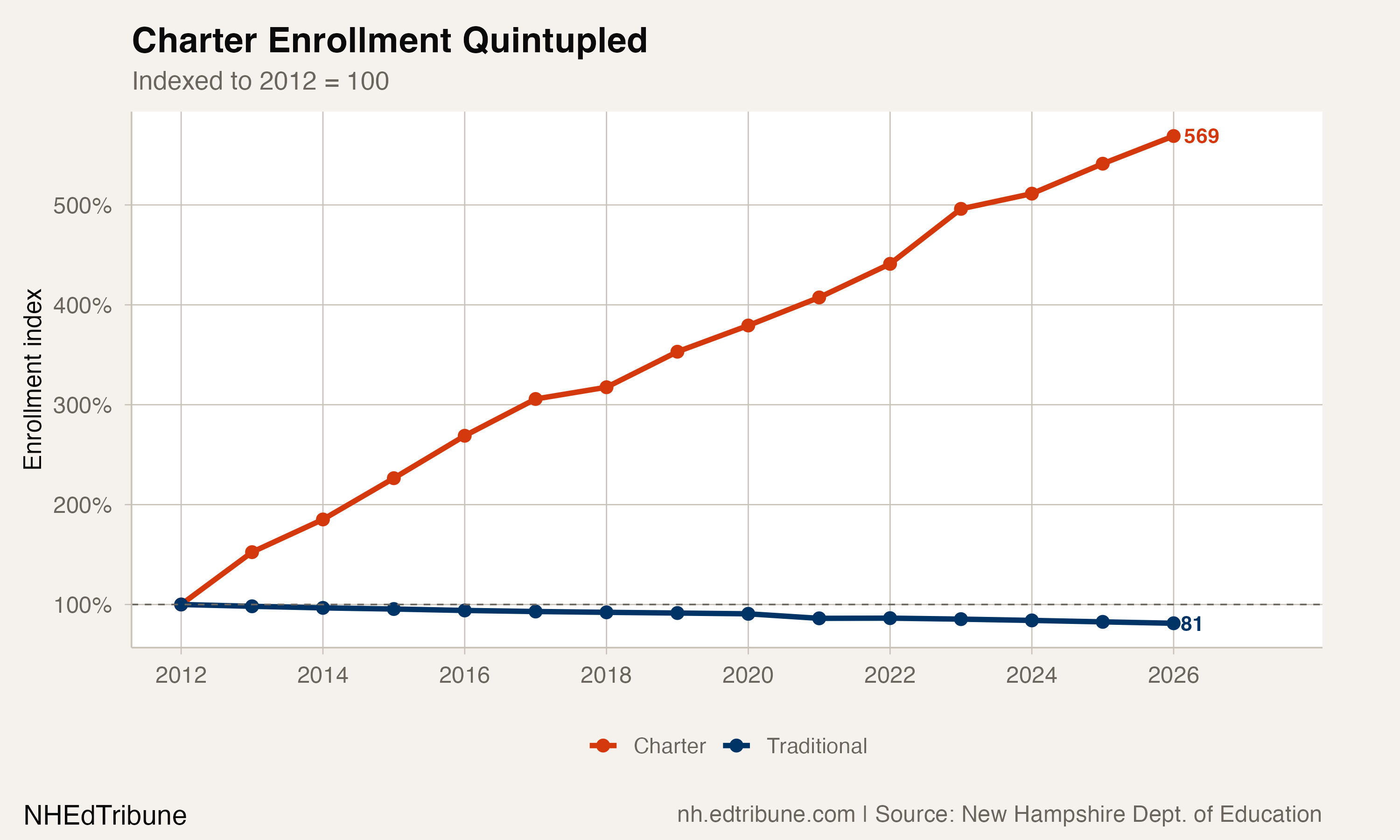
That growth is real, but small relative to the overall decline. Charter students represent 3.9% of total public enrollment in 2026, up from 0.6% in 2012. The charter sector's net gain of 5,145 students offsets 16.9% of the state's total loss of 30,483.
New Hampshire also expanded its Education Freedom Account program in 2025, removing income limits and making it universal. The program now serves 10,510 students at a cost of $51.6 million. But analysis by Reaching Higher NH found "no evidence of a meaningful change in enrollment patterns" attributable to EFAs. Public school enrollment share remains essentially flat. The EFA expansion may be redirecting some students, but the dominant force is fewer children, not families switching sectors.
Pre-K is the only grade band growing
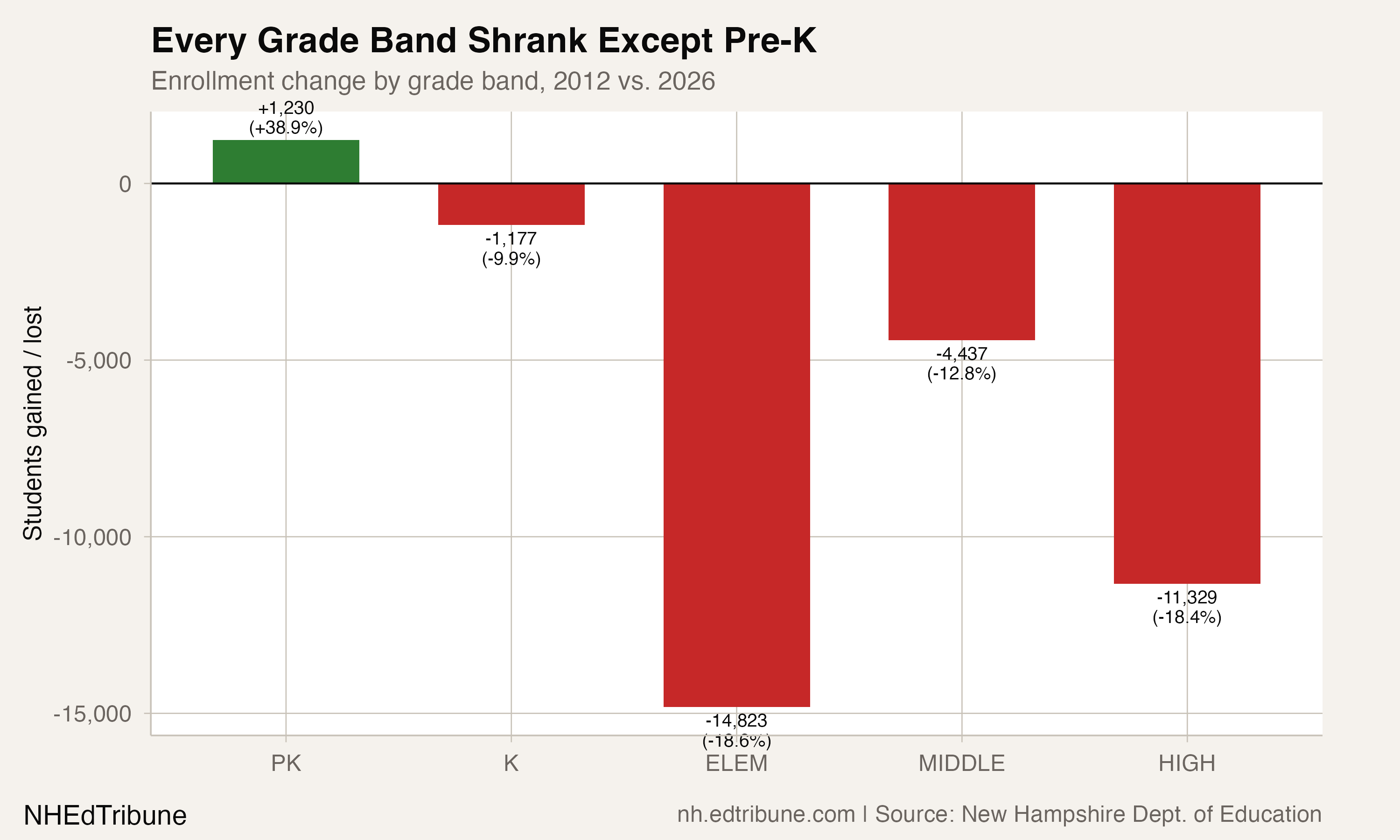
Every grade band shrank between 2012 and 2026, except pre-K. Elementary enrollment fell by 14,823 students (-18.6%), the largest absolute loss. High school grades lost 11,329 (-18.4%). Middle school lost 4,437 (-12.8%). Kindergarten lost 1,177 (-9.9%).
Pre-K, by contrast, grew by 1,230 students (+38.9%), from 3,165 to 4,395. That gain reflects expanded public pre-K programming rather than demographic growth. It does not change the enrollment trajectory for K-12.
More administrators, fewer students
One structural detail makes the fiscal pressure worse. New Hampshire had 176 districts in 2012. It has 203 in 2026, a 15% increase in administrative entities during a 16% enrollment decline. The number of school administrative units grew from 85 to 105 over approximately the same period. Communities like Cornish have pulled out of shared arrangements, citing dissatisfaction with costs, even as declining enrollment makes consolidation more fiscally rational.
A Republican proposal to reduce SAUs from 107 to 12, one per county plus Manchester and Nashua, would reverse this fragmentation. Whether the political will exists to override local control traditions in a state that prizes them is an open question.
What the next decade looks like
With births at 11,761 in 2024 and falling, the kindergarten classes of 2030 and beyond are already born. They are smaller than the 2025-26 class. The Josiah Bartlett Center's spending analysis found that per-pupil expenditure nearly doubled in inflation-adjusted terms from 2001 to 2024, reaching $26,347, as districts spent $1.25 billion more on 54,000 fewer students. That trajectory will continue as fixed costs, buildings, administrators, debt service, spread across a shrinking student body.
Enrollment will keep falling. The demographic math ensures it. UNH demographer Kenneth Johnson has framed the state as a preview for the nation: "What's already happened there may well be coming to a school near you." In Claremont, the preview has already arrived. Bluff Elementary closed less than a month into the 2024-25 school year. In Manchester, Hallsville School shut its doors after 130 years. In Berlin, one fewer student shows up almost every month, and has for 14 years straight. The state has 203 school districts. Many of them serve fewer students than a single school building was designed to hold.
Detailed code that reproduces the analysis and figures in this article is available exclusively to EdTribune subscribers.
Discussion
Sign in to join the discussion.
Loading comments...