Every fall, New Hampshire's public schools gain more first graders than they had kindergartners the year before. For over a decade, this private-to-public pipeline has reliably padded enrollment as families who started their children in private kindergarten or kept them home shifted into public school for first grade. In the 2012-13 school year, the influx ran at 114.3%, meaning public schools gained 1,705 more first graders than the prior year's kindergarten class.
That buffer is collapsing. By 2025-26, it had dropped to 102.7%, a net gain of just 298 students. And the kindergarten classes feeding it keep shrinking. In fall 2025, 10,727 children enrolled in public kindergarten, the lowest non-COVID figure in at least 15 years of data. Only the pandemic year of 2020-21, when families kept children home en masse, was lower.
New Hampshire is producing fewer children, sending a smaller share into public kindergarten, and losing the compensating mechanism that once softened the blow at first grade. The pipeline is narrowing at both ends.
The kindergarten floor
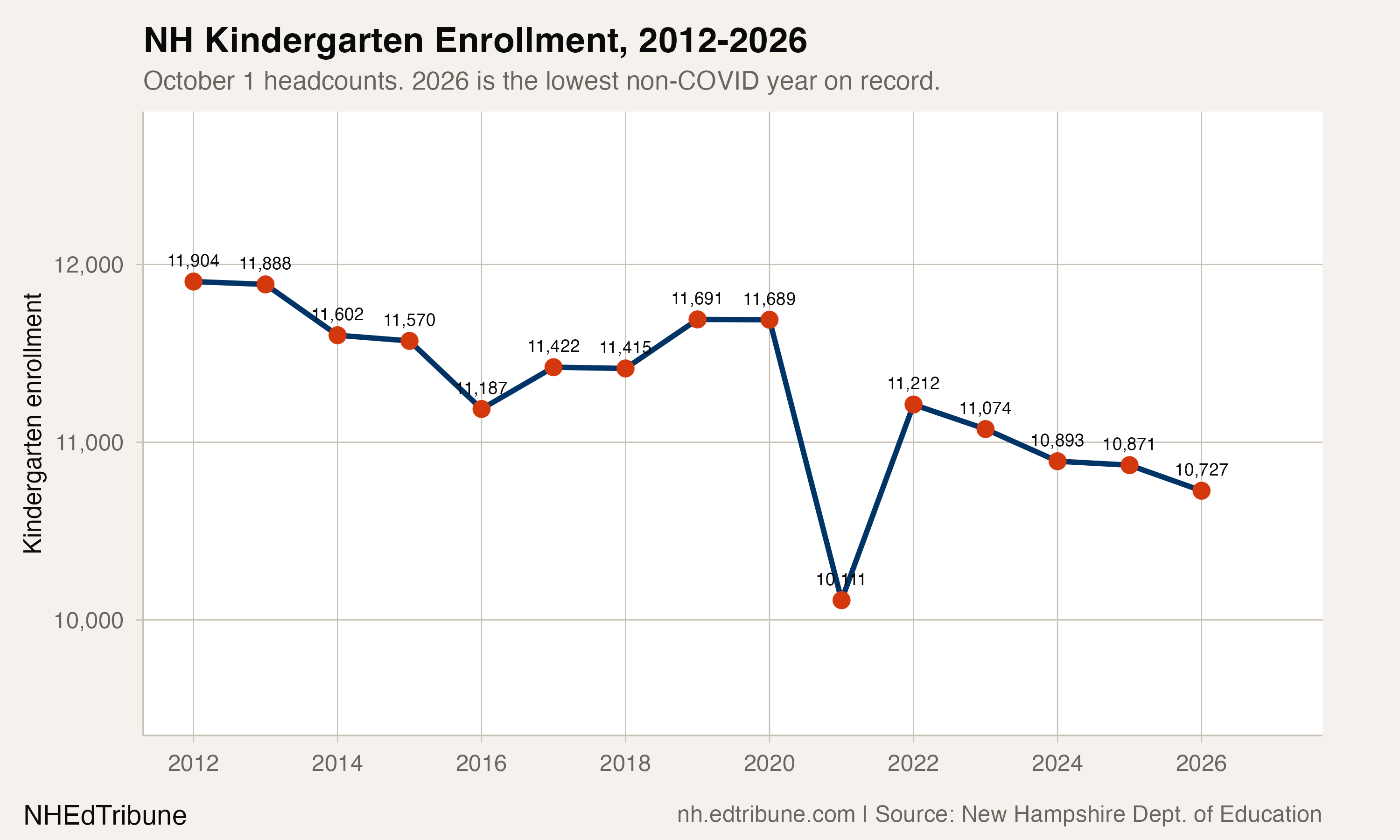
Kindergarten enrollment has fallen 9.9% since 2011-12, from 11,904 to 10,727. The path was not linear. K enrollment stabilized between 2017 and 2020, hovering between 11,400 and 11,700. Then came the pandemic crash to 10,111 in 2020-21, a partial rebound to 11,212 in 2021-22, and a steady slide since. The four most recent years have each been lower than the last.
Three of the four lowest kindergarten counts in the dataset belong to the past three years. Birth data offers no reason to expect a reversal. New Hampshire recorded 11,761 births in 2024, a modern low, down 16% from three decades ago despite the state adding nearly 200,000 residents in that time. The state has the fifth-lowest fertility rate in the country.
Among districts with at least 50 kindergartners in 2011-12, 74% saw their K enrollment decline by 2025-26. Dover lost a third of its kindergartners. White Mountains Regional lost more than half. Even Nashua, the state's second-largest district, dropped 136 kindergartners, a 17.2% decline.
A buffer that no longer buffers
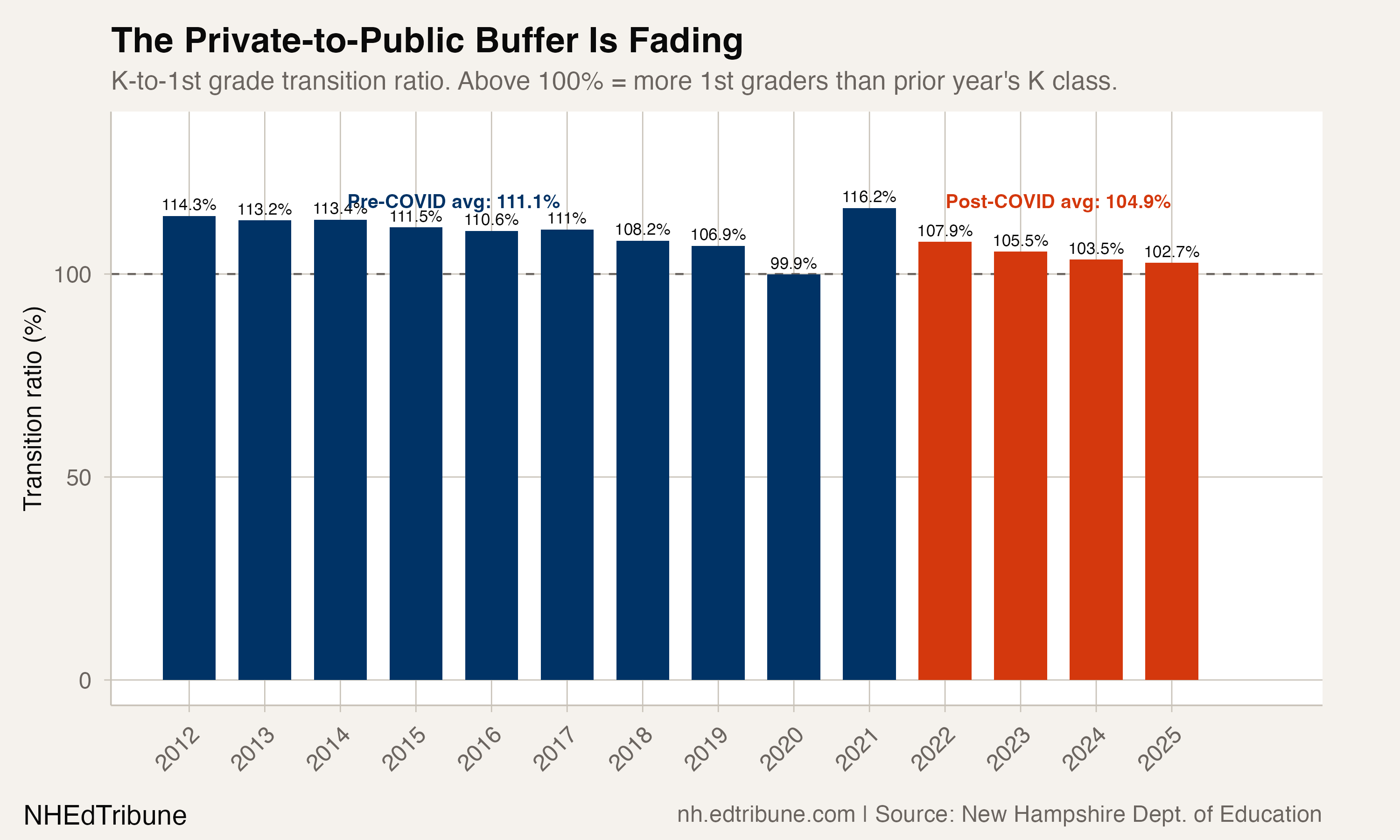
The K-to-first-grade transition ratio measures how many first graders appear in public school for every kindergartner counted the year before. A ratio above 100% means the public system gains students between K and first grade, typically from families who used private kindergarten, delayed entry, or moved into the state.
From 2011-12 through 2018-19, the average ratio was 111.1%. Public schools gained a mean of 1,294 students each year through this channel. Since 2021-22, the average has dropped to 104.9%, a mean gain of just 546 students. In 2025-26, the gain was 298.
The decline is steady: 107.9% in 2022, 105.5% in 2023, 103.5% in 2024, 102.7% in 2025. At this pace, the ratio hits 100% within a few years. No net gain at all.
One likely factor is New Hampshire's Education Freedom Account program, which was made universal in June 2025 with a cap of 10,000 students, up from roughly 5,300 participants the prior year. If EFAs keep families in private school past kindergarten who might previously have transferred to public first grade, the program narrows the K-to-1 pipeline. But the enrollment data alone cannot isolate this effect from the broader demographic shift.
An analysis by Reaching Higher NH found that public school enrollment share is "up very slightly" even as total enrollment falls, concluding: "There's nothing in the data that indicates NH public school students are fleeing for other education types." The decline is primarily a population story.
The replacement deficit
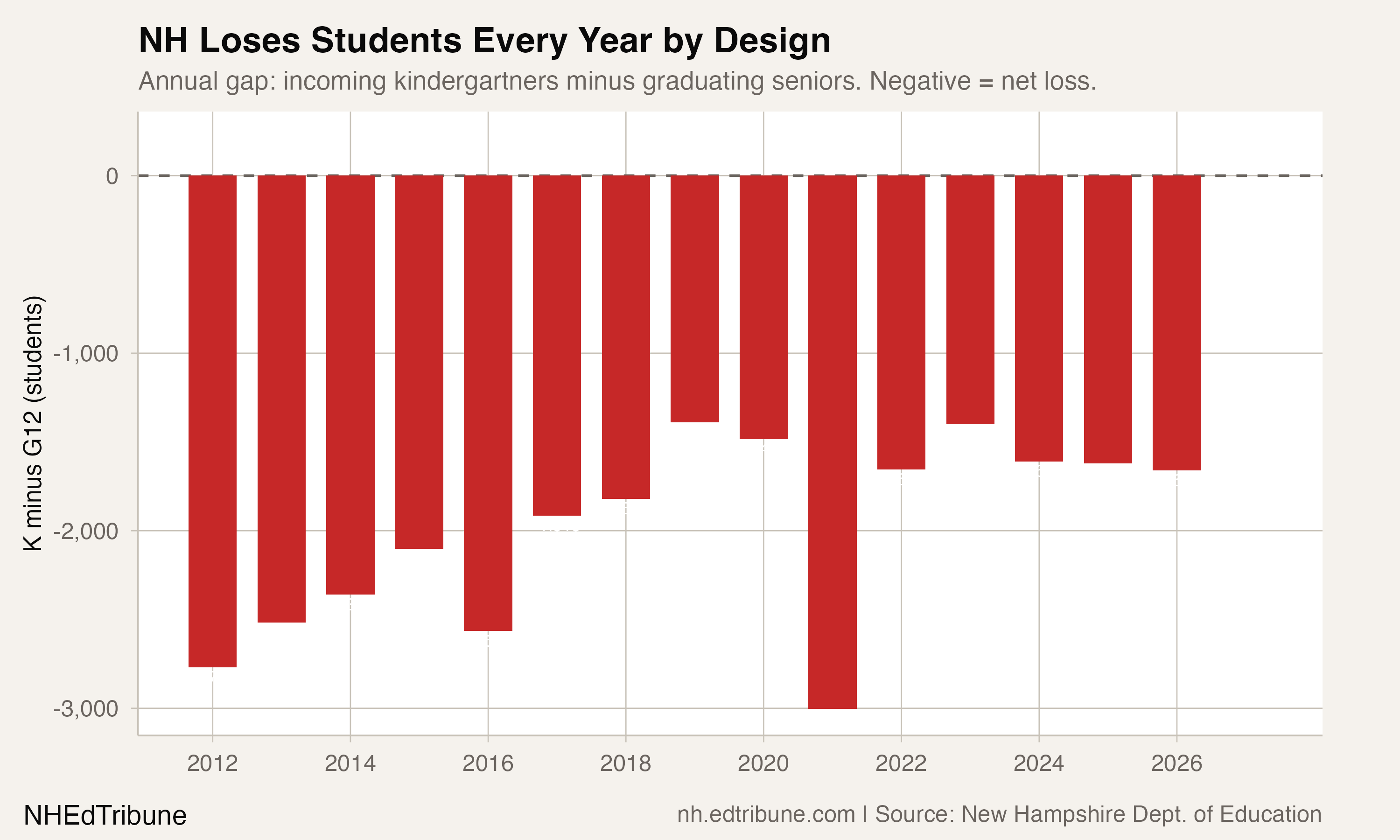
Every year, a kindergarten class enters the system and a 12th-grade class exits. In New Hampshire, the exiting class has been larger than the entering class for every year in the dataset. In 2025-26, 10,727 kindergartners entered while 12,388 seniors graduated or aged out: a net structural loss of 1,661 students.
The gap has persisted at roughly 1,400 to 2,800 students per year since 2011-12, with only the 2021 pandemic year exceeding 3,000 (K was depressed to 10,111 while G12 remained 13,114). The system is structurally built to shrink. Even if no family left for private school, homeschool, or another state, New Hampshire would still lose more than a thousand students annually simply because more seniors leave than kindergartners enter.
The 2025-26 grade staircase makes this visible. The smallest cohort is kindergarten at 10,727. First grade has 11,169. The numbers climb through the grades, peaking at 13,156 in ninth grade. Each of those larger upper-grade cohorts will be replaced by the smaller ones below, locking in years of decline even if kindergarten enrollment stabilized tomorrow.
Elementary's 14-year losing streak
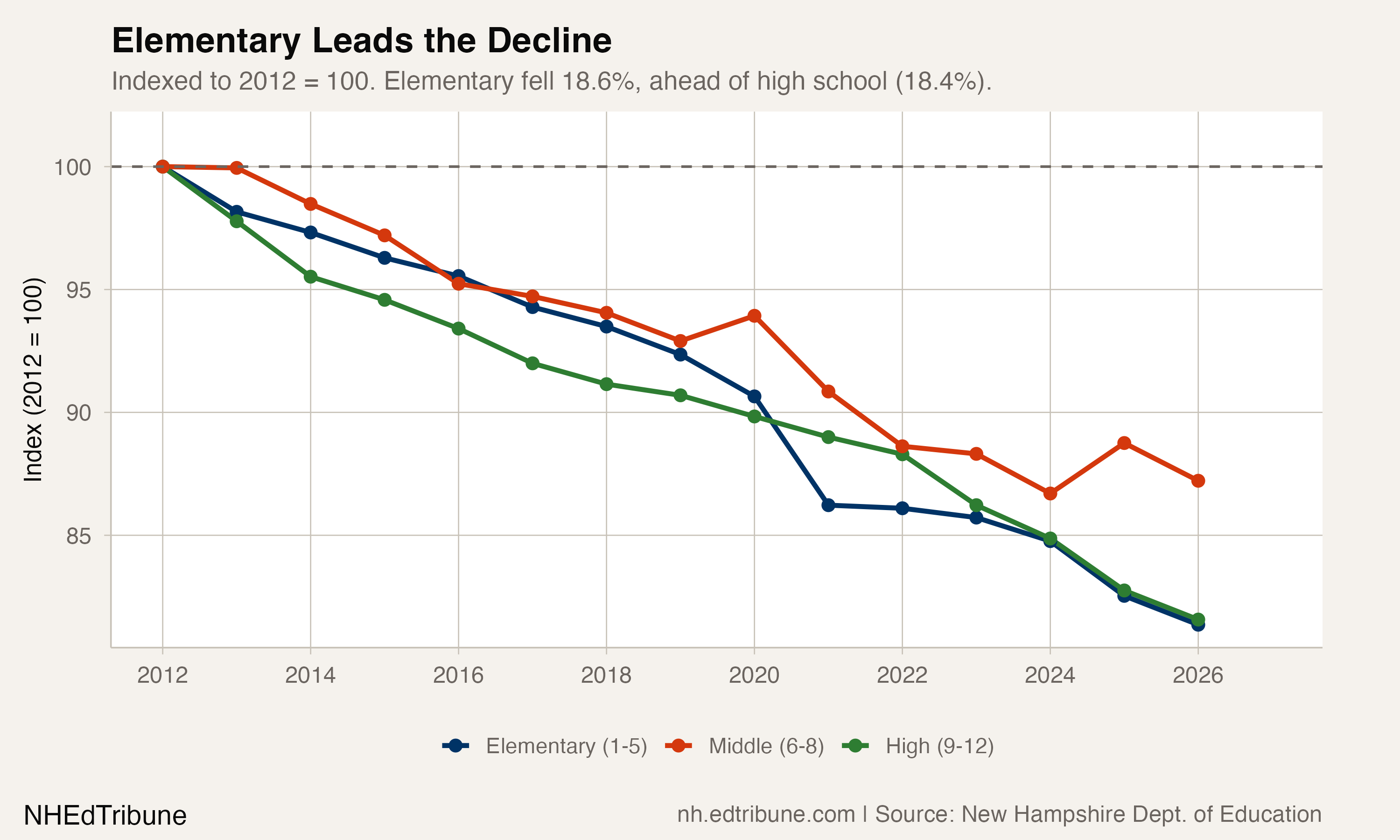
Elementary enrollment (grades 1-5) has declined every year from 2012-13 through 2025-26: 14 consecutive losses totaling 14,823 students, an 18.6% decline. No other grade band matches this streak. Middle school enrollment (grades 6-8) fell 12.8% over the same period but had one flat year. High school (grades 9-12) lost 18.4% but declined more slowly in the early years before accelerating recently.
Smaller kindergarten classes flow directly into elementary. Each smaller K cohort moves into grades 1 through 5, displacing a larger cohort that entered years earlier. The effect is cumulative and mechanical. The 2025-26 elementary loss of 934 students follows a loss of 1,772 in 2024-25, the largest non-pandemic elementary decline in the dataset.
Pre-K enrollment is the exception: up 38.9% since 2011-12, from 3,165 to 4,395. But this growth reflects expanded public pre-K programming, not a growing child population. When PK and K are combined, the 2025-26 total of 15,122 is barely above the 2011-12 combined total of 15,069.
What the staircase means
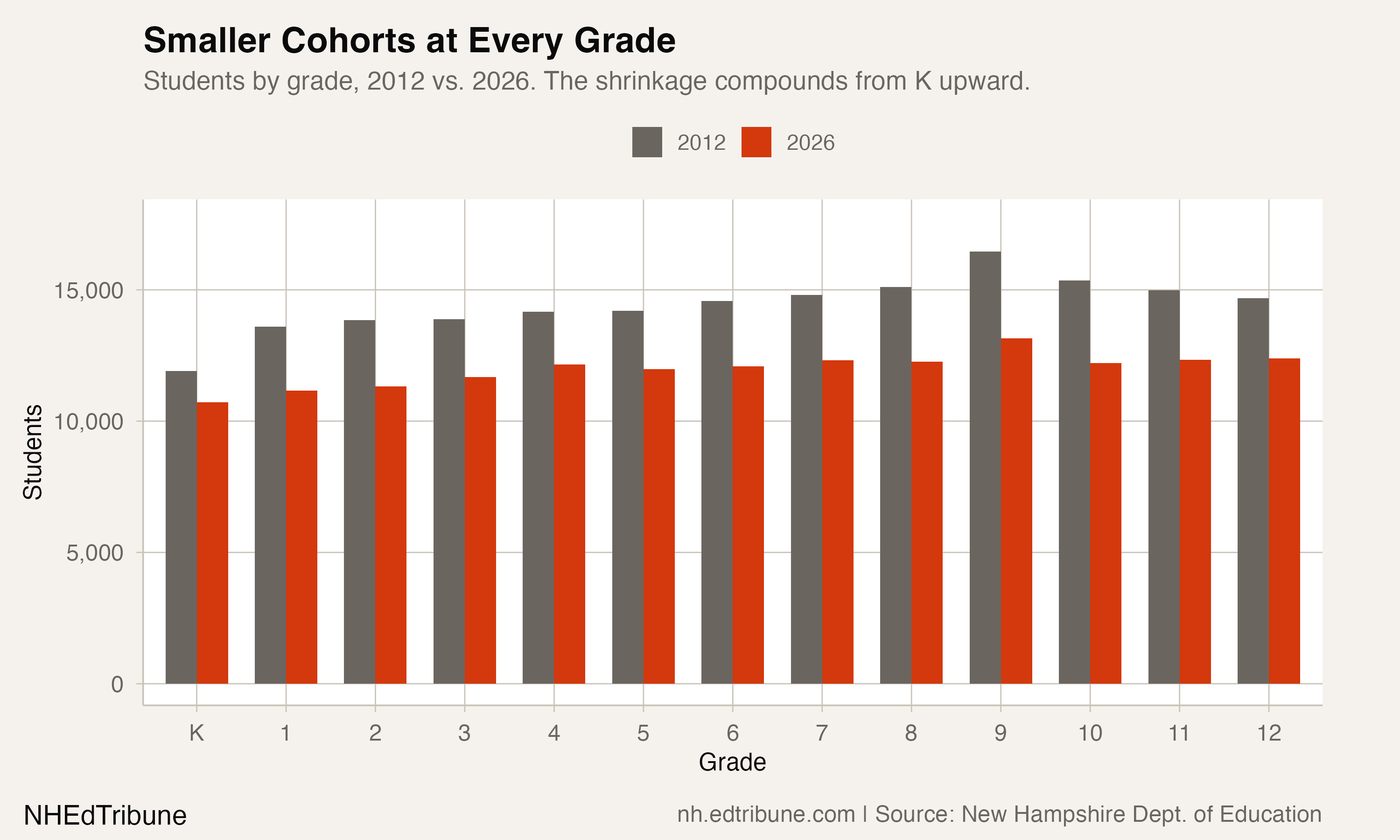
The grade staircase shows both the scale of loss and the trajectory ahead. In 2011-12, ninth grade was the largest cohort at 16,465 students, reflecting the historical bump as private middle schoolers transferred to public high school. By 2025-26, ninth grade is still the largest at 13,156, but the gap between it and the lower grades has widened.
The 2025-26 kindergarten class of 10,727 will become the 2026-27 first graders. Even with a K-to-1 ratio of 103%, that yields roughly 11,050 first graders, smaller than every cohort in grades 2 through 12 in 2025-26. As this compressed cohort progresses through the system, it will push down enrollment at each grade level it reaches.
New Hampshire's school-age population declined faster than any other state between 2010 and 2020. The state crossed a demographic threshold in 2017 when deaths began outnumbering births, a pattern that has continued annually since.
In Keene, the situation has reached a symbolic threshold. Superintendent Robert Malay told the Keene Sentinel that "next year, the district will have more students graduating high school than entering kindergarten." Keene's district enrollment has fallen from 3,284 to 2,941 in a decade, and the projected decline is expected to reduce state aid by $1.6 million.
The fiscal geometry
A district's cost structure does not shrink proportionally with enrollment. Losing 50 kindergartners does not eliminate a teaching position; it reduces average class size. Losing 200 might close a section, but the building, the principal, and the custodial staff remain. New Hampshire already ranks 50th in the nation for state education funding as a share of total revenue, with property taxes bearing most of the burden. As enrollment falls, the per-pupil cost of maintaining existing infrastructure rises, putting upward pressure on local tax rates even as the student population contracts.
In Keene, Superintendent Malay expects the 2026-27 graduating class to outnumber the incoming kindergartners. That crossover, seniors outnumbering five-year-olds, used to be a statistical curiosity. It is becoming a budget line. The private-to-public transfer pipeline that once padded first grade by 14% is down to 3%. The births that determine kindergarten classes five years from now have already happened, and they were the fewest New Hampshire has recorded. The system's last organic growth mechanism is fading at the same pace as everything else.
Detailed code that reproduces the analysis and figures in this article is available exclusively to EdTribune subscribers.
Discussion
Sign in to join the discussion.
Loading comments...