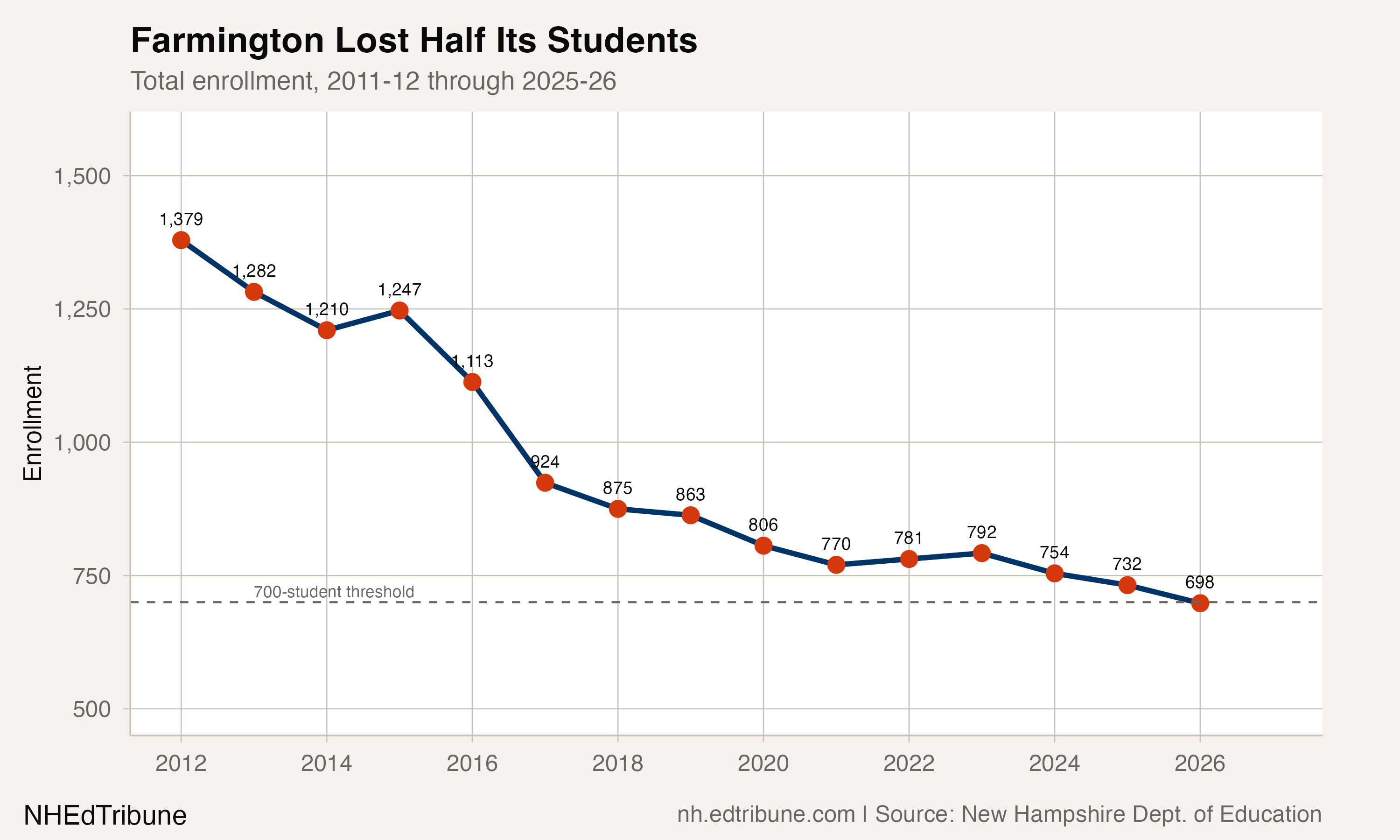
In 2011-12, Farmington↗ET enrolled 1,379 students across three schools. In fall 2025, the number was 698. The district has lost 49.4% of its enrollment in 14 years, a rate of decline more than three times the statewide average, and the steepest percentage drop among all traditional New Hampshire districts that started the period with at least 1,000 students.
At 698, Farmington has fallen below 700 students for the first time in the dataset. Each of its three schools now averages roughly 230 students. The question is no longer whether enrollment will stabilize. It is whether three schools can remain viable at this scale.
49.4% of Farmington's enrollment has disappeared since 2012, a rate 3.1 times the statewide decline and more than double the median loss among similarly-sized districts.
The two collapses
Farmington's decline arrived in two distinct waves.
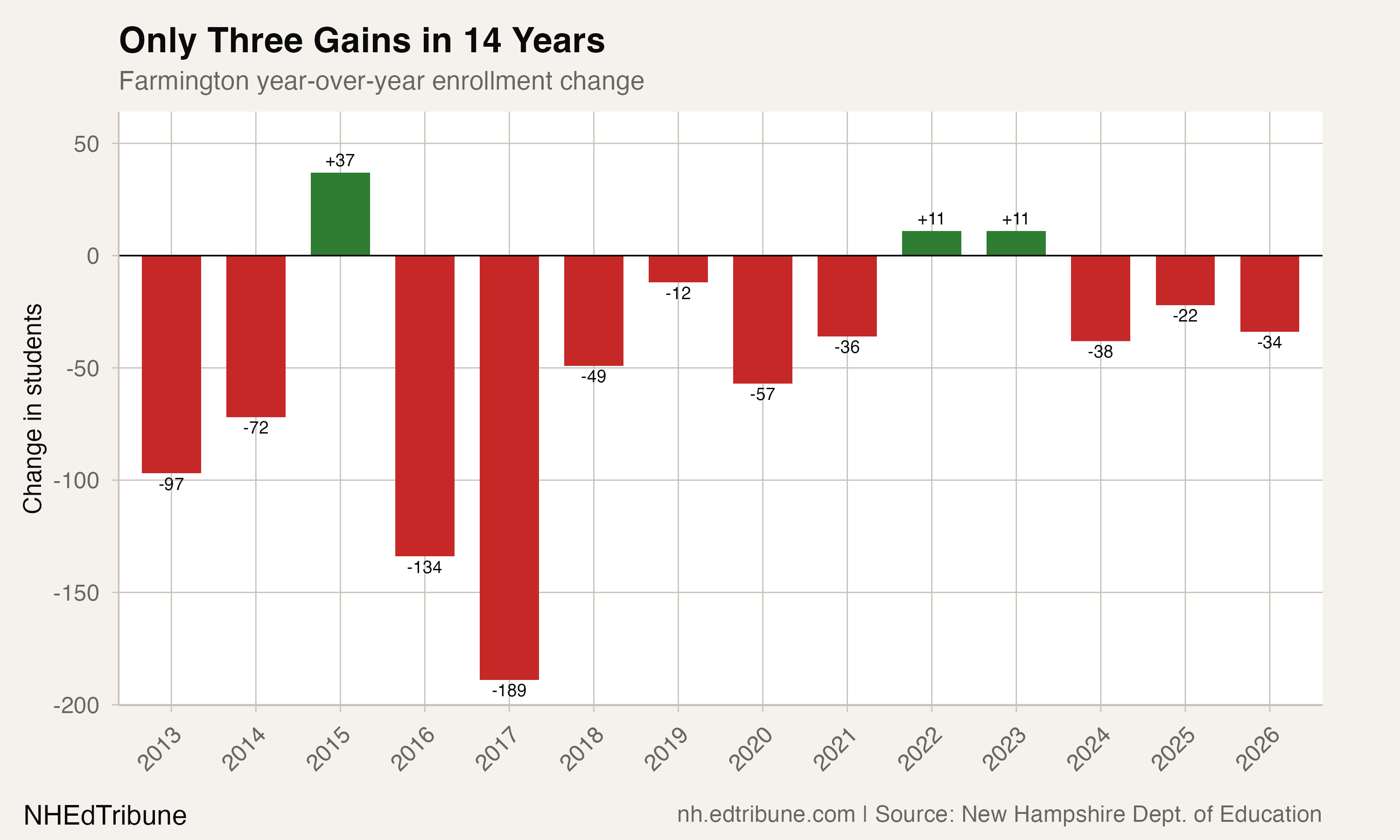
The first wave hit between 2012-13 and 2014-15, when the district shed 169 students before a brief rebound in 2014-15 (+37). The second wave was far more severe: across the 2015-16 and 2016-17 school years, Farmington lost 323 students, a 25.9% contraction from its 2014-15 level of 1,247. The 2016-17 drop alone, 189 students, remains the single largest one-year loss in the district's recent history.
After the 2016-17 cliff, the decline slowed but never stopped. The district has posted losses in 11 of 14 years, with only three modest gains: 37 students in 2014-15, and back-to-back increases of 11 in 2021-22 and 2022-23.
All three schools are shrinking
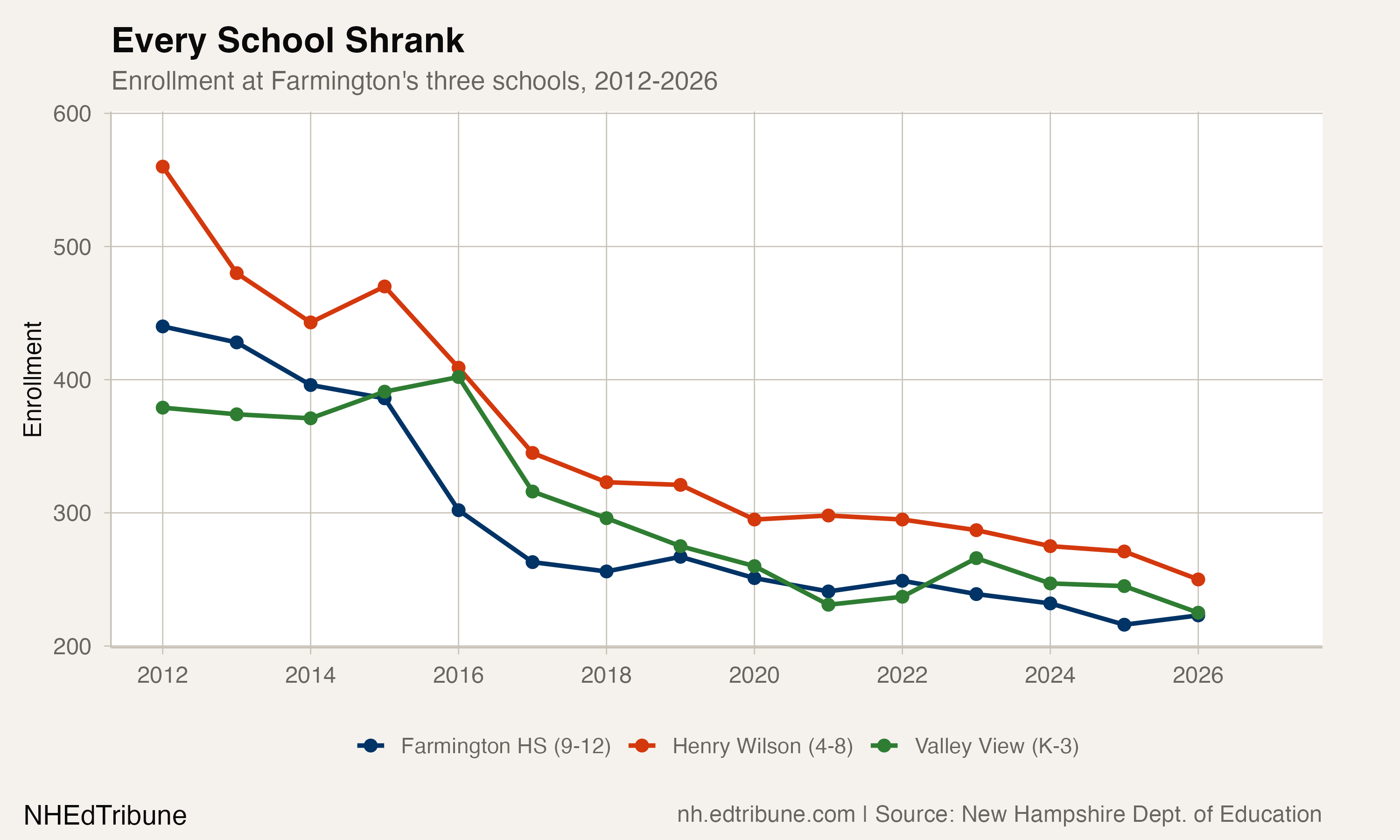
All three buildings are affected. Henry Wilson Memorial School, which serves grades 4 through 8, lost 55.4% of its enrollment, falling from 560 to 250 students. Farmington Senior High School dropped from 440 to 223, a 49.3% decline. Valley View Community School (K-3) fell from 379 to 225, a 40.6% loss.
The school-level data reveals that the 2016-17 collapse was system-wide. Farmington Senior High fell from 386 to 302 to 263 over two years. Henry Wilson dropped from 470 to 409 to 345. Valley View, which had actually grown to 402 by 2015-16, plunged to 316 in a single year.
A shrinking front door
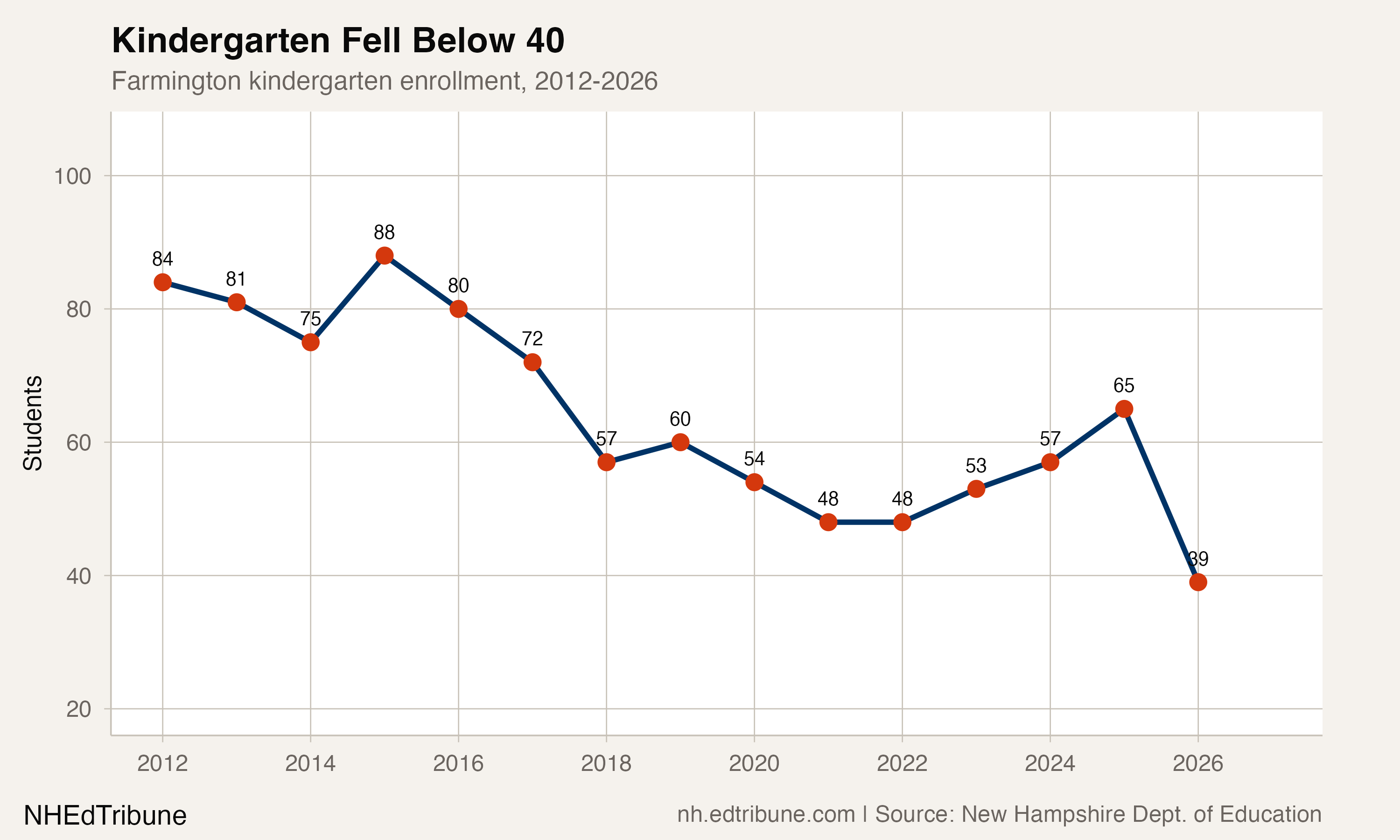
Kindergarten has been especially volatile. In 2025-26, just 39 children enrolled in kindergarten, down from 84 in 2011-12, a 53.6% decline. The 2024-25 year had shown a hopeful uptick to 65 kindergartners. The 2025-26 drop of 26, from one fall to the next, wiped out years of partial recovery.
A kindergarten class of 39 means Farmington is feeding roughly 40 new students per year into a K-12 system that once absorbed more than twice that. The arithmetic is unforgiving: even if every kindergartner stays through 12th grade, the district would need 13 cohorts of 40 to sustain a total enrollment around 520, well below its already diminished 2025-26 enrollment of 698.
Pre-kindergarten, by contrast, has grown from 9 students in 2012 to 35, a bright spot that reflects statewide expansion of early childhood programs. But pre-K enrollment does not guarantee kindergarten retention. The 2025-26 data makes that plain.
The steepest fall among its peers
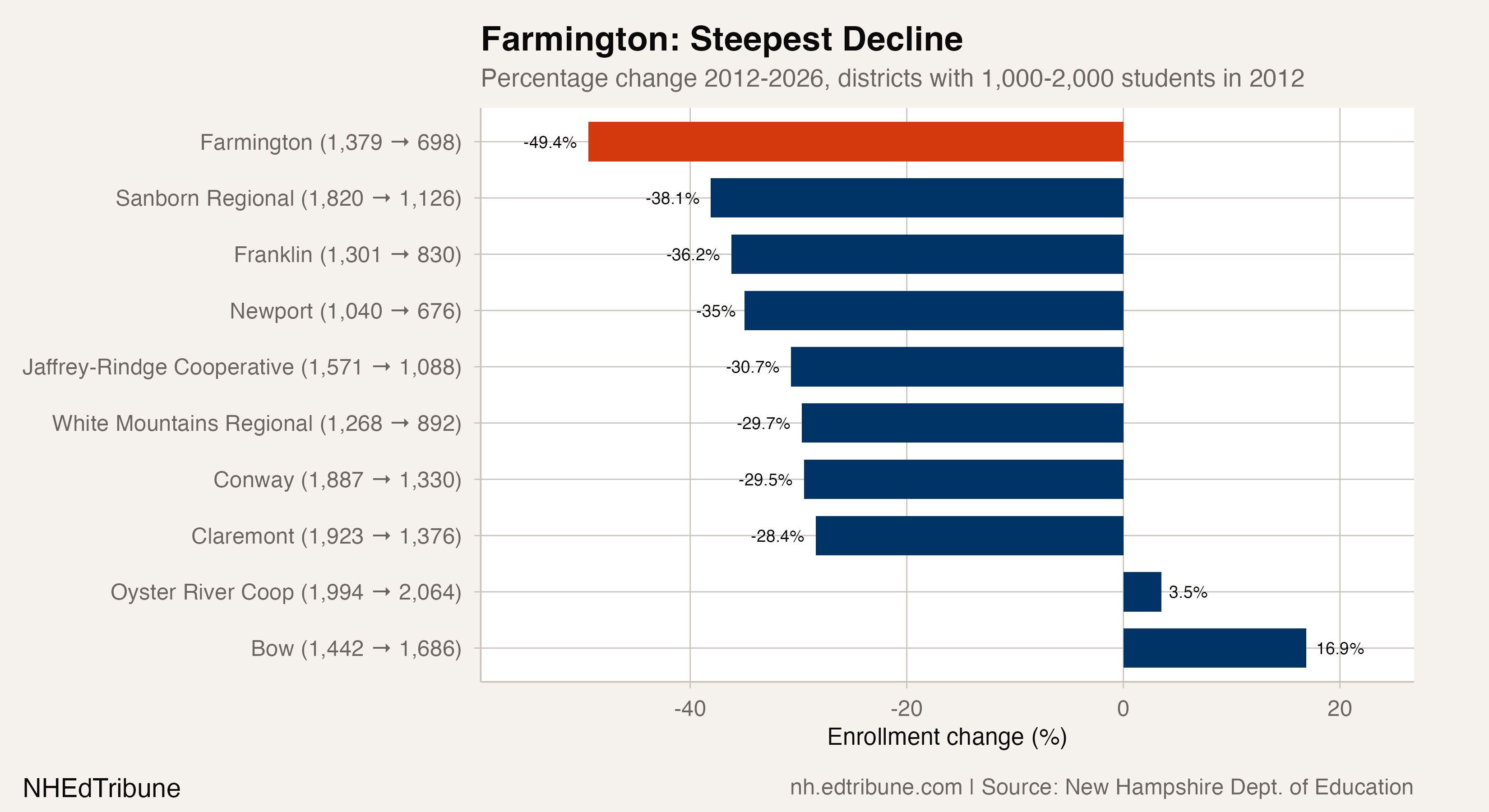
Among the 37 New Hampshire districts that enrolled between 1,000 and 2,000 students in 2011-12, the median decline over the following 14 years was 22.0%. Farmington's 49.4% loss is more than double that median and 11 percentage points worse than the second-steepest decliner in the peer group, Sanborn Regional (-38.1%).
Only two of the 37 peer districts grew at all: Bow (+16.9%) and Oyster River Cooperative (+3.5%). Every other district in the cohort lost students. But no district lost at anywhere near Farmington's rate.
For statewide context, New Hampshire's total enrollment fell 16.0% over this period, from 190,805 to 160,322. Farmington declined at 3.1 times the state rate.
What could explain this
The enrollment data alone cannot explain why Farmington's decline so dramatically outpaces its peers.
Demographics are part of it. Farmington is a small town in Strafford County with a population that has been aging along with much of rural New Hampshire. Declining birth rates have compressed kindergarten cohorts everywhere, but in a small community each missing child is a larger share of the class.
School choice may also play a role. Rochester, roughly 10 miles away with 3,679 students, draws from the same region. Education Freedom Accounts and open enrollment legislation create additional pathways out of small districts. A state Supreme Court ruling in October 2025 required districts to pay for students who switch schools, and voters in nearly 40 communities responded by moving to restrict non-resident enrollment, a sign of how seriously districts take the fiscal risk of cross-boundary student movement.
The 2016-17 cliff remains the most puzzling feature. A 323-student drop in two years, across all three schools simultaneously, looks like a structural event rather than gradual attrition. Without demographic or transfer data in the enrollment package, the cause cannot be isolated.
The fiscal bind
A district with three buildings and 698 students still needs principals, custodians, counselors, and bus routes. Per-pupil funding shrinks with each departure, but overhead does not.
Even larger districts are feeling the strain. Concord, the state capital, is grappling with a $17 million budget shortfall driven by a combination of state funding cuts, rising costs, and falling tuition revenue as sending districts redirect students elsewhere. Farmington, at a fraction of Concord's size, has far less capacity to absorb proportional shocks.
Rochester, the nearest large district, declined 16.1% over the same period, losing 704 students. That is a serious decline, but Rochester's scale (3,679 students) gives it more room to consolidate programs and spread fixed costs. Farmington's 698 students offer no such cushion.
Three buildings, 698 students
Henry Wilson Memorial has 250 students. Farmington Senior High has 223. Valley View has 225. Each building has a principal, a front office, heating costs, and maintenance needs. Rochester, 10 miles away, enrolls five times as many students and is itself declining. Voters in nearly 40 New Hampshire communities moved in 2026 to restrict non-resident enrollment, a sign of how seriously small districts take the fiscal risk of losing even a handful of families. In Farmington, a handful is a measurable share of the school.
Detailed code that reproduces the analysis and figures in this article is available exclusively to EdTribune subscribers.
Discussion
Sign in to join the discussion.
Loading comments...