Bow gained 244 students over 15 years. That makes it the fastest-growing traditional public school district in New Hampshire, a state where 148 of 173 traditional districts have lost enrollment since 2012. Bow's gain, the equivalent of about 16 students per year, is the success story.
Across the state, the 21 traditional districts that managed to grow at all added a combined 895 students. In the same period, the 148 that shrank lost a combined 36,668. For every student gained by a growing traditional district, 41 were lost elsewhere.
A decline that predates COVID and outlasted it
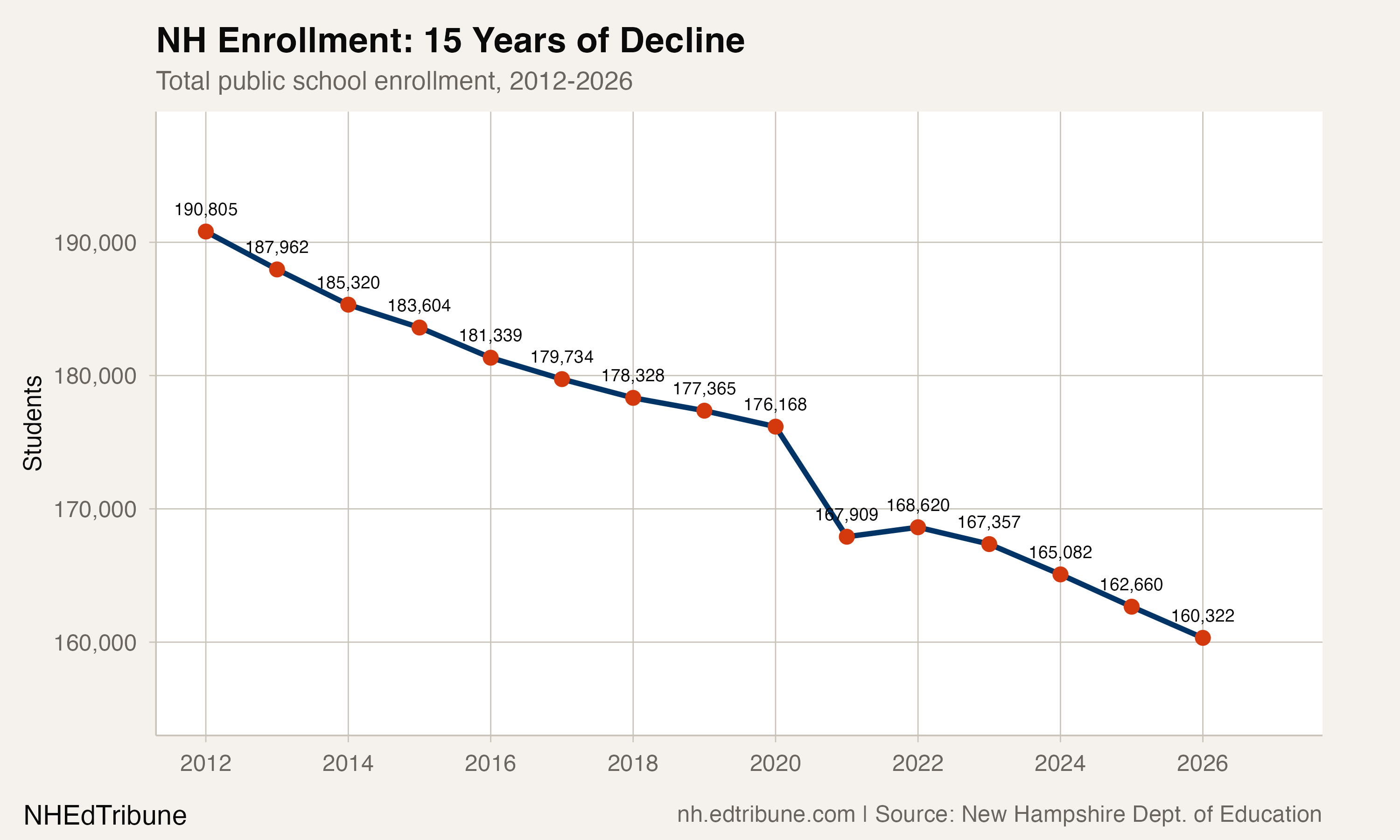
New Hampshire enrolled 190,805 public school students in 2012. By 2026, that number had fallen to 160,322, a loss of 30,483 students, or 16.0%. The state has posted only one year of growth — a partial COVID bounce of 711 students in 2022 — in the dataset's 15-year span.
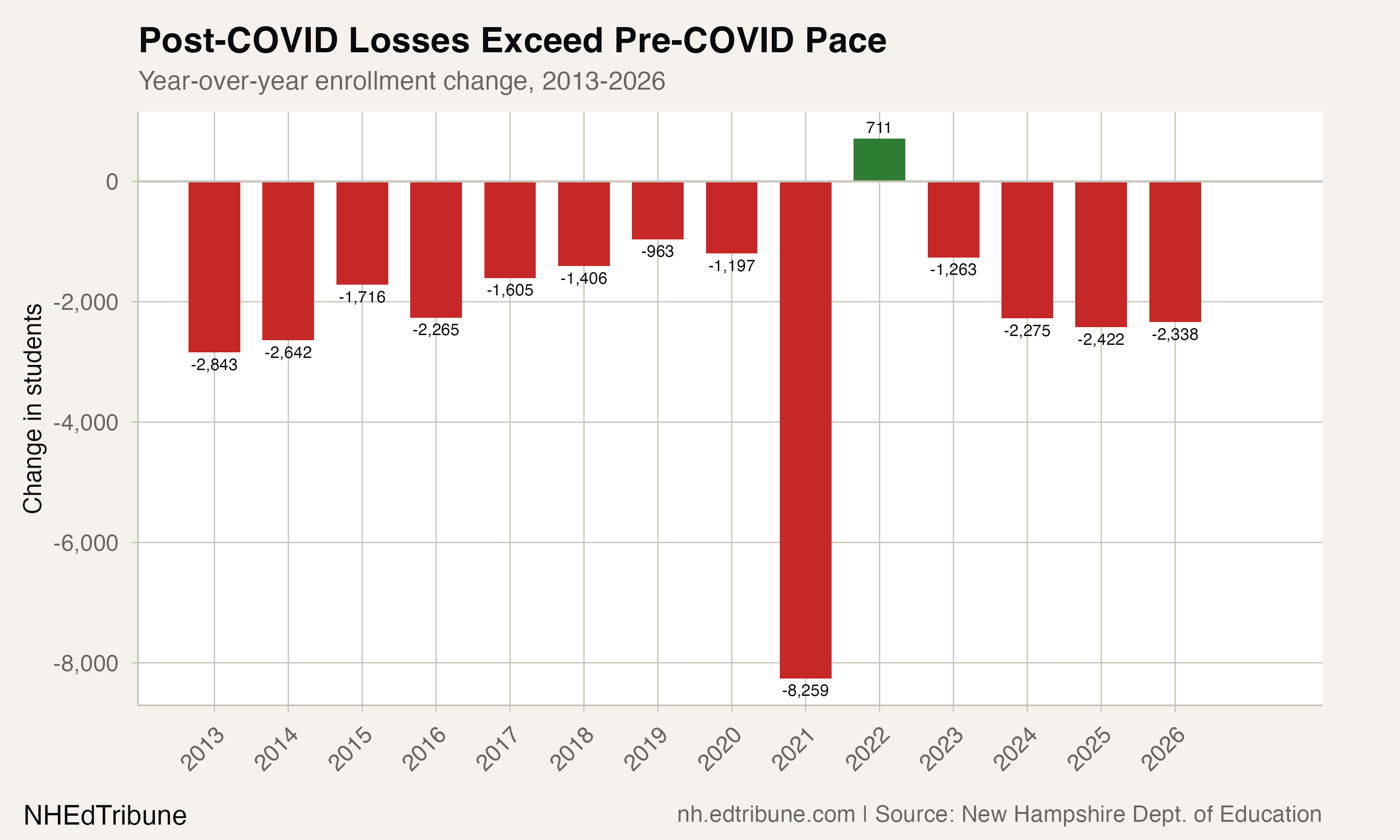
The decline was steady before COVID, averaging about 1,830 students per year from 2013 to 2020. The pandemic then carved out 8,259 students in a single year, the largest annual loss on record. A partial bounce in 2022 recovered just 711 of those students, and the decline resumed immediately. Over the three most recent years (2024-2026), the state has averaged a loss of 2,345 students annually, 28% faster than the pre-COVID pace.
That acceleration matters. Before COVID, districts could adjust through attrition. The current pace outstrips natural staff turnover, forcing active cuts.
The win-loss ledger keeps getting worse
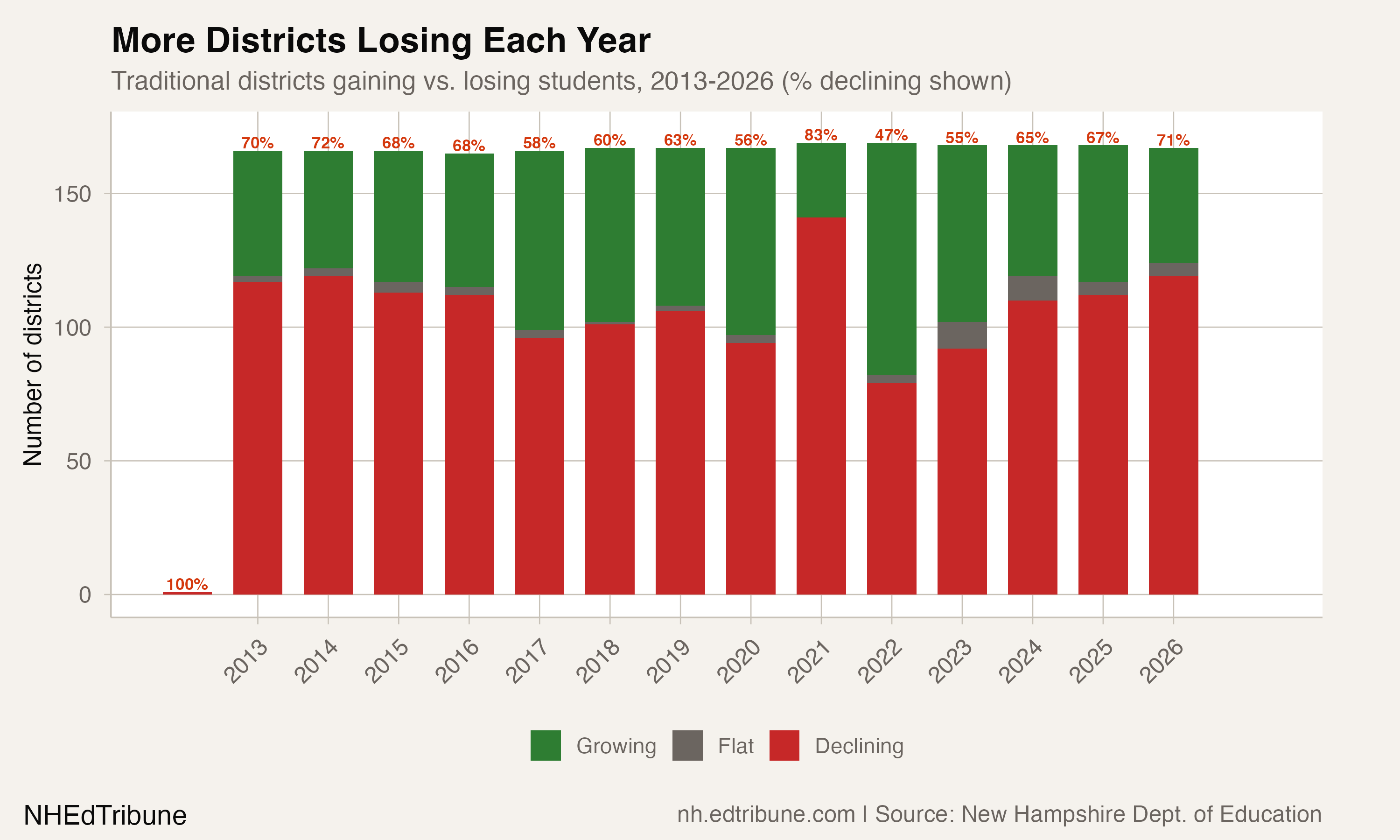
In 2022, the post-COVID rebound year, only 47% of traditional districts were declining. By 2026, that figure had climbed back to 71%. The respite is over. Among traditional districts, the share losing students in any given year has never dropped below 46% during the entire 15-year period and has exceeded 60% in 10 of 14 measured years.
The 2026 numbers are particularly stark at the top of the size distribution. Among the 24 traditional districts that started with 2,000 or more students, 23 have shrunk, a 96% decline rate. Among those with 1,000 to 1,999 students, 35 of 37 lost enrollment, or 95%. The pattern loosens only at the smallest scale: districts under 500 students declined at a 78% rate, partly because small-enrollment fluctuations of a few students can register as growth.
Who is growing, and how little it matters
The 21 traditional districts that gained enrollment are overwhelmingly small. Seven started with fewer than 100 students, where a single family moving in can swing the count. Only six started with 500 or more: Bow (+244), Windham (+202), Oyster River Coop (+70), Auburn (+64), Hollis (+56), and Nottingham (+26).
Bow and Windham, both suburban communities in southern New Hampshire within commuting distance of the Massachusetts border, account for half the total gain. Oyster River Coop, home to the University of New Hampshire in Durham, added 70.
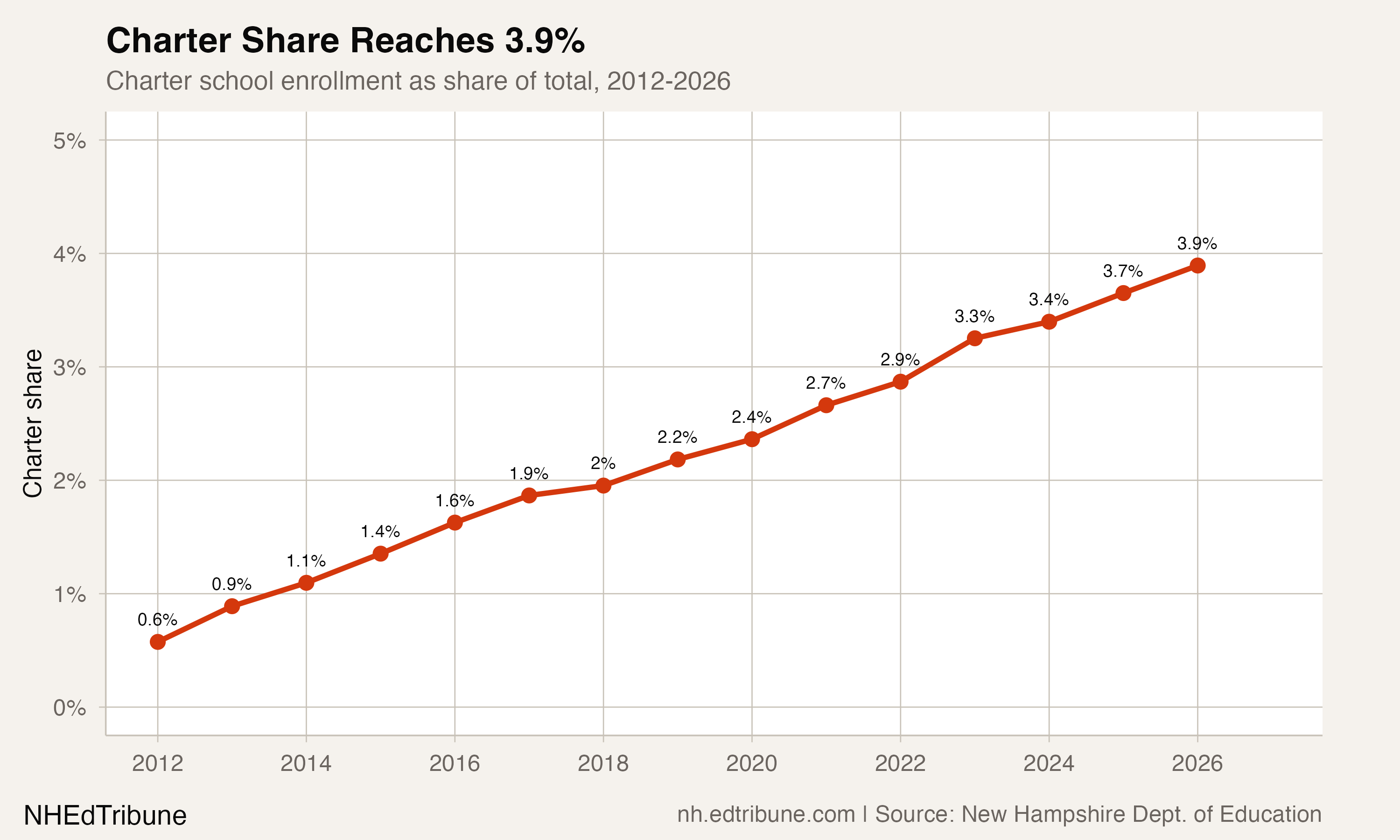
The charter sector tells a different story. Of 41 charter-named districts in the data, 33 grew, adding a combined 3,222 students. Virtual Learning Academy Charter School alone added 476. Charter enrollment rose from 1,097 students (0.6% share) in 2012 to 6,242 (3.9%) in 2026, growing every single year.
But charter growth does not change the demographic math. Even if every charter student had stayed in a traditional district, the state would still have lost more than 25,000 students.
The cities are hollowing out
Manchester↗ET lost 3,824 students since 2012, a 24.6% decline. That single district accounts for more than 10% of all traditional district losses statewide. Nashua↗ET lost 2,393, a 20.1% drop. Together, the state's two largest cities shed 6,217 students, nearly as many students as the entire charter sector enrolled in 2026.
The damage extends well beyond the cities. Hudson lost 1,177 (29.0%). Concord↗ET, the state capital, lost 1,087 (22.4%). Londonderry, Timberlane Regional, Salem, Milford, Exeter Region Cooperative, and Merrimack each lost more than 800.
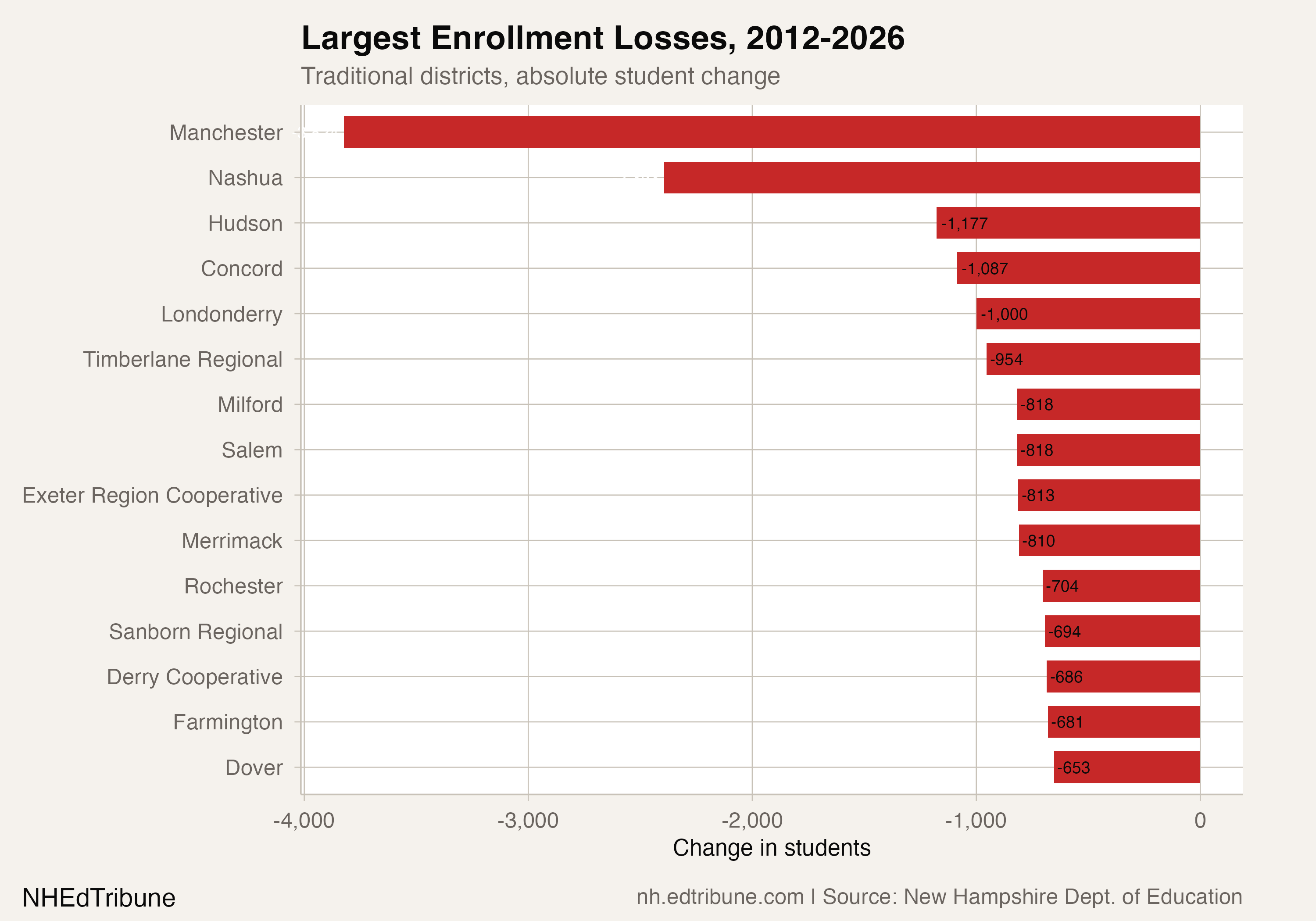
On a percentage basis, the steepest declines hit mid-sized communities that lack both the suburban appeal of a Bow and the urban institutional anchors of a Manchester. Farmington↗ET lost 49.4% of its enrollment, falling from 1,379 to 698. Sanborn Regional lost 38.1%. Franklin lost 36.2%.
Five districts have been declining for a decade or more without interruption: Berlin↗ET for 14 consecutive years, Dover and Exeter Region Cooperative for 11 each, Rochester for 11, and Conway for 10.
Births, not departures
The primary driver is demographic. New Hampshire's birth rate fell from 14,565 in 2004 to 11,397 in 2024, a 22% drop that feeds directly into smaller kindergarten cohorts. The state's total population of residents under 18 has fallen 17% since its peak in 2000, a loss of 53,000 children.
Keene↗ET Superintendent Robert Malay captured the dynamic plainly: students switching to charter, private, or homeschool options have contributed to losses, but "to a lesser degree than birth rates."
School choice is a frequent counterargument. New Hampshire's Education Freedom Account program enrolled 10,510 students in 2025-26, nearly double the prior year, after the state removed income eligibility caps in June 2025. But 96.7% of EFA recipients were already in a private or homeschool setting before enrolling, meaning the program mostly subsidizes existing choices rather than pulling students out of public schools.
Analysis from Reaching Higher NH reinforced this: the decline is "not just a public school problem, but a population problem," with no evidence of a meaningful shift in enrollment patterns toward private alternatives.
The fiscal math of empty seats
The fiscal impact is direct. New Hampshire provides roughly 33% of K-12 education funding, with the rest falling to local property taxes. When enrollment drops, state adequacy aid follows the students down. Fixed costs (heating buildings, maintaining buses, employing teachers under contract) do not fall at the same rate. In Keene, the superintendent estimated that declining enrollment would reduce state aid by $1.6 million, likely raising taxpayer costs to cover the gap.
The state legislature is already responding to the structural mismatch. A Republican-backed proposal would consolidate the state's 107 school administrative units into 12, one per county plus standalone units for Manchester and Nashua. Whether administrative consolidation can offset the fiscal drag of 30,000 fewer students is unclear. The cost of maintaining school buildings in Berlin (enrollment down every year since 2012) or in Farmington (half the students gone) is not administrative overhead.
The lopsided ledger
Bow added 244 students over 15 years. Manchester lost 3,824. That is the scale of the mismatch. The 21 traditional districts still growing added a combined 895 students over the entire period. The state lost more than that in four months of the 2020-21 school year. Southern New Hampshire's suburban pockets are real, but they are rounding errors against the demographic tide running through Manchester, Nashua, and the 146 other districts that keep getting smaller.
Detailed code that reproduces the analysis and figures in this article is available exclusively to EdTribune subscribers.
Discussion
Sign in to join the discussion.
Loading comments...