Manchester↗ET enrolled 11,712 students in fall 2025. Nashua↗ET enrolled 9,501. Both are the lowest totals either district has posted in 15 years of state enrollment data. They are not outliers. They are not even unusual. In 2025-26, 86 of 193 New Hampshire districts with five or more years of enrollment history are at their lowest point in the dataset, a share of 44.8%. Only 11 districts are at all-time highs. Seven of those 11 are charter schools.
The ratio of record lows to record highs is 7.8 to 1. Decline in New Hampshire is not a pocket phenomenon confined to rural towns or struggling cities. It is the default condition.
Every major district, the same story
All 10 of New Hampshire's largest districts sit at record lows in 2026. Not eight. Not nine. All 10. Manchester has shed 3,824 students since its 2012 peak, a 24.6% decline. Nashua has lost 2,393, or 20.1%. Concord↗ET, the state capital, is down 1,087 students, 22.4% below its peak.
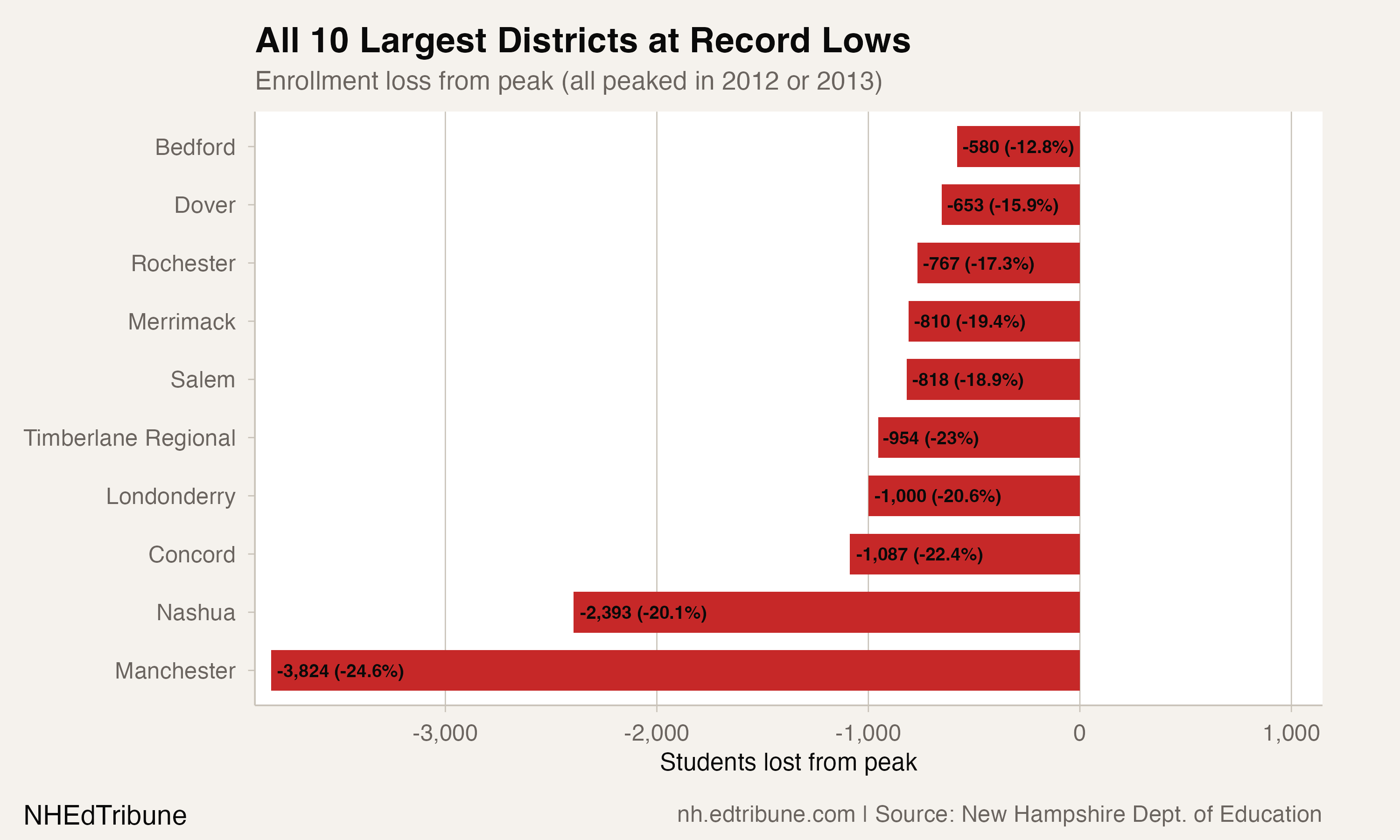
The losses span regions and community types. Bedford↗ET, an affluent suburb south of Manchester, is down 12.8%. Rochester↗ET, an old mill city on the Maine border, is down 17.3%. Timberlane Regional↗ET, a cooperative district serving four towns, has lost 23% of its enrollment since 2012.
Among smaller districts at record lows, the percentage losses are steeper. Farmington↗ET has lost 49.4% of its enrollment since its peak, dropping from 1,379 to 698 students. Franklin is down 36.2%. Newport has declined 35%, and Conway 30.8%.
A population problem, not a school problem
New Hampshire enrolled 190,805 public school students in 2012. By 2026, that figure had fallen to 160,322, a loss of 30,483 students, or 16%.
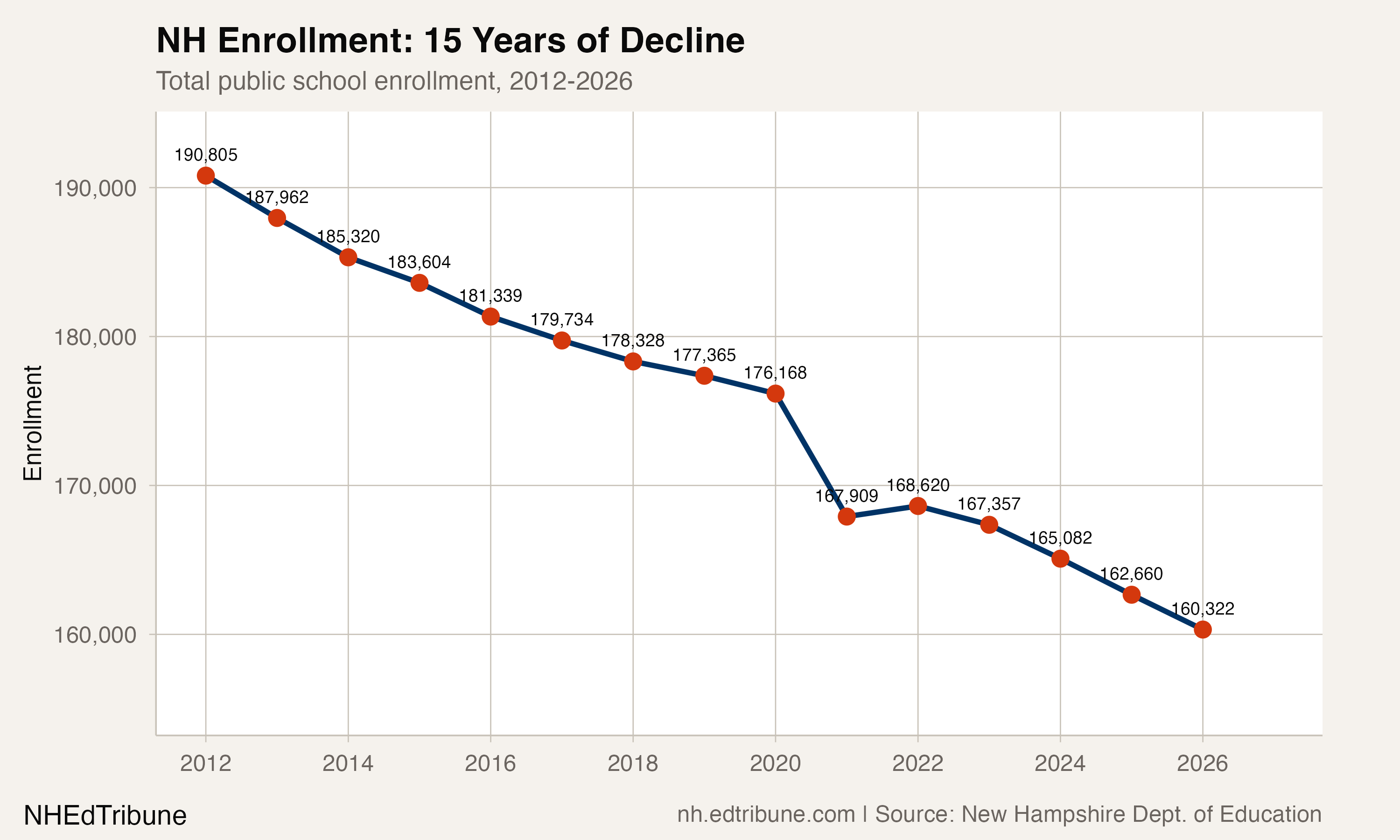
The decline predates COVID. It predates the expansion of school choice. It predates most policy interventions. Enrollment fell every single year from 2012 through 2020, losing between 963 and 2,843 students annually. The pandemic accelerated the slide: 8,259 students disappeared in a single year between fall 2020 and fall 2021. A brief bounce of 711 students in 2022 proved to be exactly that. The state has since lost 8,298 more students over four years.
The driver is demographic. New Hampshire recorded 11,761 births in 2024, the lowest number in modern times, down from more than 14,000 annually in the early 2000s. Fewer babies born in 2018 and 2019 means fewer kindergartners showing up in 2023 and 2024.
Reaching Higher NH, a nonpartisan education research organization, examined the 2025-26 enrollment data and concluded that the trend extends beyond public schools:
"There's nothing in the data that indicates NH public school students are fleeing for other education types."
Their analysis frames this as structural:
"The decline is not just a public school problem, but a population problem."
Keene Superintendent Robert Malay put it more plainly. "Slowing birth rates are the biggest drag on enrollment," he told the Keene Sentinel. His district, Keene↗ET, dropped from 3,284 students in 2015 to 2,941 in 2026, and the decline has reduced state aid by an estimated $1.6 million.
The COVID spike and the long slide
The year-over-year pattern reveals two distinct eras of decline, with a COVID-driven chasm in between.
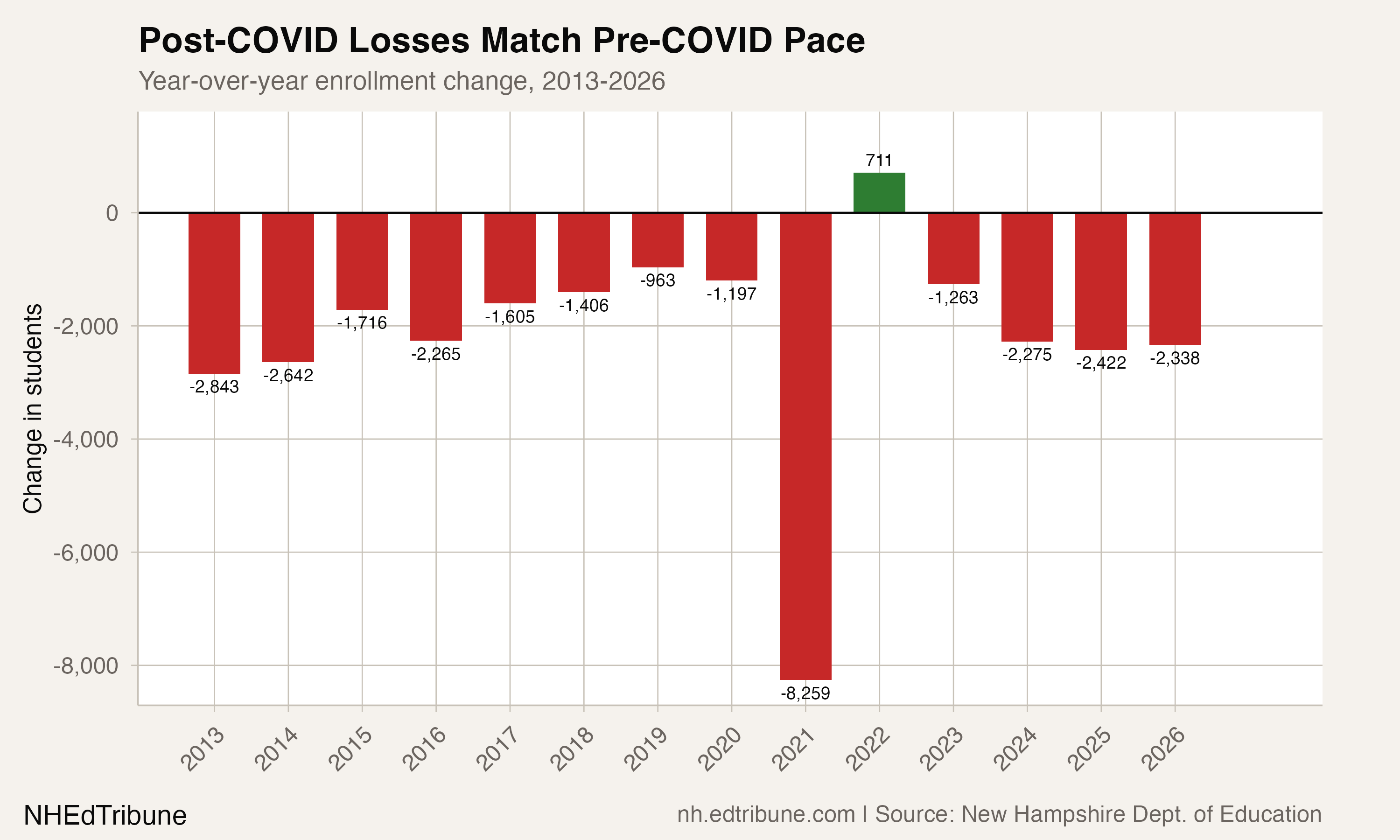
From 2013 through 2020, New Hampshire lost between 963 and 2,843 students per year. The losses were large but decelerating: by 2019, the annual loss had slowed to 963, the smallest in the series. Then COVID struck, erasing 8,259 students in one year, pushing 115 districts to all-time lows simultaneously.
The 2022 bounce recovered just 711 of those students. Since then, the annual losses of 2,275, 2,422, and 2,338 students have returned to the pace of 2013 and 2014, before the pre-COVID slowdown ever happened. The deceleration that characterized 2017-2019 has been erased.
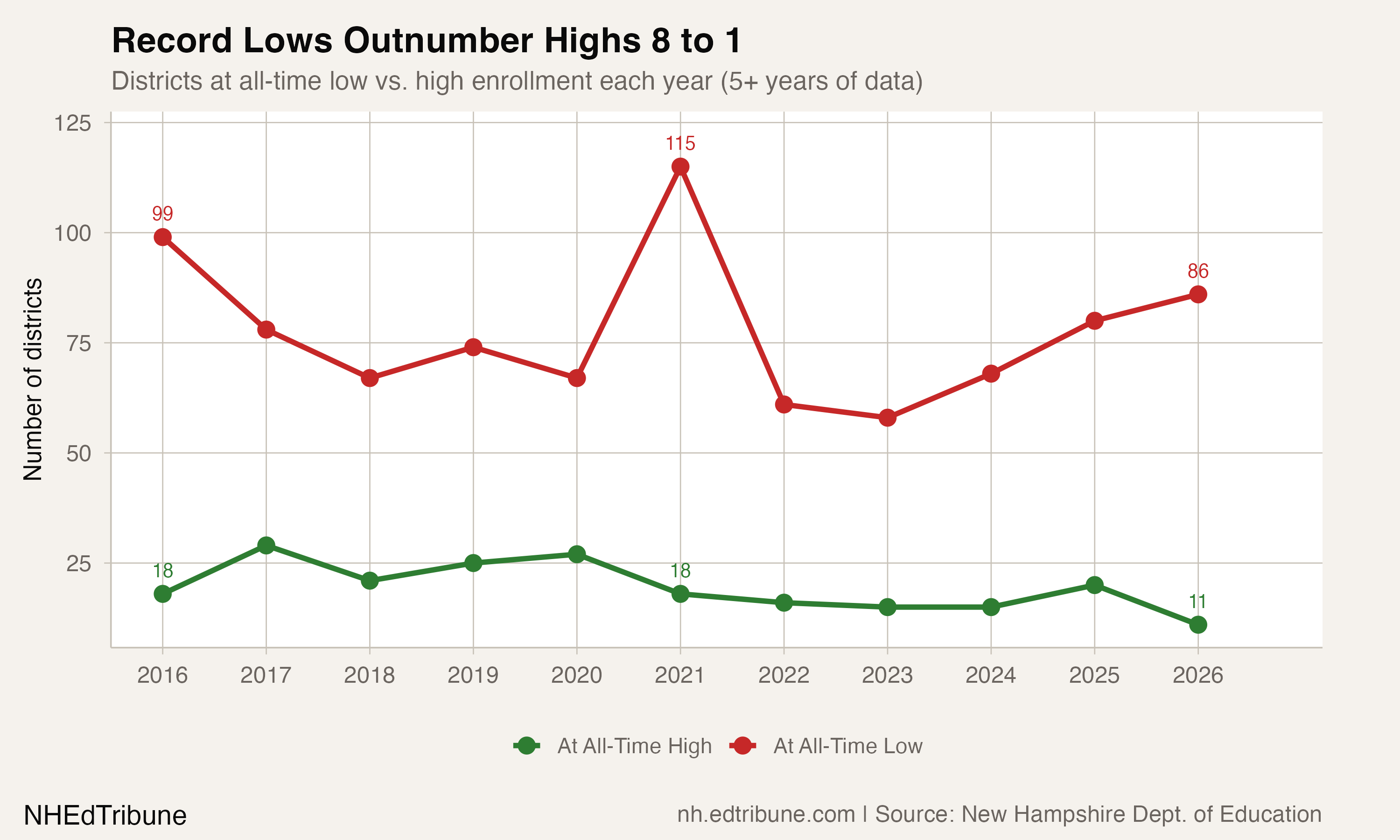
The count of districts at record lows spiked to 115 during COVID, fell to 58 in 2023 as some districts clawed back students, and has now climbed to 86. Meanwhile, the number at all-time highs has collapsed from a range of 18-29 in 2016-2021 to just 11 in 2026.
Berlin's 14-year unbroken decline
One district has not gained a single student in the entire 15-year dataset. Berlin↗ET, a former paper mill city in the state's North Country, has declined every year from 2012 through 2026: 14 consecutive years of losses, from 1,292 students to 959. That is a 25.8% decline with no interruption, no bounce, no year of relief.
Berlin is an extreme case, but the pattern is common across New Hampshire's northern and western communities: aging populations, outmigration of young adults, a shrinking tax base. UNH demographer Kenneth Johnson has described the state as a preview for the nation: high school and college graduates leave, retirees stay, and the median age climbs to 43.4.
Charters grow, but they are not the cause
New Hampshire's charter sector has grown 469% since 2012, from 1,097 students to 6,242. Charter schools now account for 3.89% of total enrollment, up from 0.57%.
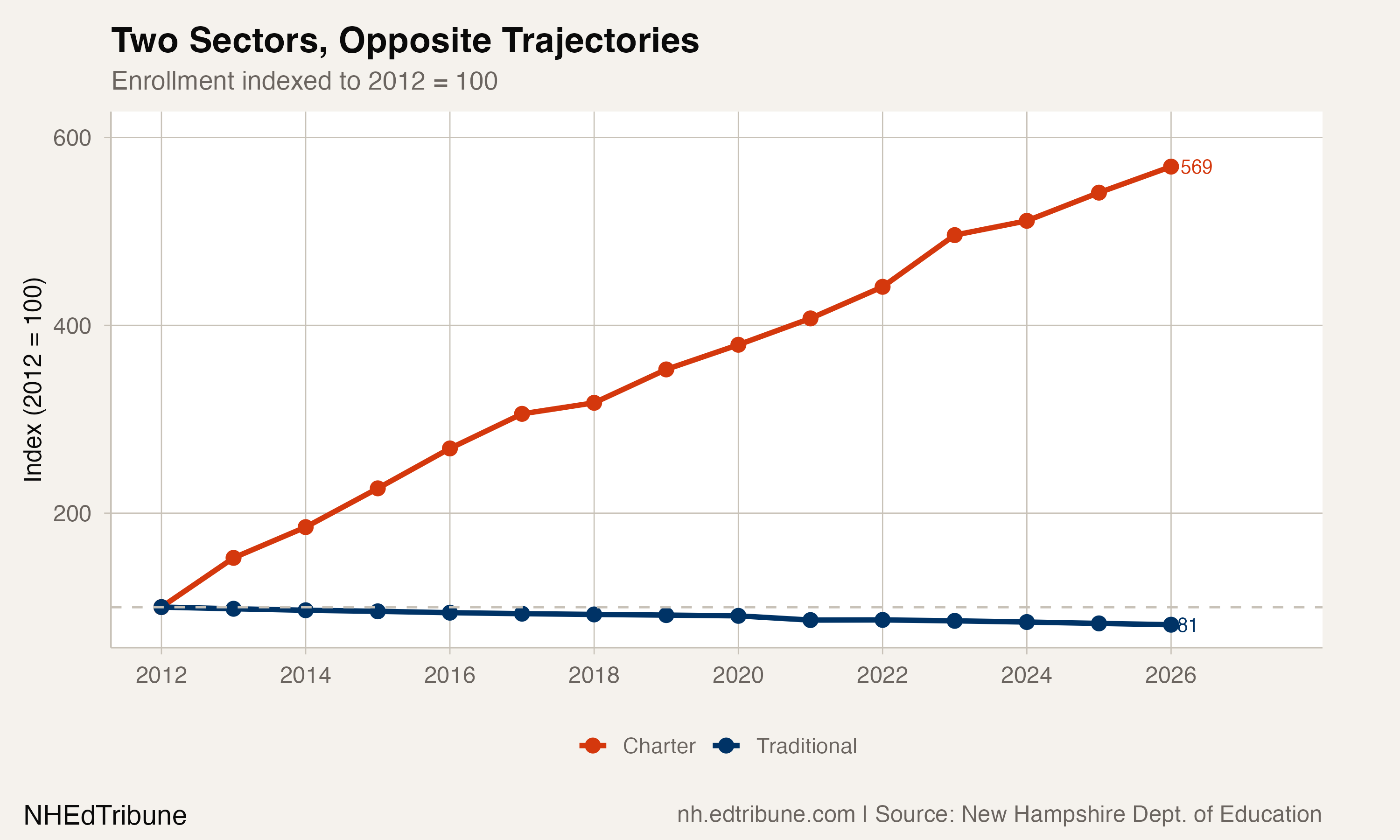
Seven of the 11 districts at all-time highs are charter schools, including The Founders Academy (435 students), MicroSociety Academy (363), and The Birches Academy (330). Only four traditional districts, all small, are at record highs: Hollis (686), Nottingham (534), Wentworth (83), and Newington (54).
But charter growth, while real, is too small to explain the traditional sector's losses. Traditional districts have shed 35,628 students since 2012. The charter sector has added 5,145 over the same period. Even if every charter student had been pulled from a traditional school, that transfer would account for less than 15% of the traditional sector's losses.
The state's Education Freedom Account program, which provides vouchers for private school tuition, enrolled about 10,500 students in 2025-26. However, Reaching Higher NH found that the vast majority of EFA recipients were already in private or home school programs before receiving a voucher. Fewer than 500 students statewide switched from public schools to EFAs in the most recent year, representing about 0.3% of public enrollment.
What consolidation looks like in practice
When enrollment declines by a quarter over 15 years, the question becomes what to do with the buildings. Manchester, which has lost 3,824 students, faces an estimated $150 million in deferred maintenance and has received a consultant's recommendation to close four elementary schools and one high school.
At the state level, Republican legislators have proposed consolidating New Hampshire's 107 school administrative units into 12. The proposal reflects a structural oddity: even as enrollment has steadily declined, the state has added administrative units rather than consolidated them. An earlier version of the consolidation bill was voted down unanimously by the full House in 2025, but a revised proposal remains under consideration. Shrinking enrollment and fragmented governance remain on a collision course.
The entering class keeps getting smaller
New Hampshire enrolled 11,904 kindergartners in 2012. By 2026, that number had dropped to 10,727, a 9.9% decline. Given that the state recorded its lowest birth year on record in 2024, the kindergarten class of 2030 will be drawn from an even smaller pool.
Eleven districts are at all-time highs. Seven are charter schools. Four are traditional districts, all small: Hollis, Nottingham, Wentworth, and Newington. Together they enroll 1,357 students. The 86 districts at record lows enroll 101,538. That imbalance is the state's enrollment story in a single frame.
Detailed code that reproduces the analysis and figures in this article is available exclusively to EdTribune subscribers.
Discussion
Sign in to join the discussion.
Loading comments...