New Hampshire's public schools had been bleeding students for years before the pandemic. Between 2016 and 2020, the state lost 5,171 students across four school years, a steady trickle of roughly 1,300 per year. Then COVID hit, and the 2020-21 school year wiped out 8,259 students in a single October headcount: a 4.7% plunge that exceeded the previous four years of losses combined.
That was five years ago. The state has recovered 8.6% of what it lost.
The cliff and the long slope after it
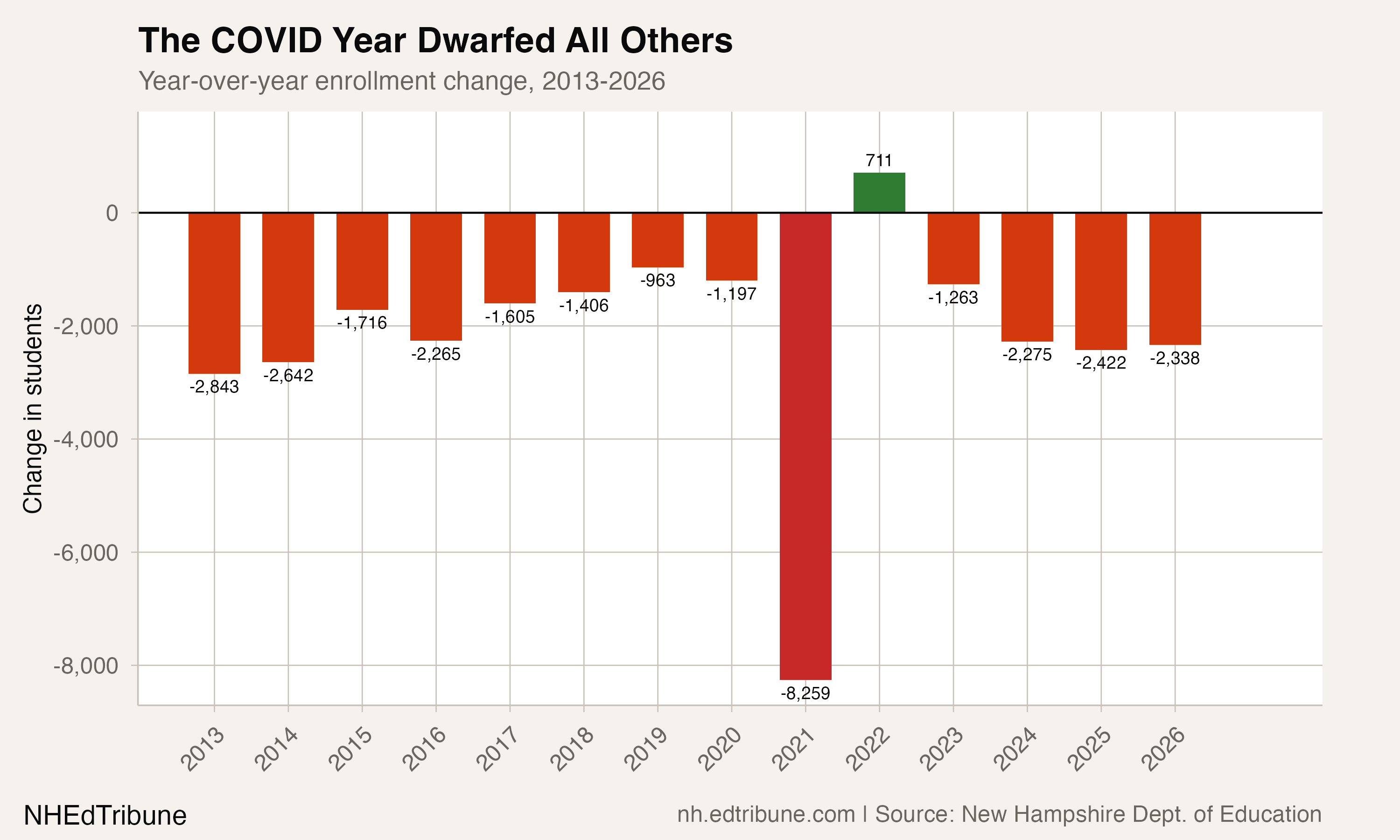
The COVID-year loss was structurally different from every other year in the 15-year dataset. At 8,259 students, it was 2.9 times the next-largest single-year drop (2,843 in 2013). In a state where annual losses had been moderating from roughly 2,800 per year in 2013 to under 1,200 by 2020, the pandemic year broke every precedent.
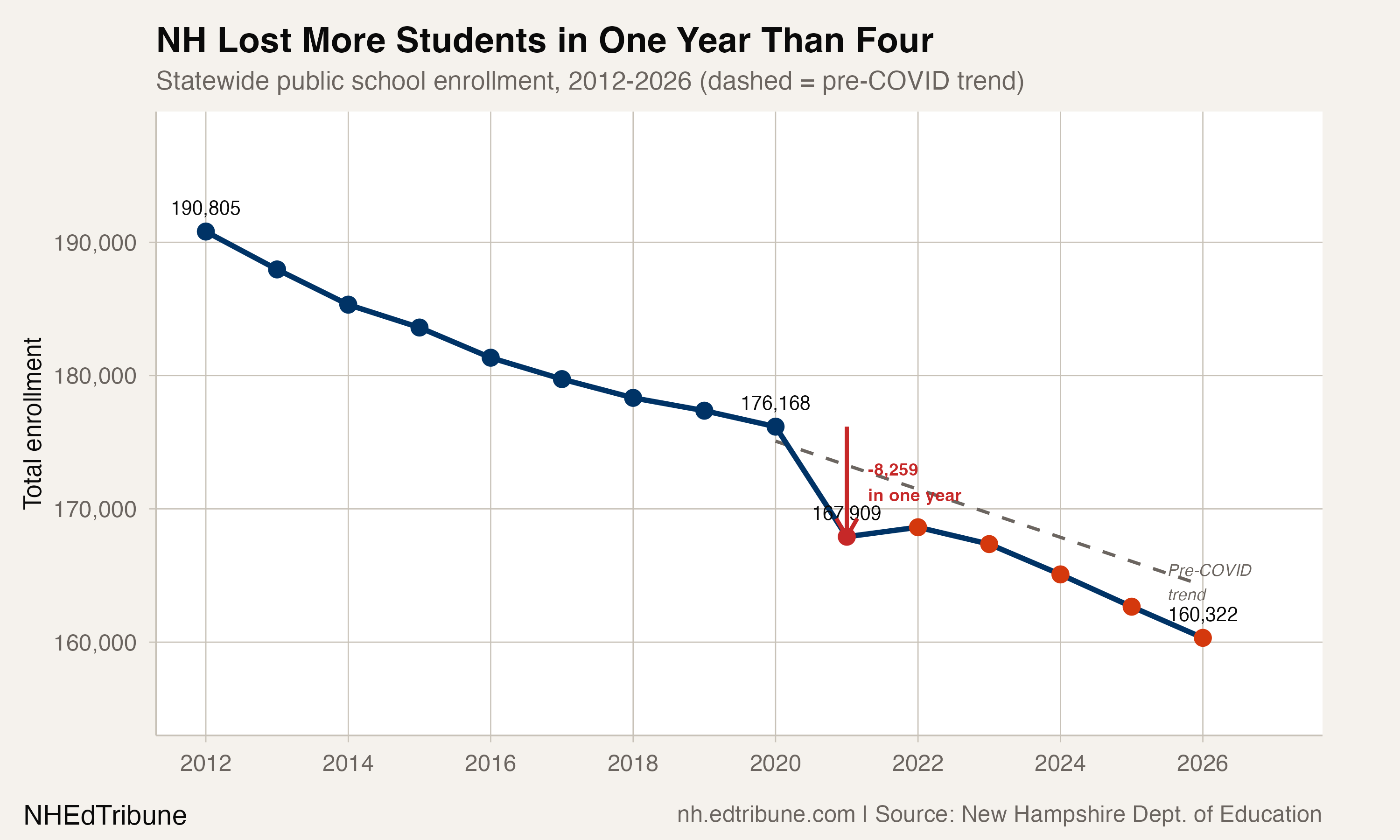
A brief bounce followed. The 2021-22 school year brought back 711 students, the only positive year in the entire 15-year series. But the recovery stalled immediately: the state lost 1,263 students the following year, then 2,275, then 2,422, then 2,338. Post-COVID annual losses have erased the moderation trend that defined the late 2010s.
The result: New Hampshire enrolled 160,322 students in 2025-26. A linear projection of the pre-COVID trend (which itself was declining at about 1,800 per year) would have predicted 164,260. The state is 3,938 students below even the pessimistic trajectory it was already on.
The youngest students vanished first
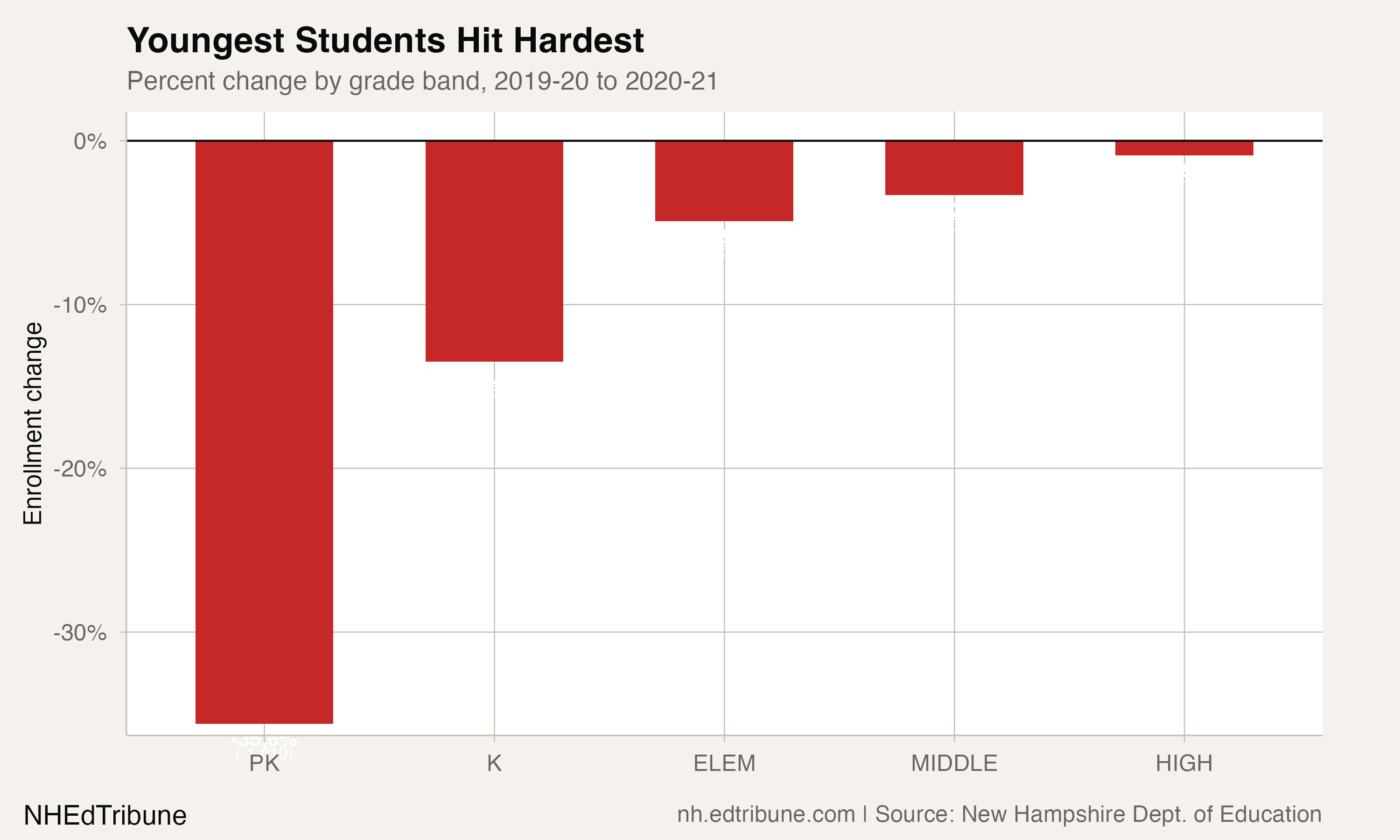
The pandemic did not hit all grade levels equally. Pre-kindergarten collapsed 35.6%, falling from 4,518 to 2,908 in a single year. Kindergarten dropped 13.5%, losing 1,578 students. PK and K together accounted for 38.6% of the total loss despite representing roughly 9% of enrollment.
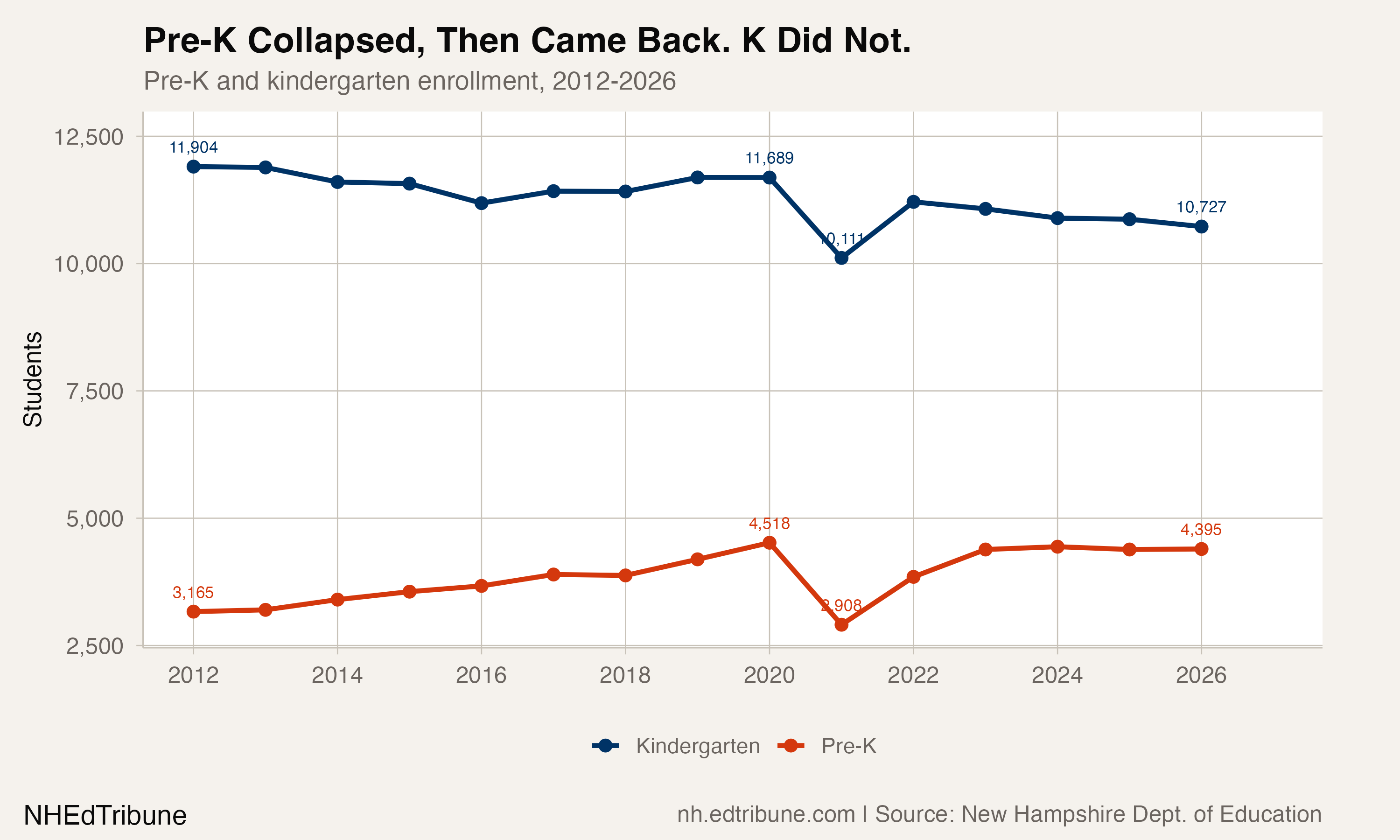
What happened next diverges sharply by grade. Pre-K has largely recovered: from its COVID low of 2,908, it climbed back to 4,395 in 2025-26, reaching 97.3% of its pre-COVID level. Parents who delayed preschool eventually sent their children.
Kindergarten did not come back. After rebounding partially to 11,212 in 2021-22, it has fallen every year since, reaching 10,727 in 2025-26, still 8.2% below its pre-COVID count of 11,689. The kindergarten shortfall has a different root cause: New Hampshire's second-lowest birth rate in the nation, which had dropped from roughly 14,000 annual births in the early 2000s to approximately 11,000-12,000 by the mid-2020s. The children who should be entering kindergarten in 2025-26 were born in 2019-20, at the tail end of a decade-long birth decline.
Where the damage persists
Five years after the COVID shock, 144 of 191 districts with data for both years remain below their 2019-20 enrollment. That is a 24.6% recovery rate. Among traditional public school districts, it is worse: just 19.0% have recovered, compared to 65.2% of charter-named districts.
Not one of the 23 districts with 2,000 or more students in 2019-20 has returned to pre-COVID levels. Nashua↗ET is down 1,523 students (-13.8%), Manchester↗ET is down 1,506 (-11.4%), Concord↗ET has lost 553 (-12.8%), and Rochester↗ET is down 528 (-12.6%). Together, Nashua and Manchester account for 19.1% of the statewide loss since 2020 despite serving a combined 13.2% of students.
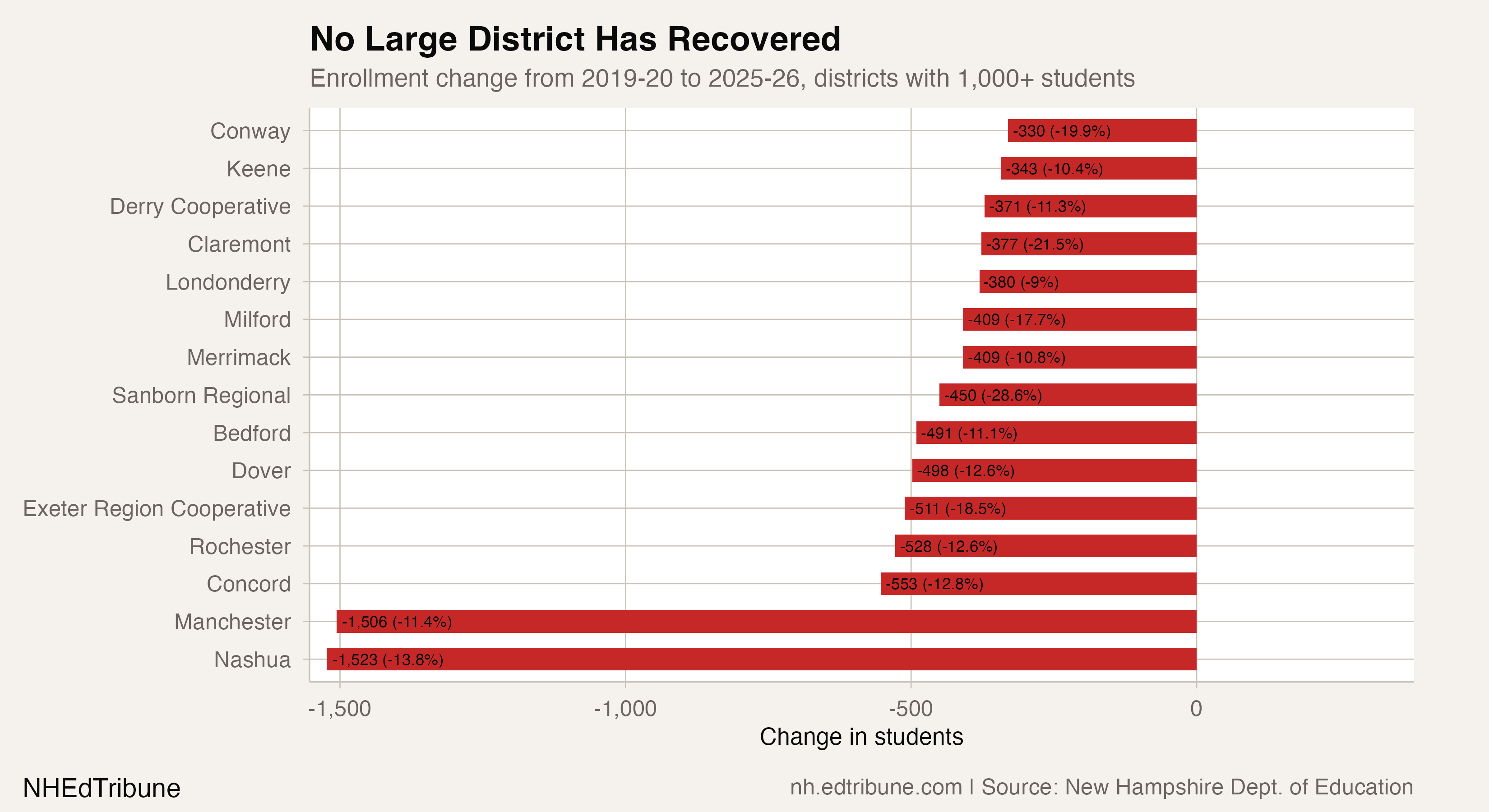
Bedford↗ET, an affluent suburb, lost 491 students (-11.1%). Exeter Region Cooperative dropped 511 (-18.5%). Sanborn Regional fell 450 (-28.6%). The losses span geography and community type.
A demographic problem wearing a pandemic mask
The pandemic accelerated a decline already baked in. As NHPR reported in January 2022, New Hampshire's public school enrollment had fallen 18.5% over two decades before COVID arrived. The state's aging population and persistently low birth rate were already compressing the pipeline of school-age children.
COVID added three forces on top of that demographic slide. First, families pulled children from public schools during the disruption. The number of first-time homeschool registrations jumped roughly 50% in 2020. Second, the state launched its Education Freedom Account program in 2021, providing vouchers for private school tuition and other education expenses. By 2024-25, approximately 5,300 students were participating, with the program expanding to universal eligibility in 2025-26 and a 10,000-student enrollment cap.
Third, charter schools grew steadily through and after the pandemic. The charter-named sector enrolled 3,993 students in 2019-20 and 6,242 in 2025-26, a 56.3% increase, while traditional district enrollment fell 10.5%. The Virtual Learning Academy Charter School alone jumped from 349 to 478 students during the COVID year, a 37% increase, as families sought remote-learning alternatives.
Reaching Higher NH, a nonpartisan education research organization, analyzed the 2025-26 data and concluded that the decline is fundamentally demographic:
"The decline is not just a public school problem, but a population problem."
The same analysis found no evidence of a mass exodus to alternative school types, noting that enrollment patterns across public, private, and home education have remained broadly stable as a share of the school-age population.
The fiscal math of fewer students
Fewer students does not mean proportionally lower costs. Schools still need buses, buildings, and heating whether they serve 400 students or 350. As NHPR reported in November 2022, lower enrollment translates directly into less per-pupil state aid, putting local taxpayers on the hook for covering more of the rising costs.
The Federal Reserve Bank of Boston documented this dynamic across northern New England, finding that New Hampshire's per-pupil expenditures rose 59.8% (inflation-adjusted) since 2000, the highest increase among the three northern New England states. Fewer students, higher per-pupil costs, and a property-tax-dependent funding model create a structural mismatch that compounds with every year of decline.
Meanwhile, the state's administrative structure has moved in the opposite direction of its enrollment. New Hampshire now has more school administrative units than it did two decades ago, 105 in 2025 compared with 85 in 2005, even as enrollment has fallen steadily. Proposals to consolidate SAUs from over 100 to 12 county-based units have drawn pushback from local officials who see consolidation as a threat to community control.
What the next five years look like
The post-COVID acceleration is the most concerning pattern in the data. Before the pandemic, annual losses were moderating: from 2,843 in 2013 to 2,265 in 2016 to just 963 in 2019. The state looked to be approaching a gentler slope. After the brief 2022 bounce, losses have settled at 2,275 to 2,422 per year, erasing that moderation entirely and returning to early-decade rates of decline. The state is not settling back to its pre-pandemic trajectory.
The kindergarten pipeline offers no relief. With annual births running 2,000-3,000 below early-2000s levels, each entering cohort will be smaller than the one it replaces for the foreseeable future. State projections anticipate 1% annual enrollment declines for at least the next decade.
Before the pandemic, losses were moderating. By 2019, the annual decline had slowed to 963 students, the mildest year in the series. There was a reasonable case that New Hampshire was approaching a gentler slope. Four years of post-COVID data have erased that hope. The 2022 bounce recovered 711 of the 8,259 students lost. Annual losses since then have returned to the pace of 2013 and 2014. The moderation is gone, and so are the students.
Detailed code that reproduces the analysis and figures in this article is available exclusively to EdTribune subscribers.
Discussion
Sign in to join the discussion.
Loading comments...