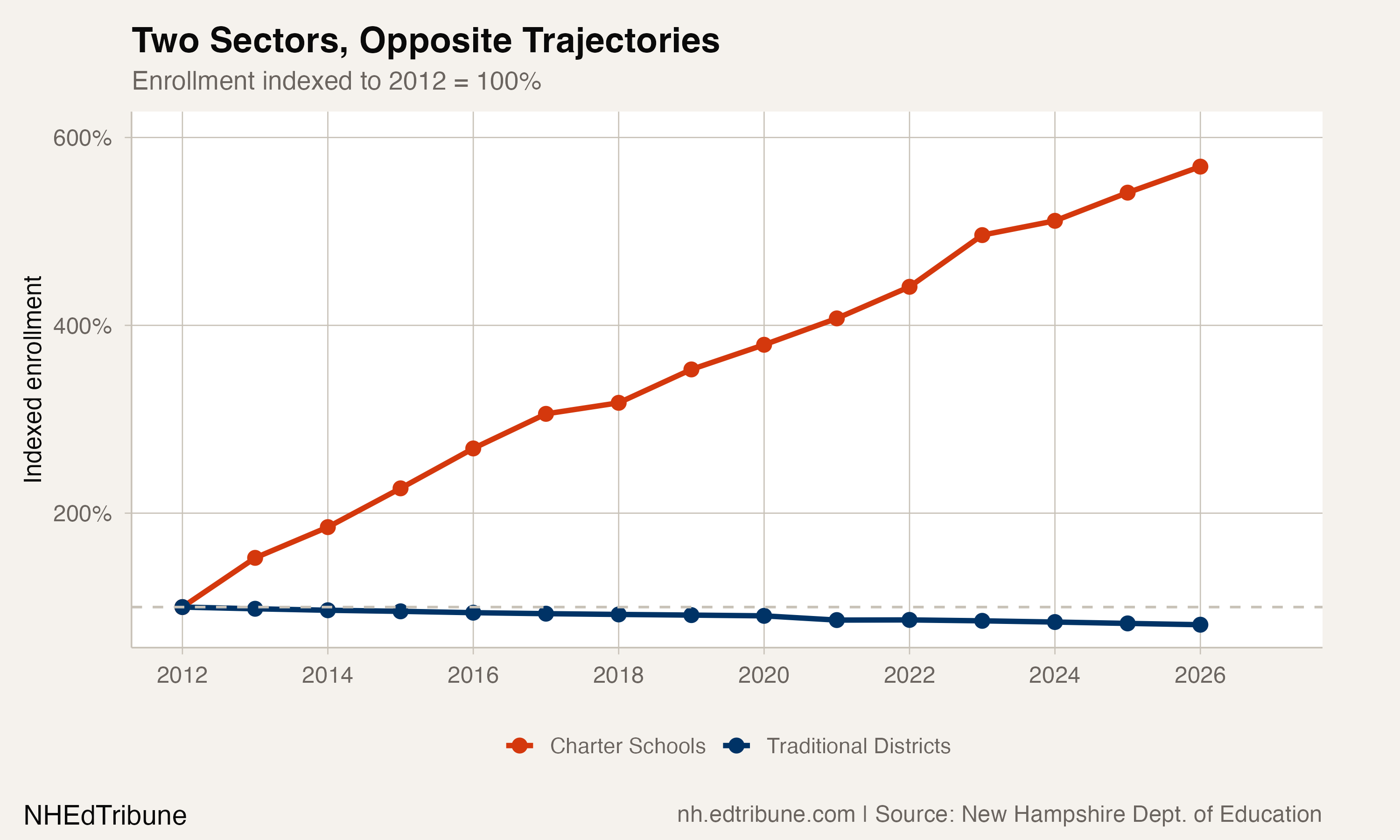
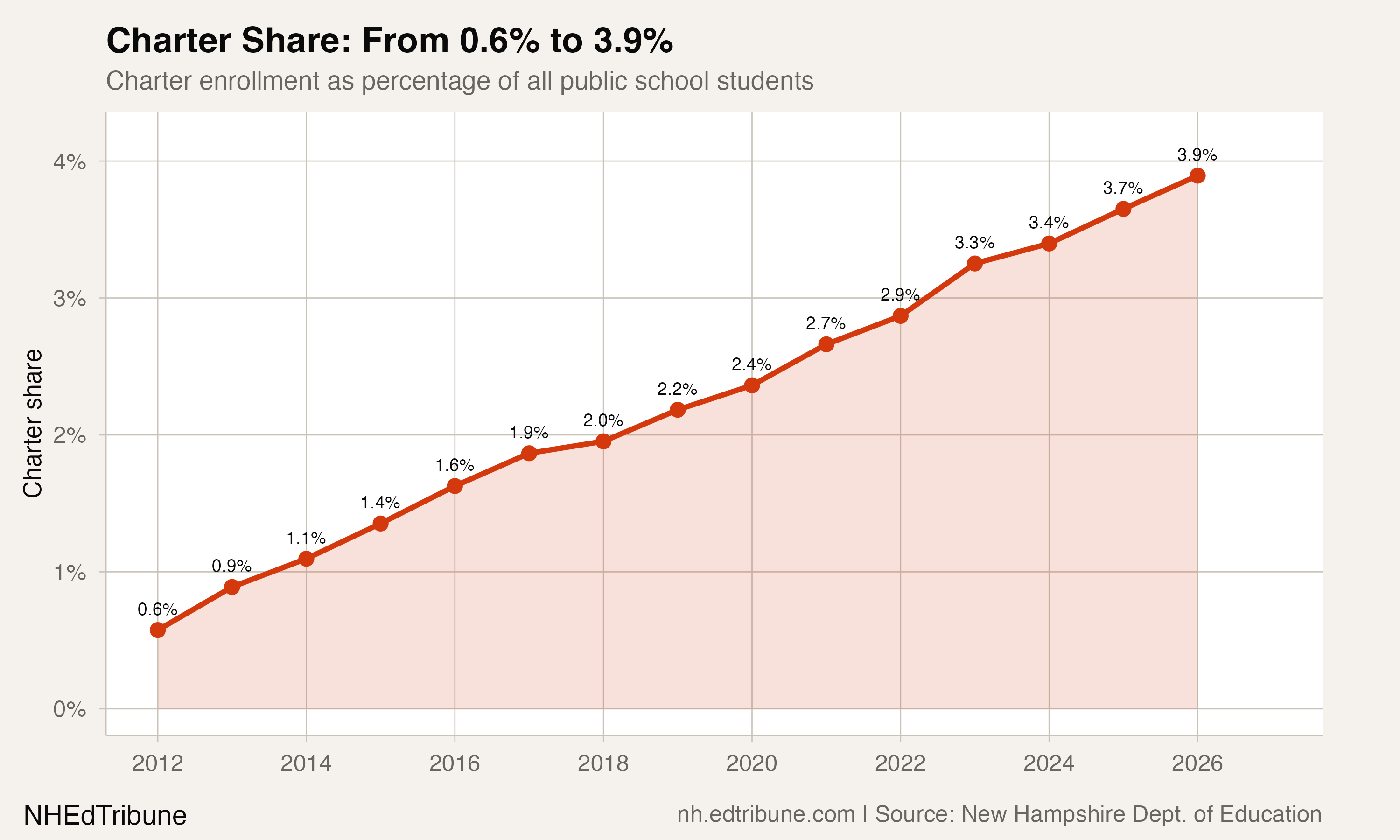
In the 2011-12 school year, New Hampshire had 10 charter schools enrolling 1,097 students. They were a rounding error: 0.6% of the state's public school population. Fifteen years later, 35 charter schools enroll 6,242 students, and the sector's share has grown nearly sevenfold to 3.9%.
That 469% growth rate happened while traditional districts shed 35,628 students, an 18.8% decline. The two lines on the chart move in opposite directions, and they have for every year in the dataset.
A sector built from new schools, not bigger ones
Most of the growth did not come from the original 10 charter schools getting larger. Nine of them still operate in 2025-26, enrolling a combined 2,194 students. That is double their 2012 total. But the 25 schools that opened after 2012 now enroll 4,048 students, accounting for 79% of the sector's net growth of 5,145 students.
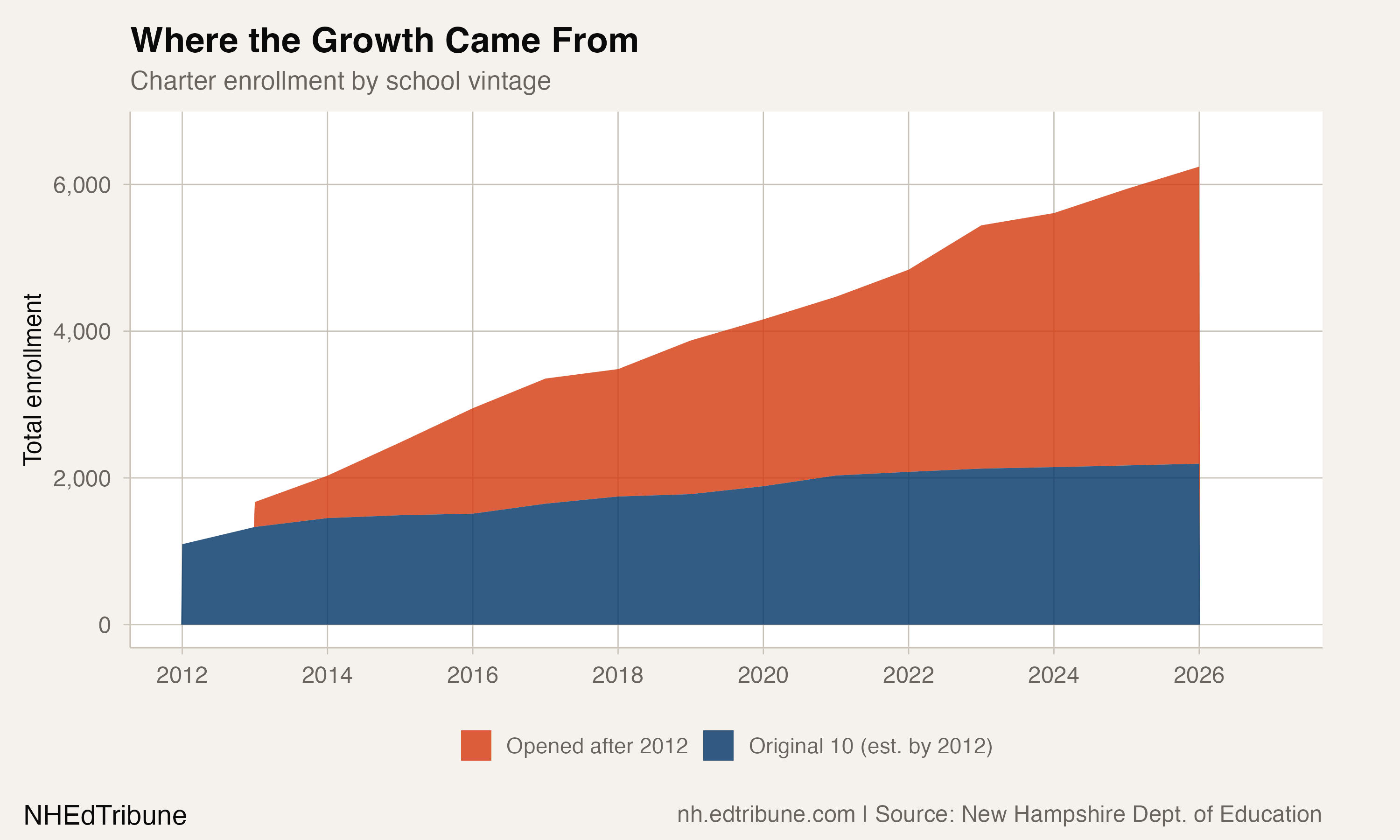
New charter openings came in waves. Six opened in 2013, four in 2015, three in 2019, and then a second acceleration beginning in 2023. Eleven new charters have opened in the past four years alone, including four in 2025-26: Granite Valley Preparatory, NH Career Academy, North Star Academy, and Wellheart.
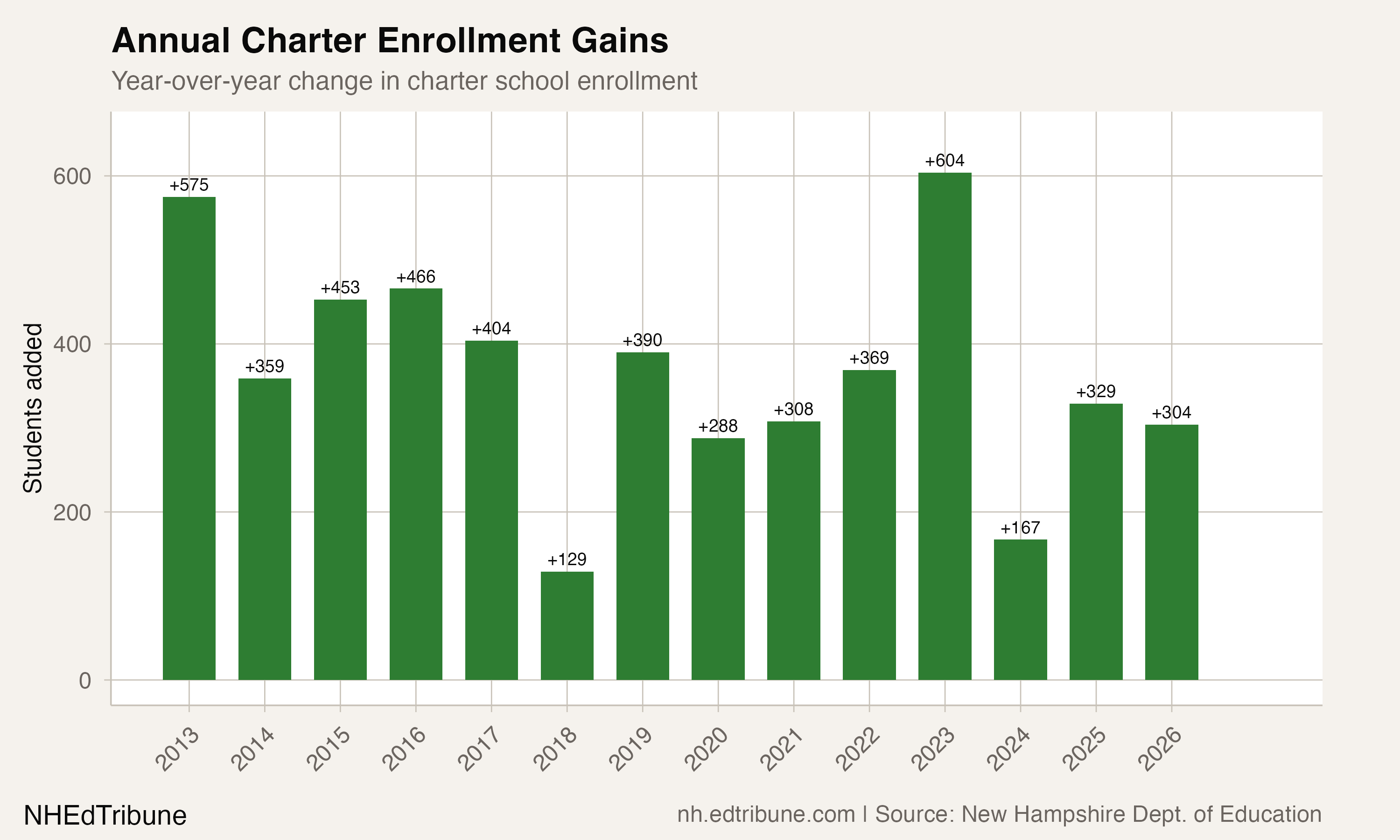
The 2023 cohort brought the single largest year-over-year enrollment gain since 2013: 604 students, a 12.5% jump. That year saw Lionheart Classical Academy open in Peterborough with 195 students. By 2025-26, it enrolls 372.
Small schools with distinct identities
No large charter networks operate in New Hampshire. The median charter school enrolls 118 students. Sixteen of the 35 schools have fewer than 100 students. Only eight exceed 300.
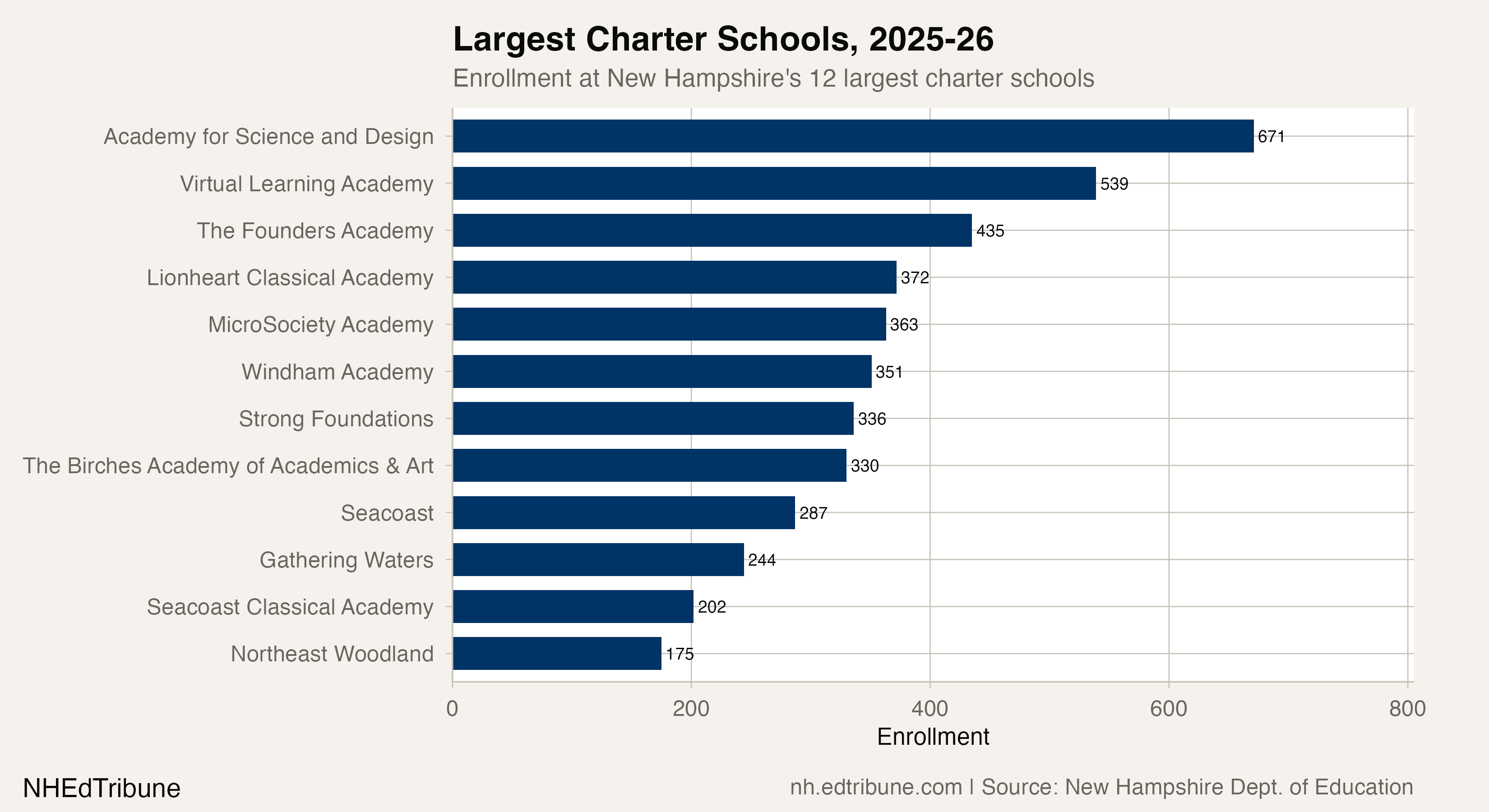
The Academy for Science and Design in Nashua, a STEM-focused school, is the largest at 671 students, up from 285 in 2012. The Virtual Learning Academy Charter School ranks second at 539. The rest are small, mission-driven schools: arts academies, Montessori-inspired programs, classical education schools, project-based learning models.
The clearest growth niche is classical academies. Four schools with classical or founding-era educational philosophies now enroll a combined 1,166 students, nearly a fifth of the sector: The Founders Academy (435 students, opened 2015), Lionheart Classical Academy (372, opened 2023), Seacoast Classical Academy (202, opened 2025), and Compass Classical Academy (157, opened 2016). In a state with no large charter management organizations, the classical model has carved out a sizable footprint.
The virtual school that peaked during COVID
The Virtual Learning Academy Charter School tells its own story within the broader trend. VLACS grew from 63 students in 2012 to a peak of 613 in 2023, a tenfold expansion driven in part by pandemic-era demand for remote instruction. But enrollment has since settled to 539, a 12.1% retreat from that peak. The pandemic likely pulled forward demand that partially receded once in-person schooling resumed.
Charter growth in context: 14 cents on the dollar
A 469% growth rate sounds transformative. In absolute terms, it is more modest. The 5,145 students added to charter rolls since 2012 offset only 14.4% of the 35,628 lost by traditional districts. The remaining 85.6% of the decline reflects falling birth rates, an aging population, and homeschool growth.
New Hampshire's birth rate has fallen from roughly 14,000 annually in the early 2000s to about 11,400 in 2024, the second lowest per capita in the country. The state's population of children under 18 declined faster than any other state between 2010 and 2020, according to Reaching Higher NH. In that analysis, "there is no evidence of a meaningful change in enrollment patterns" across sectors; the entering cohort is simply shrinking.
The voucher factor
Charters are not the only school choice mechanism expanding in New Hampshire. The state's Education Freedom Account program, which provides state-funded vouchers for private school tuition, homeschool expenses, and other non-public education costs, went universal in 2025 when Governor Kelly Ayotte signed Senate Bill 295 removing income limits. The program hit its 10,000-student enrollment cap in its first year of universal eligibility, with 295 students waitlisted, according to the NH Department of Education.
The EFA program is roughly 60% larger than the entire charter sector by headcount, and it grew to that scale in four years. But the two programs are different animals: charters are public schools that appear in state enrollment data, while EFA recipients attend private schools or are homeschooled. Their departures from the public system are harder to trace in enrollment files.
An analysis by Reaching Higher NH found that over 65% of EFA recipients were not previously enrolled in public schools. In 2024-25, only 493 new EFA participants, about 32% of new enrollments, switched from local public schools. The fiscal impact, however, is broader: both charters and EFAs draw from the same Education Trust Fund. The EFA program is projected to cost approximately $50 million in 2025-26, roughly double its prior-year cost.
"Universal vouchers exacerbate the already inequitable public education funding system." -- Megan Tuttle, New Hampshire Education Association, August 2025
The political accelerant
Charter growth has coincided with intensifying political interest in expanding the model further. House Majority Leader Jason Osborne introduced HB 1358 in 2026, which would establish a commission to study converting all public schools into charter schools.
"If the model works this well for these students, why not offer it to all 170,000 students." -- House Majority Leader Jason Osborne (R-Auburn), February 2026
Critics, including the state's two teachers' unions, argue the proposal underestimates the structural differences between charter and traditional public school operations. Charter schools in New Hampshire are required to have only 50% state-certified teachers, compared to 100% in traditional districts. They also lack the transportation obligations and collective bargaining agreements that shape traditional district budgets.
What to watch
The charter sector's year-over-year gains have been positive in all 14 consecutive years since 2012, averaging 367 students annually. Whether the current pace of new school openings, combined with the EFA program's expansion, shifts the trajectory from linear to exponential remains to be seen. At the current rate of share growth, roughly 0.24 percentage points per year, charters would reach 5% of enrollment around 2030. But several new charter schools are in the approval pipeline, including Breakthrough Academy in the Mt. Washington Valley and additional schools working through the application process.
The more consequential issue may be fiscal. State adequacy aid, approximately $4,100 per student, follows students to charter schools. Traditional districts that lose students cannot proportionally reduce fixed costs, so the per-pupil spending gap widens mechanically.
State Education Commissioner Caitlin D. Davis acknowledged the challenge: "New Hampshire's public schools are navigating a continued decline in student enrollment." The charter sector's growth may be a response to that decline, a contributor to it, or a parallel phenomenon riding the same demographic current. The enrollment data alone cannot tell those apart.
Detailed code that reproduces the analysis and figures in this article is available exclusively to EdTribune subscribers.
Discussion
Sign in to join the discussion.
Loading comments...