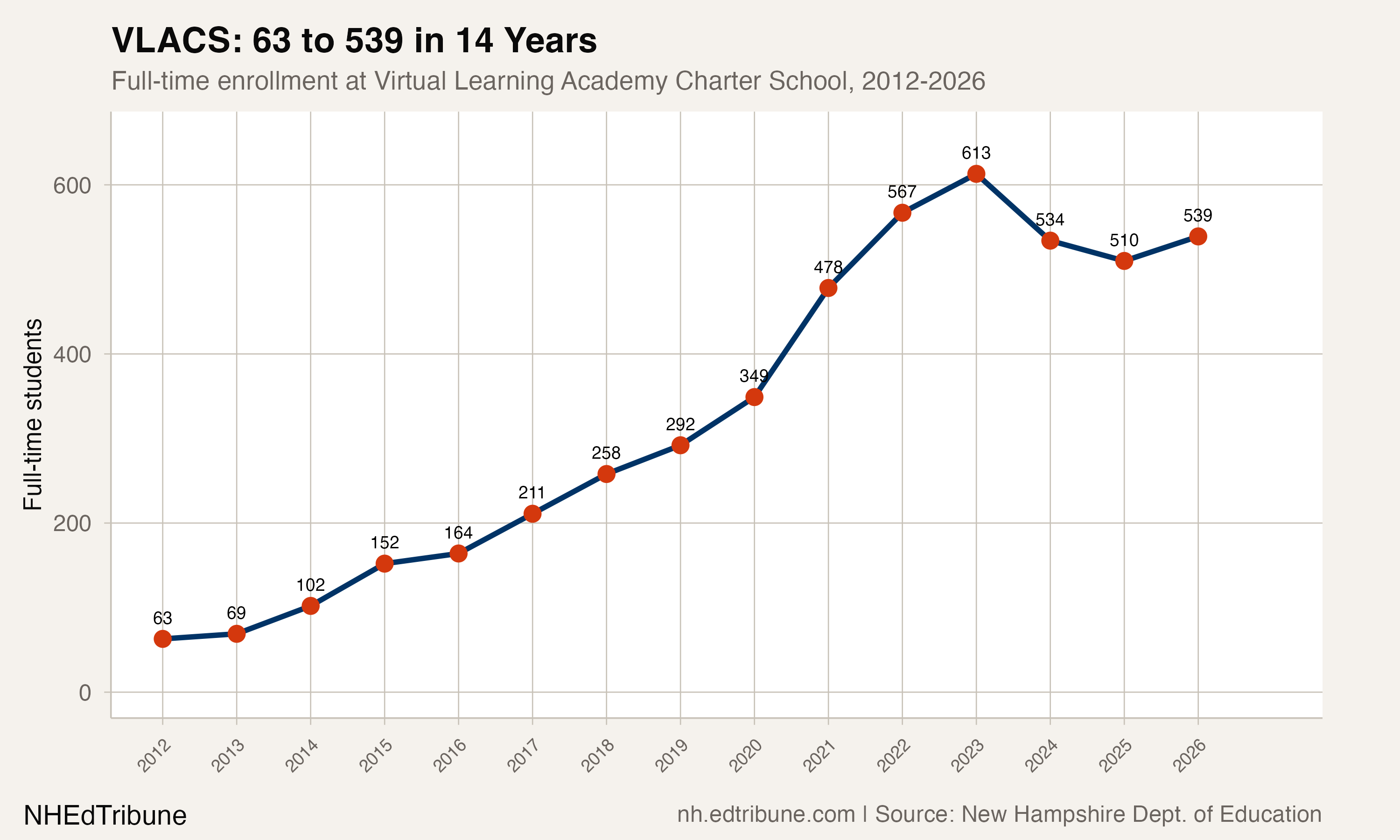
In 2011-12, the Virtual Learning Academy Charter School↗ET enrolled 63 full-time students. Every one of them was in high school. Fourteen years later, VLACS enrolls 539, has expanded into elementary grades, and ranks 76th among New Hampshire's 203 districts. It grew 755.6% during a period when the state lost 30,483 students.
The growth was not linear. VLACS added students every single year from 2013 through 2023, an 11-year unbroken streak. Then the pandemic aftershock hit: enrollment peaked at 613 in 2022-23, fell to 510 by 2024-25 — a 16.8% drop — then partially recovered to 539 in 2025-26. The school appears to have settled at a new level: larger than anyone would have predicted in 2012, smaller than its COVID-era peak.
An 11-Year Streak, Then a Correction
VLACS grew at a 16.6% compound annual rate over 14 years. That rate masks distinct phases. During the startup years of 2012 to 2015, enrollment more than doubled from 63 to 152, but the base was tiny. The steady-growth phase from 2016 to 2019 added 128 students at a more measured pace.
Then COVID arrived. In 2020-21, VLACS added 129 students in a single year, a 37.0% jump. The following year brought another 89. In two years, the school gained 218 full-time students, nearly as many as it had accumulated in its first seven years combined.
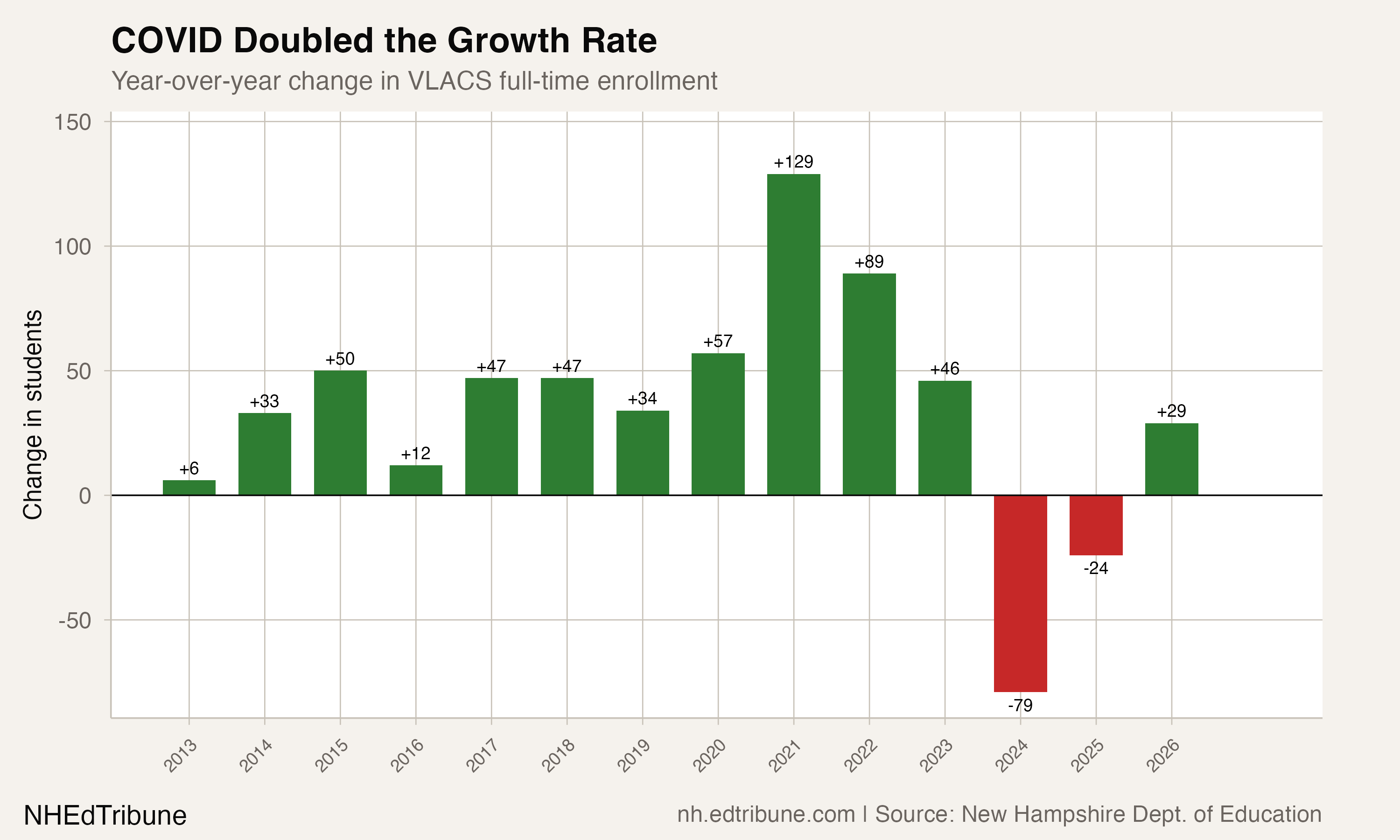
The post-pandemic correction was sharp. VLACS lost 79 students in 2023-24 and another 24 in 2024-25 as families returned to in-person schooling. The 29-student rebound in 2025-26 suggests the school may have stabilized around 530-540 full-time students, between the 2020-21 level of 478 and the 2021-22 level of 567.
The Competency-Based Difference
VLACS operates differently from most virtual schools. Founded in 2007, it operates on a competency-based model where students advance by demonstrating mastery of specific skills, not by accumulating seat time. Students must score 85% or better on each competency to progress.
"When you think about virtual education, it's often more about efficiency... than it is about relationships." — Steve Kossakoski, VLACS founder, The Hechinger Report
That model may explain why VLACS retained enrollment better than many virtual schools nationally after the pandemic. According to The Hechinger Report, approximately 90% of VLACS's full-time students started as part-time students taking individual courses from their local districts. The part-time pipeline, which serves over 10,000 students annually, feeds the full-time program as families discover the model works for their children.
The full-time headcount in state data, 539, represents only a fraction of the school's footprint. VLACS reports over 10,000 students taking at least one course, with more than 20,000 course enrollments across 280 New Hampshire communities in 2024-25.
Elementary Expansion and Retreat
VLACS launched as a high-school-only program and stayed that way for its first four years. Elementary students first appeared in 2015-16 with just 13. The State Board of Education expanded VLACS's authorization to include kindergarten through third grade during the pandemic at the Department of Education's request.
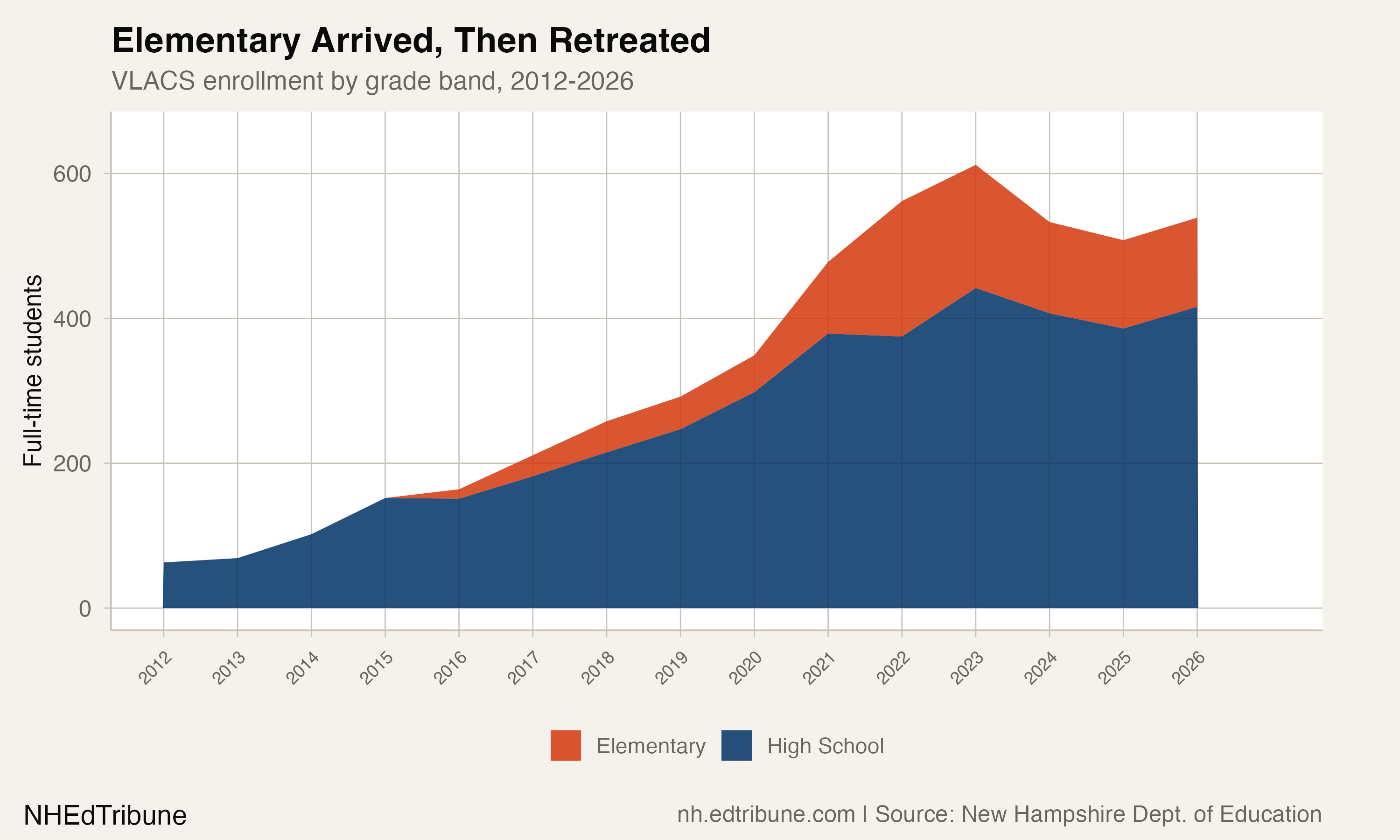
Elementary enrollment peaked at 187 in 2021-22, when pandemic-era parents sought virtual options for younger children. It has since fallen 34.2% to 123, while the high school program recovered to 416. In 2025-26, high school students account for 77.2% of VLACS's enrollment. The elementary drop-off suggests that virtual schooling for younger children was a pandemic expedient, not a lasting preference, for most families.
A Growing Share of a Shrinking Pie
New Hampshire's total enrollment fell from 190,805 in 2011-12 to 160,322 in 2025-26, a 16.0% decline. VLACS grew 755.6% over the same period. Indexed to 2012, the state sits at 84 while VLACS sits at 856.
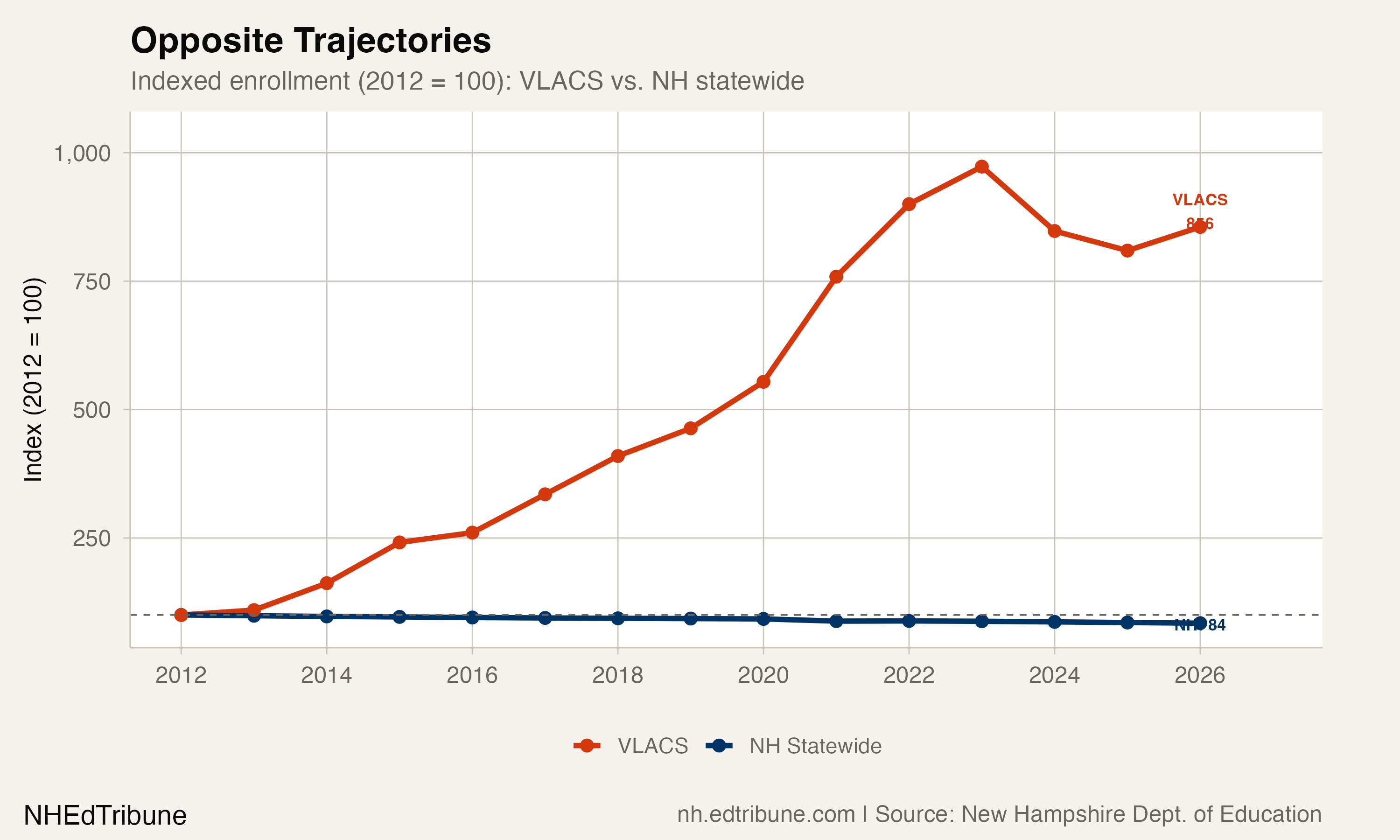
VLACS's share of state enrollment multiplied tenfold, from 0.033% to 0.336%. In high school specifically, the 416 VLACS students represent 0.83% of the state's 50,144 high schoolers. Those are small numbers in absolute terms. But VLACS now enrolls more full-time students than established districts like Hinsdale (508), Pittsfield (442), or Sunapee (453).
The Wider Charter Landscape
Other charter schools are growing too. New Hampshire's charter sector expanded from 10 schools enrolling 1,097 students in 2012 to 35 schools enrolling 6,242 in 2026. Charter share of statewide enrollment rose from 0.57% to 3.89%, nearly a sevenfold increase.
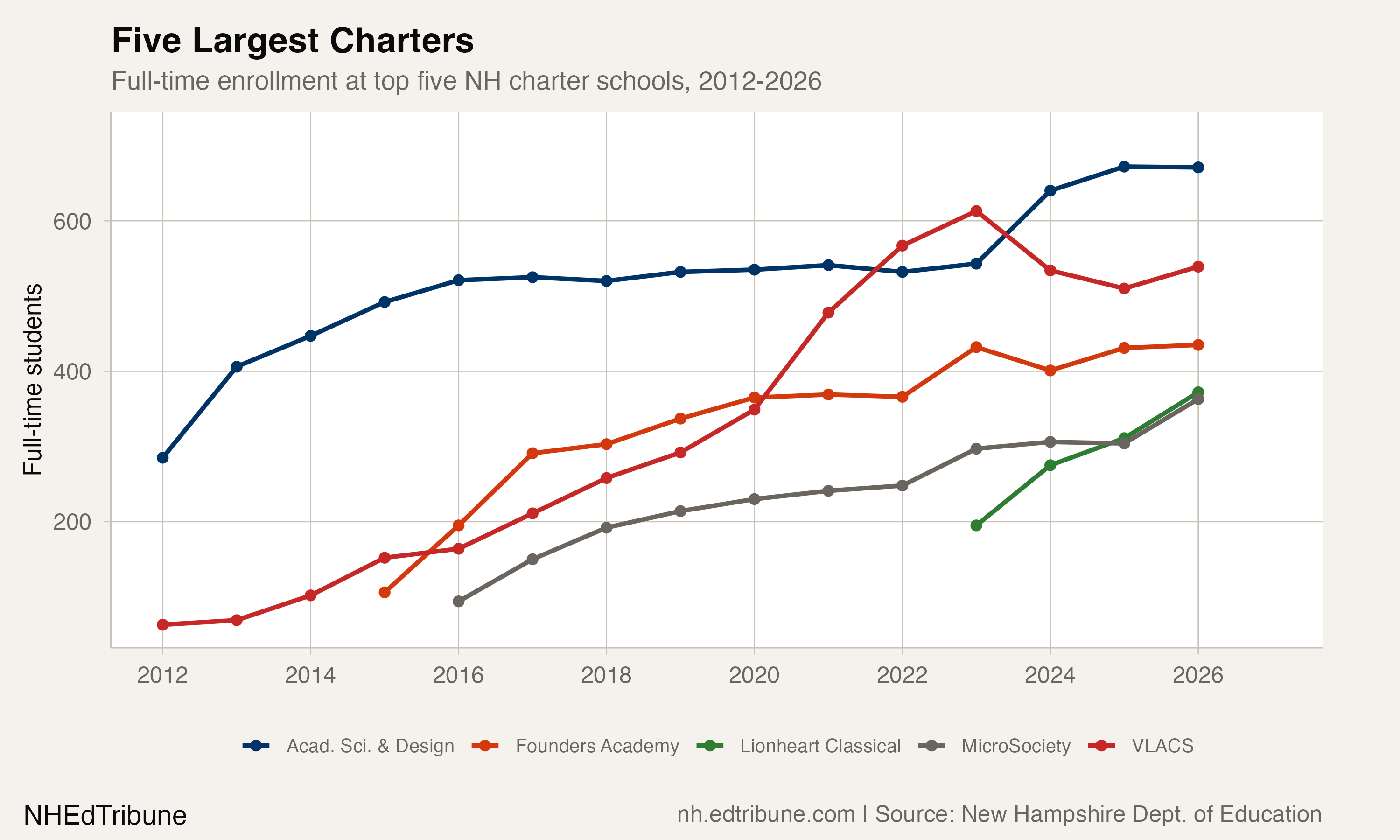
VLACS accounts for 8.6% of the charter sector's enrollment. The Academy for Science and Design, a brick-and-mortar STEM school, is the state's largest charter at 671 students, having grown 135.4% since 2012. The Founders Academy (435 students) and MicroSociety Academy (363) have also grown substantially. New Hampshire has no statutory cap on charter school numbers, though past budget shortfalls have triggered moratoriums on new approvals. Recent legislative sessions have increased charter per-pupil funding with automatic 2% annual escalators.
Charter schools in New Hampshire receive state adequacy aid (approximately $4,182 per pupil in fiscal year 2025) plus an additional charter grant of roughly $4,900. Unlike traditional districts, charters do not receive local property tax revenue. The total per-pupil amount, around $9,100, is below what most traditional districts spend when local funds are included, which may constrain VLACS's ability to scale further.
Beyond the headcount
The 539 full-time students in New Hampshire's enrollment data understate VLACS's influence on the state's education system. The school serves students from 27 states and nine countries, and its 250-plus instructors are distributed across eight states. When NHPR reported on the fall 2021 enrollment surge, VLACS had over 7,300 students of all types, suggesting that for every full-time student counted in state headcounts, roughly 13 more are taking individual courses.
That part-time reach creates a different kind of fiscal question than traditional charter enrollment. A student taking two VLACS courses while enrolled in a local district does not show up in state enrollment figures as a VLACS student. But the courses still carry costs, and the student's local district still receives full per-pupil funding.
Whether 539 full-time students is a plateau or a way station depends on several things: whether competency-based models gain broader acceptance, whether New Hampshire's new universal school choice program reshapes enrollment patterns, and whether the 10,000-student part-time pipeline keeps converting families to full-time virtual schooling.
Detailed code that reproduces the analysis and figures in this article is available exclusively to EdTribune subscribers.
Discussion
Sign in to join the discussion.
Loading comments...