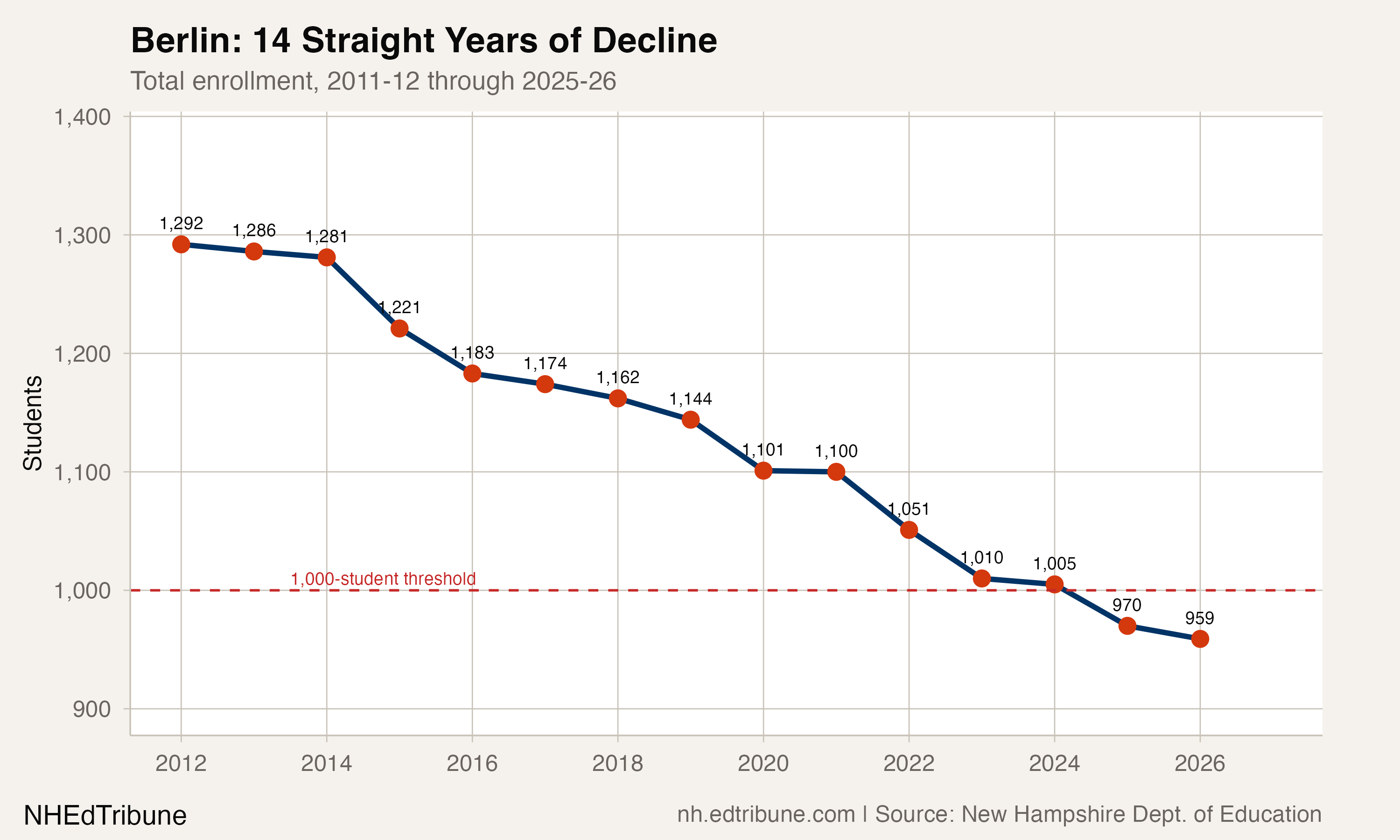
There is no year in the dataset when Berlin↗ET gained students. Not one. From 2011-12 through 2025-26, the former paper mill city in New Hampshire's North Country has posted 14 consecutive years of enrollment decline, losing 333 students over that span. It is the only district in the state with an unbroken streak stretching across every year the data covers.
Berlin now enrolls 959 students. It crossed below 1,000 for the first time in 2024-25 and has kept falling.
The streak no district wants
Fourteen consecutive years of decline places Berlin in a category by itself. The next-longest current streaks in New Hampshire belong to Dover, Exeter Region Cooperative, and Rochester, each at 11 years. Berlin's streak began before any of those, and it has never paused.
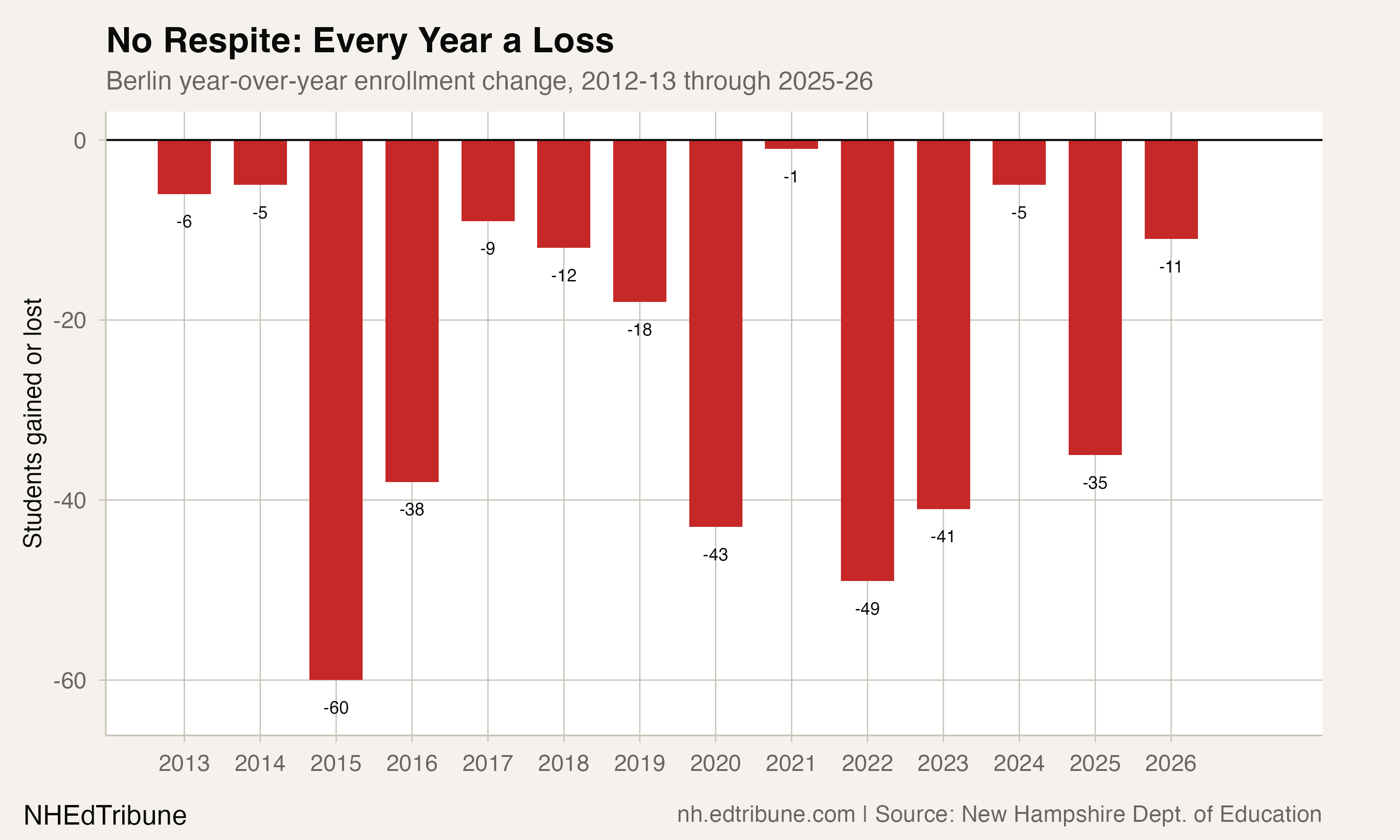
The losses have not been uniform. The worst single year was 2014-15, when enrollment dropped by 60 students, a 4.7% plunge. The mildest year was 2020-21, when Berlin lost exactly one student. That the COVID year barely registered in Berlin's enrollment data says something: the pandemic could not disrupt a trajectory that was already steep.
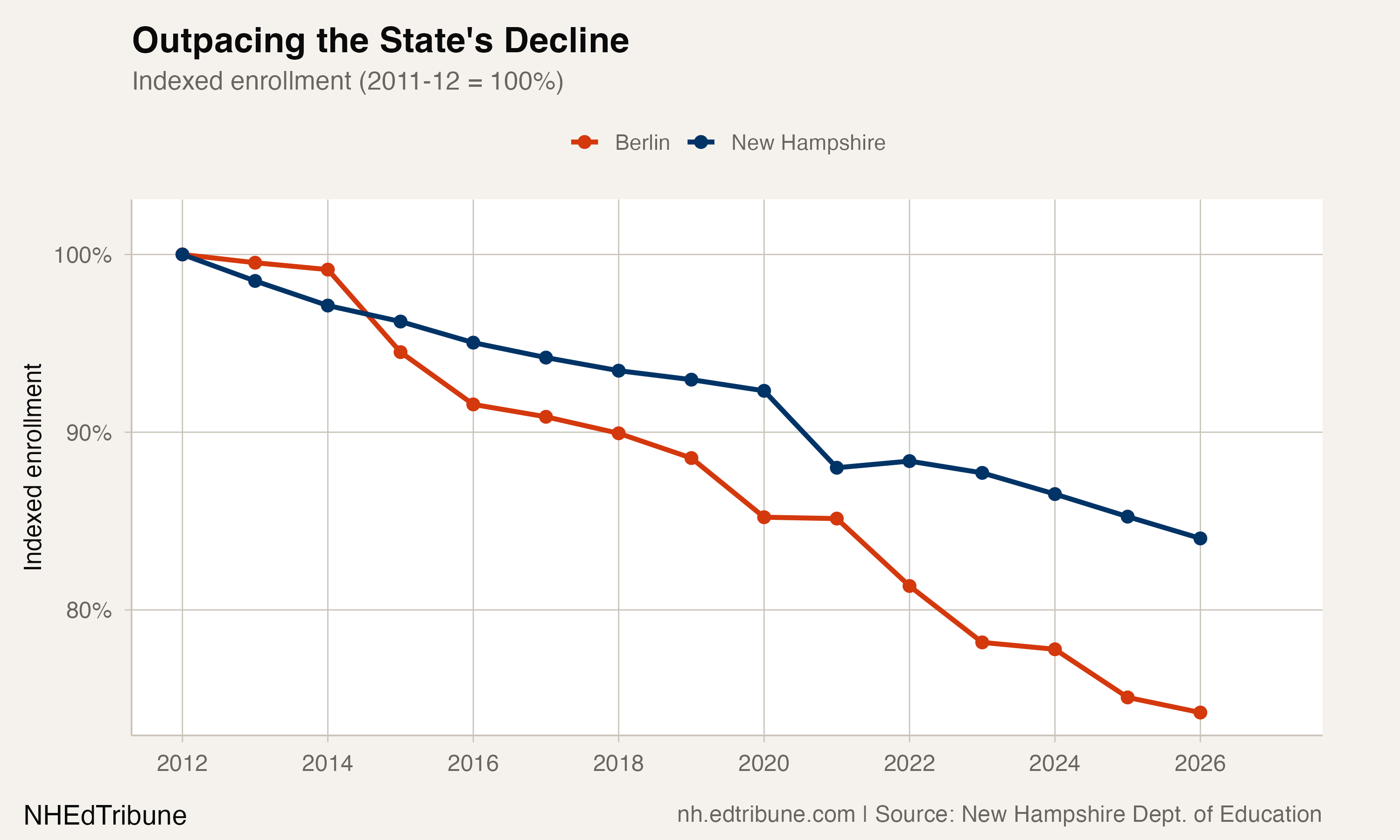
Over three-year windows, the pace has worsened. From 2011-12 to 2014-15, Berlin lost 71 students (5.5%). From 2020-21 to 2023-24, it lost 95 (8.6%). The decline is accelerating.
A mill town after the mills
Berlin's enrollment decline tracks the long unraveling of its economic base. The city's population peaked above 20,000 in the 1930 census, built on the paper and pulp industry that once defined the region. Fraser Papers closed Berlin's pulp mill in 2006, eliminating 250 jobs and shuttering a facility that had operated for more than a century.
The city has attempted to diversify. An iron works company, a biomass power plant, and both a federal and state prison now operate within city limits. But none have replaced the economic gravity of the mills, and Berlin's 2025 population of roughly 9,200 continues to decline at about 0.6% annually.
The enrollment losses are steeper than the population losses. Berlin is losing residents of child-bearing and child-rearing age faster than the overall population, consistent with younger workers leaving for employment elsewhere while retirees stay.
Coos County, which contains Berlin, is the only New Hampshire county where deaths far exceed births. Carsey School research at UNH found that Coos County had the state's largest natural population loss, with migration barely offsetting the gap between deaths and births.
What the budget cannot absorb
Enrollment loss in a small district translates directly into funding loss. New Hampshire's adequacy formula provides a base amount of about $4,100 per student. At that rate, 333 fewer students translates to roughly $1.4 million less in annual base state aid in 2025-26 than Berlin received in 2011-12.
Berlin has already made the cuts available to it. In 2019, the district closed Brown Elementary School, its last stand-alone elementary, consolidating K-2 students into a building that originally served as a high school. That saved an estimated $300,000 per year. More than 20 staff positions have gone unfilled as teachers retired or left.
"The state is essentially handing Berlin a shovel and telling us to dig our own grave." — Mayor Paul Grenier, quoted by NHPR, Aug. 2019
State stabilization grants, which partially compensated property-poor districts for declining enrollment, have been phased down by 4% annually since 2016. Berlin's property tax rate is nearly double the state average, and most of the city's property is nontaxable, consisting of national forest, state and federal prisons, and government land, limiting the local revenue base.
The New Hampshire Supreme Court ruled in 2025 that the state's adequacy formula is unconstitutionally low, finding that the base per-pupil amount should be no less than $7,356. Whether and when the legislature acts on that ruling will matter enormously to districts like Berlin.
Not just Berlin
Every North Country district has lost students since 2011-12. Every one. Colebrook is down 33.2%, Lisbon Regional 30.8%, White Mountains Regional 29.7%. Berlin's 25.8% loss actually ranks fourth among its regional peers. The difference is that Berlin has not had a single year of relief.
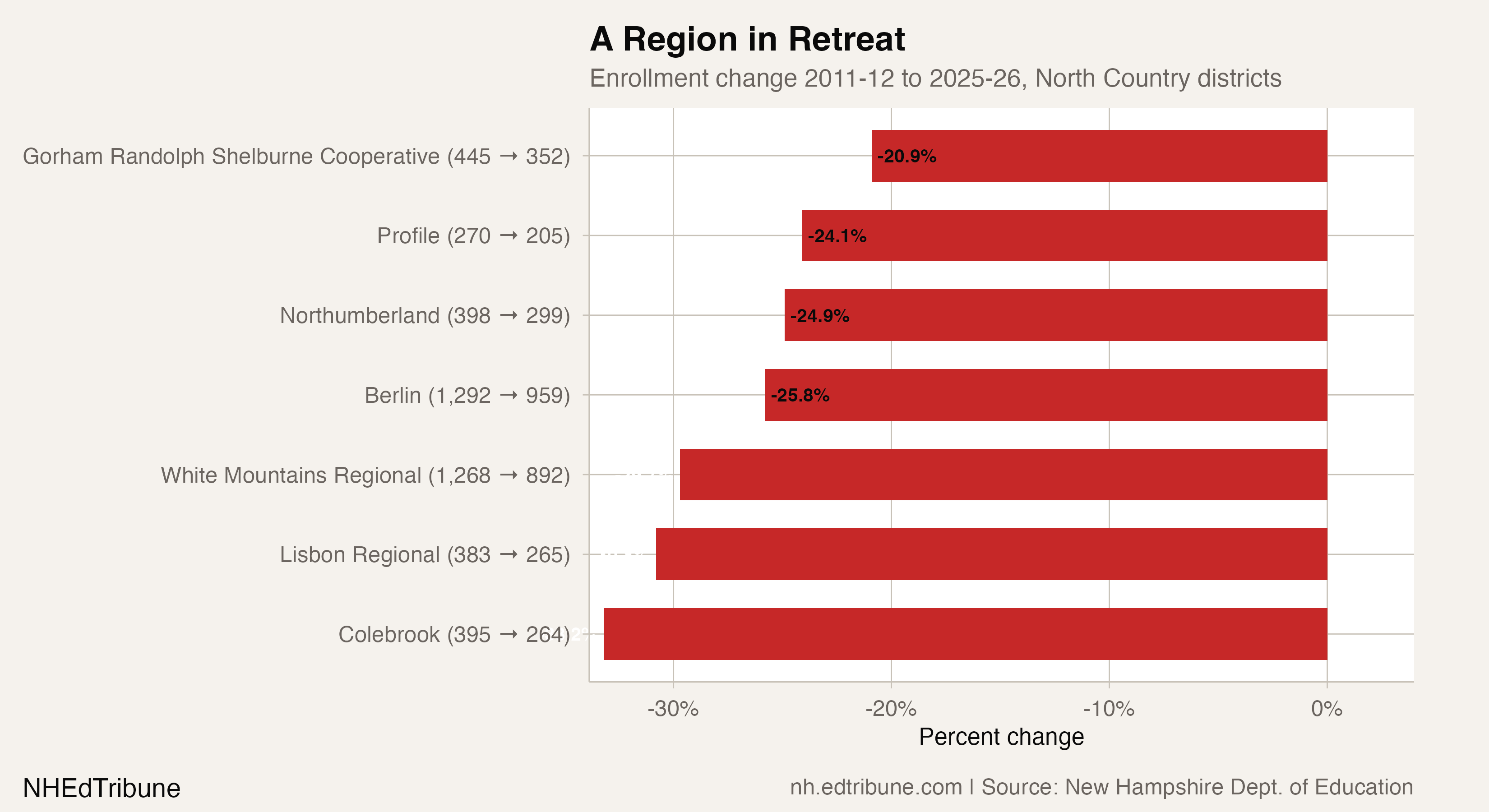
Statewide, New Hampshire enrollment fell 16.0% over the same period. Berlin's decline runs 1.6 times the state pace, and even the mildest North Country loss (Gorham Randolph Shelburne Cooperative, down 20.9%) exceeds the statewide figure.
Where the pipeline narrows
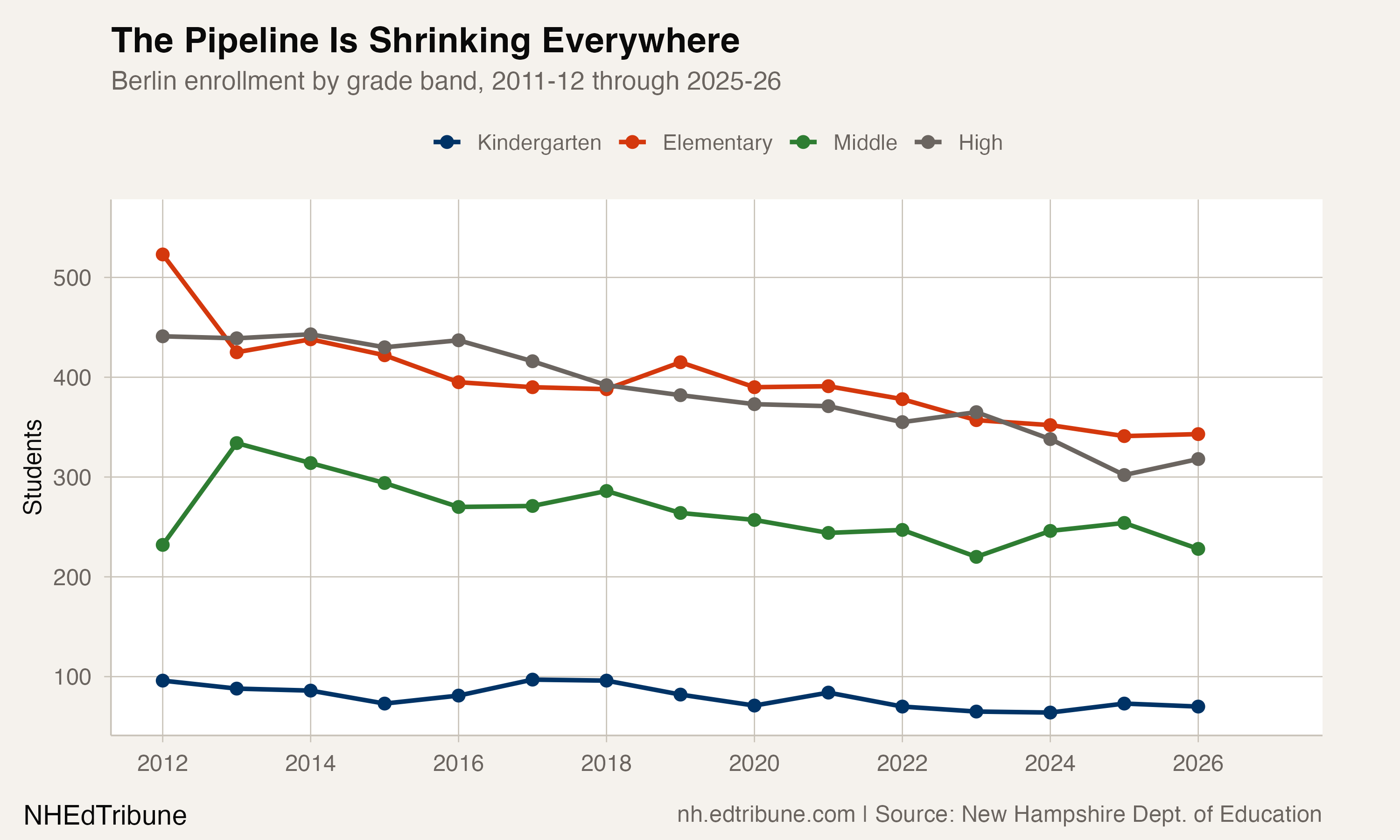
Berlin's elementary enrollment has fallen 34.4%, from 523 to 343 students, the steepest drop of any grade band. High school enrollment is down 27.9%, from 441 to 318. Kindergarten, which feeds the entire pipeline, has averaged just 68 students per year over the last five years, down from 96 in 2011-12, a 27.1% decline.
Middle school enrollment has held comparatively steady, down only 1.7% (232 to 228), likely reflecting cohort-size fluctuations rather than a structural difference. The overall pattern points to smaller incoming cohorts working their way through the system.
Berlin's decline has been steeper than the state's at every point in the dataset. Indexed to 2011-12 levels, Berlin is at 74.2% of its starting enrollment while New Hampshire overall sits at 84.0%.
What 959 students means for a district
A district with 959 students operates at a different scale than one with 1,292. Fixed costs do not decline proportionally: the district still needs a superintendent, a business administrator, maintenance staff, building infrastructure. The overhead spreads across fewer students each year.
Berlin closed Brown Elementary in 2019, consolidating K-2 into a repurposed former high school. More than 20 staff positions have gone unfilled as teachers retired. The state's adequacy formula sends roughly $4,100 per student; 333 fewer students translates to about $1.4 million less in annual aid. The mayor called it being handed a shovel and told to dig. Coos County's deaths have outpaced births for years, and in-migration barely registers. The mills are gone. The children followed.
Detailed code that reproduces the analysis and figures in this article is available exclusively to EdTribune subscribers.
Discussion
Sign in to join the discussion.
Loading comments...