Correction: An earlier version overstated the share of New Hampshire enrollment in districts with fewer than 500 students. The corrected analysis finds 13.5%.
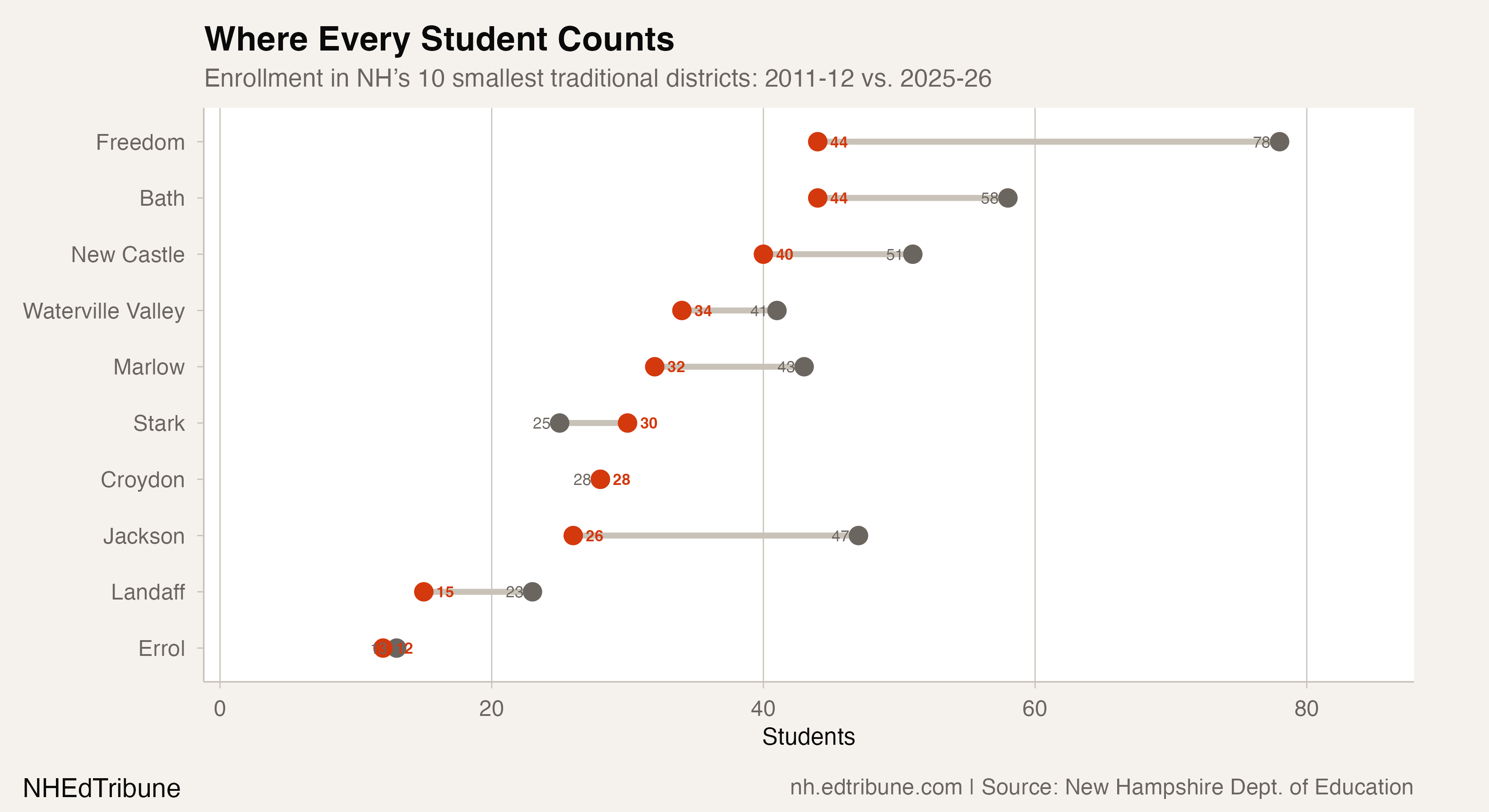
Errol↗ET has 12 students. Landaff↗ET has 15. Jackson↗ET has 26. Each is a legally independent school district in New Hampshire, with its own school board, its own budget, its own vote at town meeting. Each educates fewer children than a single kindergarten classroom in Manchester↗ET.
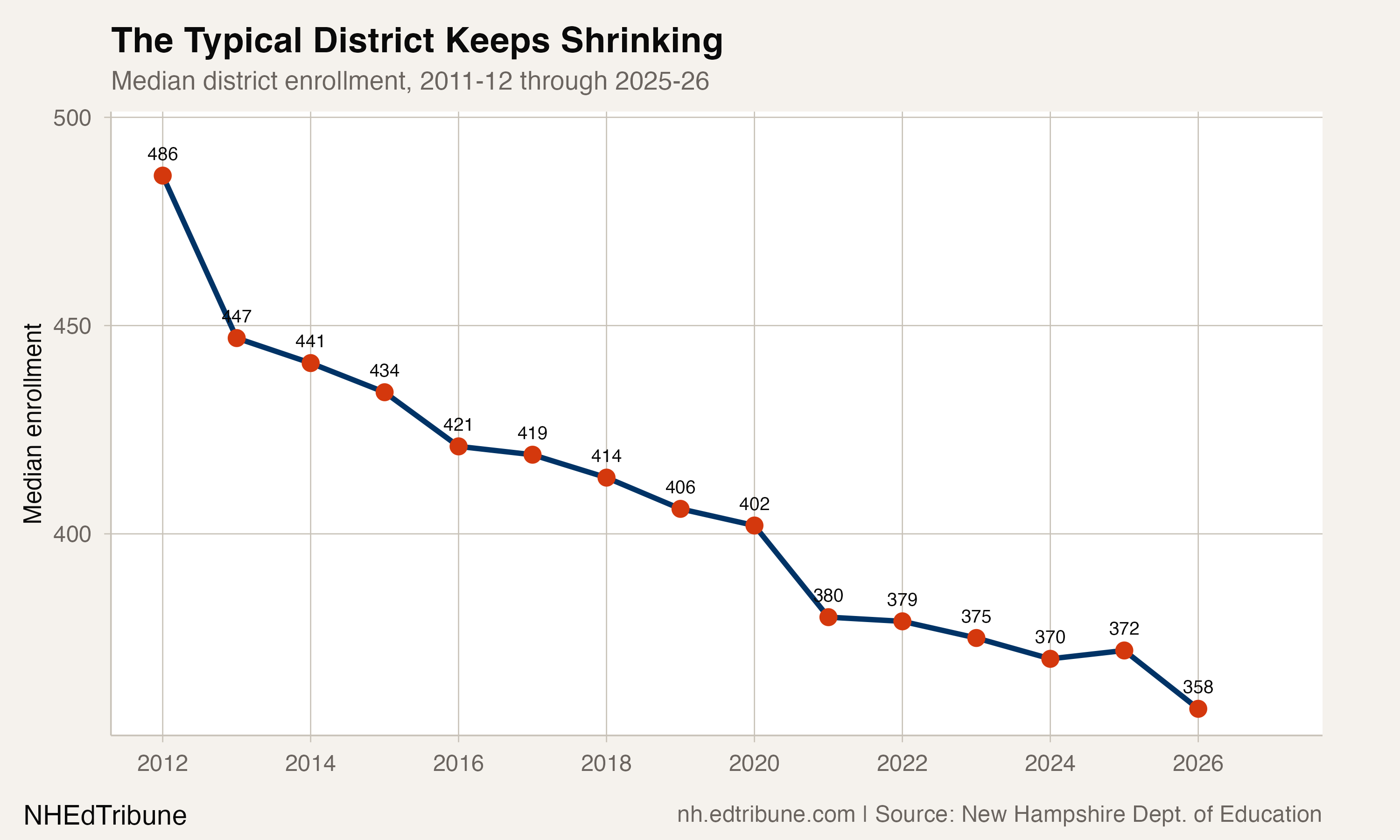
They are not anomalies. New Hampshire has 44 districts with fewer than 100 students in 2025-26, more than one in five of its 203 total districts. Together these 44 districts enroll 2,440 students, 1.5% of the state's public school population. The median New Hampshire district has just 358 students, down 26.3% from 486 in 2011-12.
The state is simultaneously getting smaller and more fragmented. Total enrollment has fallen 16.0% since 2011-12, from 190,805 to 160,322. But the number of districts has grown from 176 to 203 over the same period, driven almost entirely by new charter school authorizations. The result is a governance structure where most districts are small but most students attend a handful of large ones.
203 districts, two realities
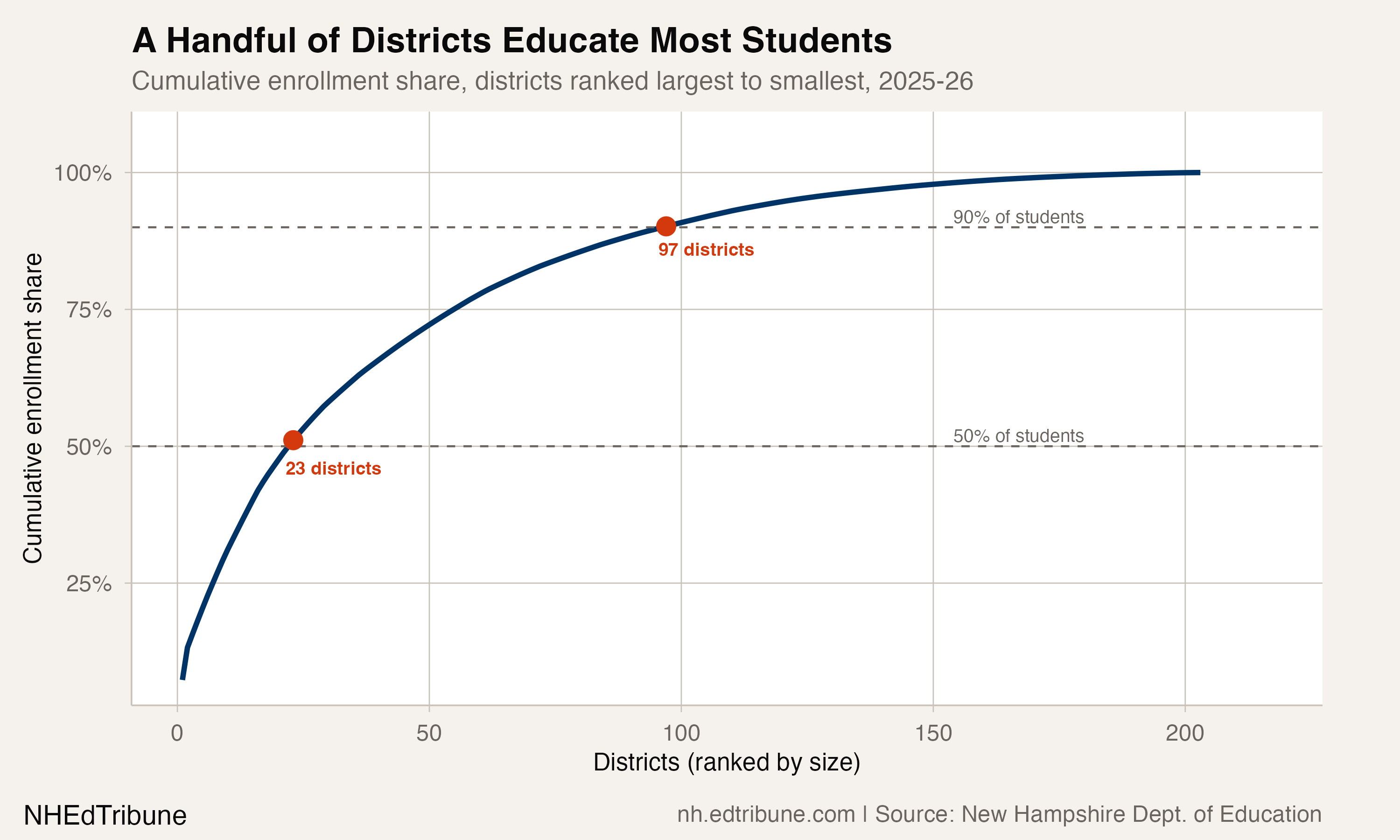
The mismatch is large. Just 23 districts, the 11.3% largest, educate half of New Hampshire's public school students. It takes 97 districts to reach 90%. The remaining 106 districts, more than half the total, share the last 10%.
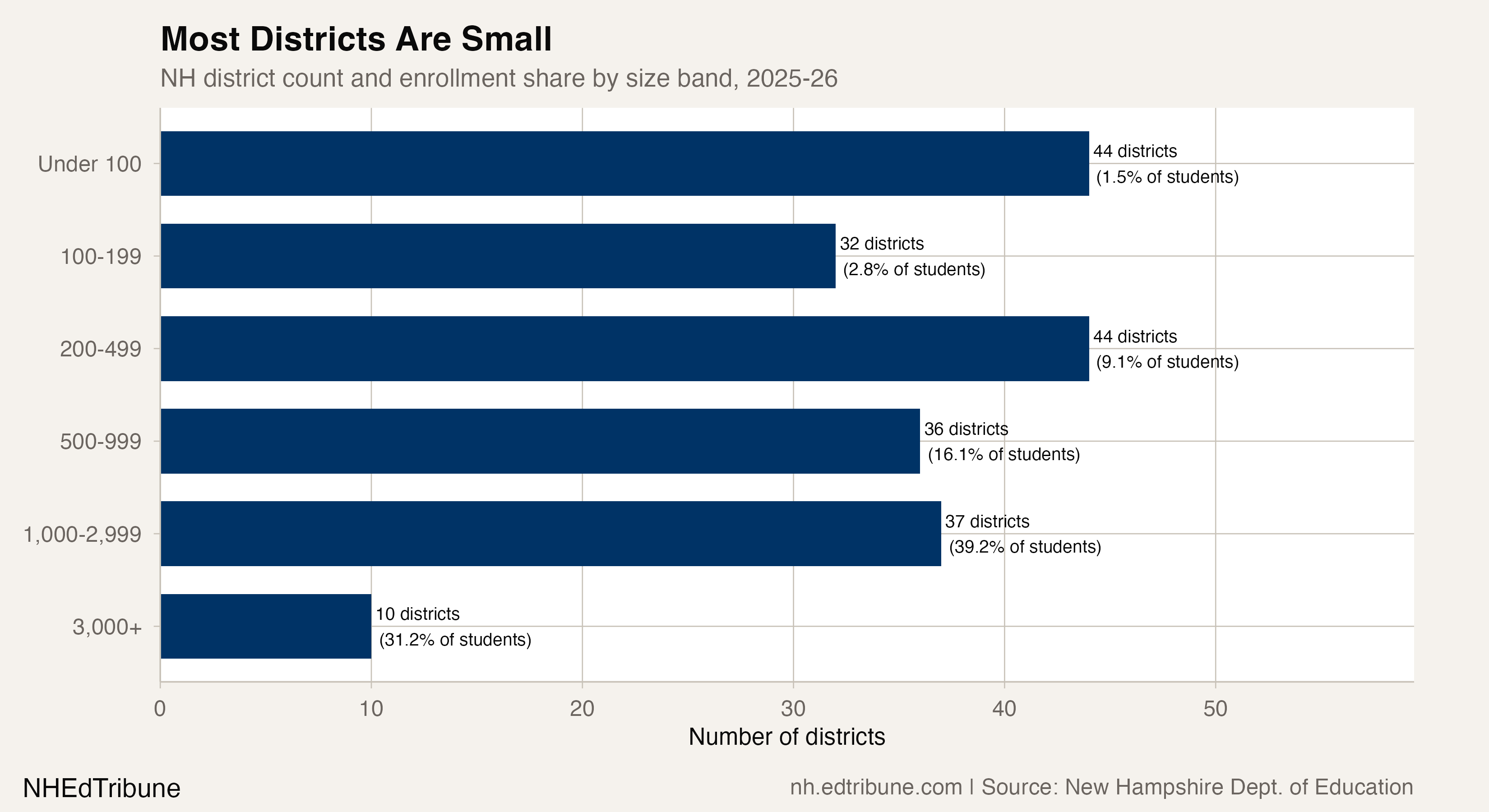
At the top, 10 districts with 3,000 or more students serve 31.2% of all enrollment. At the bottom, 120 districts with fewer than 500 students, 59.1% of all districts, serve 13.5%. The gap between the median district (358 students) and the mean (790) captures the skew: a small number of large districts pull the average far above the typical experience.
The concentration has deepened over the available panel. In 2011-12, the median district enrolled 486 students. By 2025-26, that figure had fallen to 358, even with a small uptick in the middle of the series. The shift has pushed the typical district closer to the scale where staffing and programming constraints become acute.
Elementary schools with their own school boards
Of the 28 traditional (non-charter) towns with under 100 students, 25 operate elementary schools only. They serve students through roughly sixth grade, then tuition their older students to regional cooperatives or neighboring districts for middle and high school. Only Pittsburg↗ET (75 students, with a high school) and Rivendell (65, an interstate cooperative with Vermont) break this pattern among the smallest.
That is New Hampshire's governance model in miniature. Errol maintains its own K-6 school and school board for its 12 students, then pays tuition for its handful of teenagers to attend school elsewhere. The Town Tuitioning Program redirects per-student costs to the receiving school, with amounts calculated separately by grade band.
Many of these micro-districts cluster under shared School Administrative Units. The Plymouth SAU bundles eight districts, three of them under 100 students (Waterville Valley at 34, Rumney↗ET at 83, Wentworth at 83). The Keene SAU manages seven districts, three under 100 (Marlow at 32, Harrisville at 45, Nelson at 58). The shared superintendent and back-office functions absorb some of the overhead that would otherwise be untenable for a 32-student district.
A growing count, but the growth is charters
The number of districts with under 100 students has risen from 30 in 2011-12 to 44 in 2025-26. But the composition has shifted. Traditional towns under 100 have remained relatively stable, rising from 24 to 28 over 15 years. The growth has come from charter schools: 16 of the 44 under-100 districts are charter-named, compared to six in 2012. New Hampshire's charter sector has grown from 10 to 35 districts statewide, and many start small.
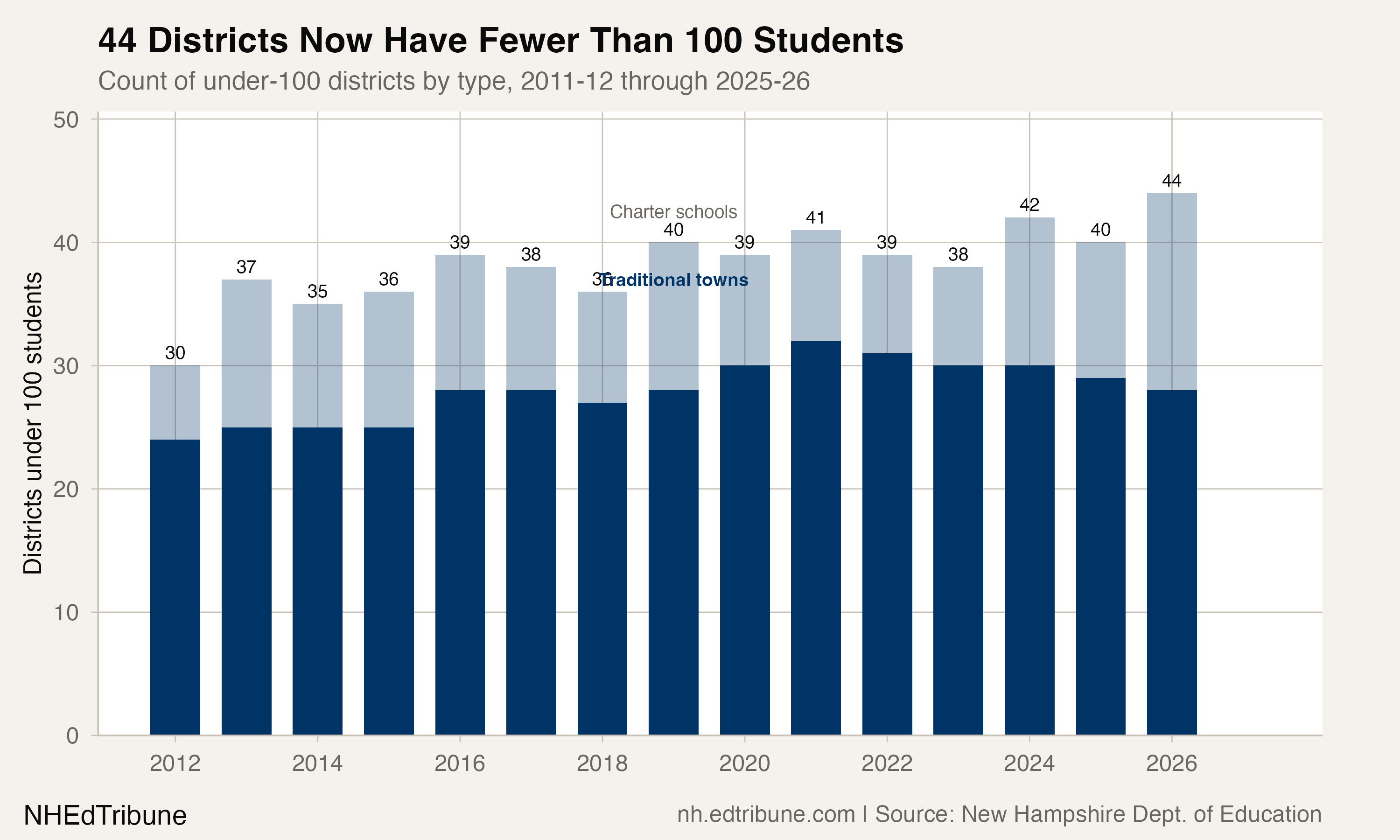
Three traditional districts crossed below 100 students since 2011-12. Lafayette Regional↗ET fell from 114 to 97. Pittsburg↗ET dropped from 108 to 75. Rumney↗ET declined from 122 to 83. At these enrollment levels, the loss of a single family can shift a grade from four students to two.
Why consolidation keeps failing
New Hampshire's fragmented structure is not an oversight. Towns want their own schools, their own budgets, their own votes. The state's political culture and legal framework reinforce that preference.
Since 1996, when the state board lost its veto authority over district withdrawals, towns have increasingly opted to leave multi-district cooperatives. NHPR reported that Windham's withdrawal from its partnership with Pelham forced Pelham to hire duplicate administrators. Cornish↗ET left SAU 6 partly over administrative cost disputes.
"We are fiercely proud of local community governance. People are proud of their schools and if they can afford their own arrangement they're looking at that." — Ted Comstock, NH School Boards Association, NHPR
The result: even as enrollment declines, the number of administrative units has grown. A Republican-backed proposal in the Legislature would consolidate SAUs into county-based units by 2029-30, preserving local school boards for academic decisions while combining business functions like transportation, payroll, and human resources. School officials have pushed back.
"I think that sometimes when we break apart, and we go smaller and smaller and smaller, there are fewer opportunities for students to have that equitable access to a superb education because the resources become more limited." — Carl Ladd, NH School Administrators Association, NHPR
Whether consolidation would actually save money is uncertain. A 2024 Yale thesis analyzing Vermont's post-2015 mergers found that merged districts did not significantly reduce per-pupil spending compared with districts that did not merge. Administrative savings were offset by higher staff salaries and transportation expenses.
The demographic floor
This is not just a public school problem. As the education policy organization Reaching Higher NH noted, first-grade enrollment declined across all education sectors since 2022, tracking documented reductions in state birth rates. New Hampshire's population of children under 18 declined faster than any other state between 2010 and 2020. State Senator Tim Lang has projected continued enrollment declines for at least the next decade.
For Nashua↗ET or Manchester, even a modest annual decline can mean losing enough students to close a wing or reduce a few teaching positions. For Errol, a comparable percentage change is a fraction of a child. The math does not scale. A district of 12 loses or gains students in increments that can double or halve a grade level in a single year.
Nobody has answered where the floor is. New Hampshire has 27 more districts than it did in 2011-12 even as it educates 30,483 fewer students. The Supreme Court ruled in July 2025 that the state's school-funding formula is unconstitutionally low, leaving the Legislature to decide how to respond to a lower-court threshold.
Errol's 12 students have their own school board. Landaff's 15 have theirs. The funding debate reaches those towns as directly as it reaches Nashua and Manchester. Somewhere between a 12-student district in the North Country and a county-based consolidation plan, New Hampshire needs to decide what it can afford to keep.
Detailed code that reproduces the analysis and figures in this article is available exclusively to EdTribune subscribers.
Discussion
Sign in to join the discussion.
Loading comments...