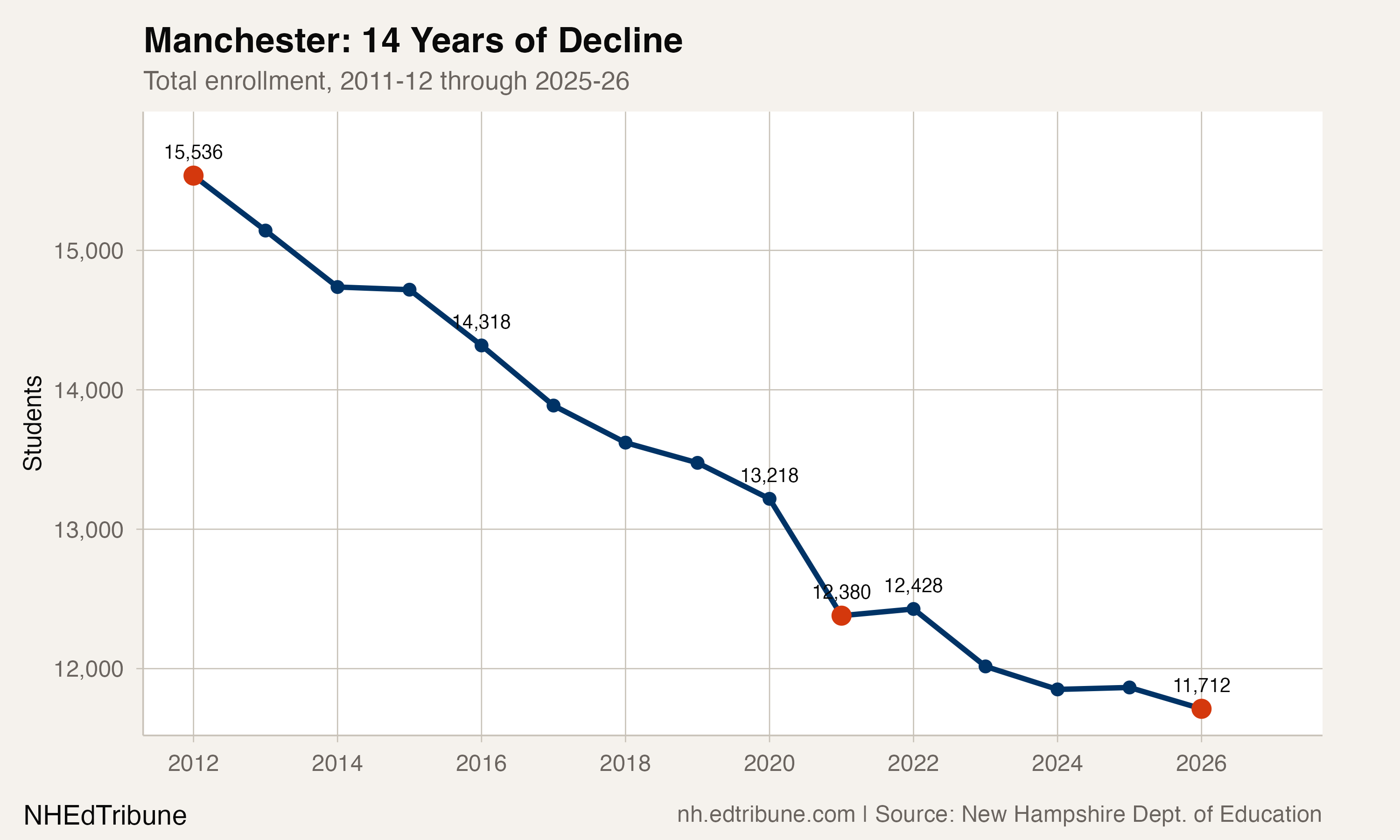
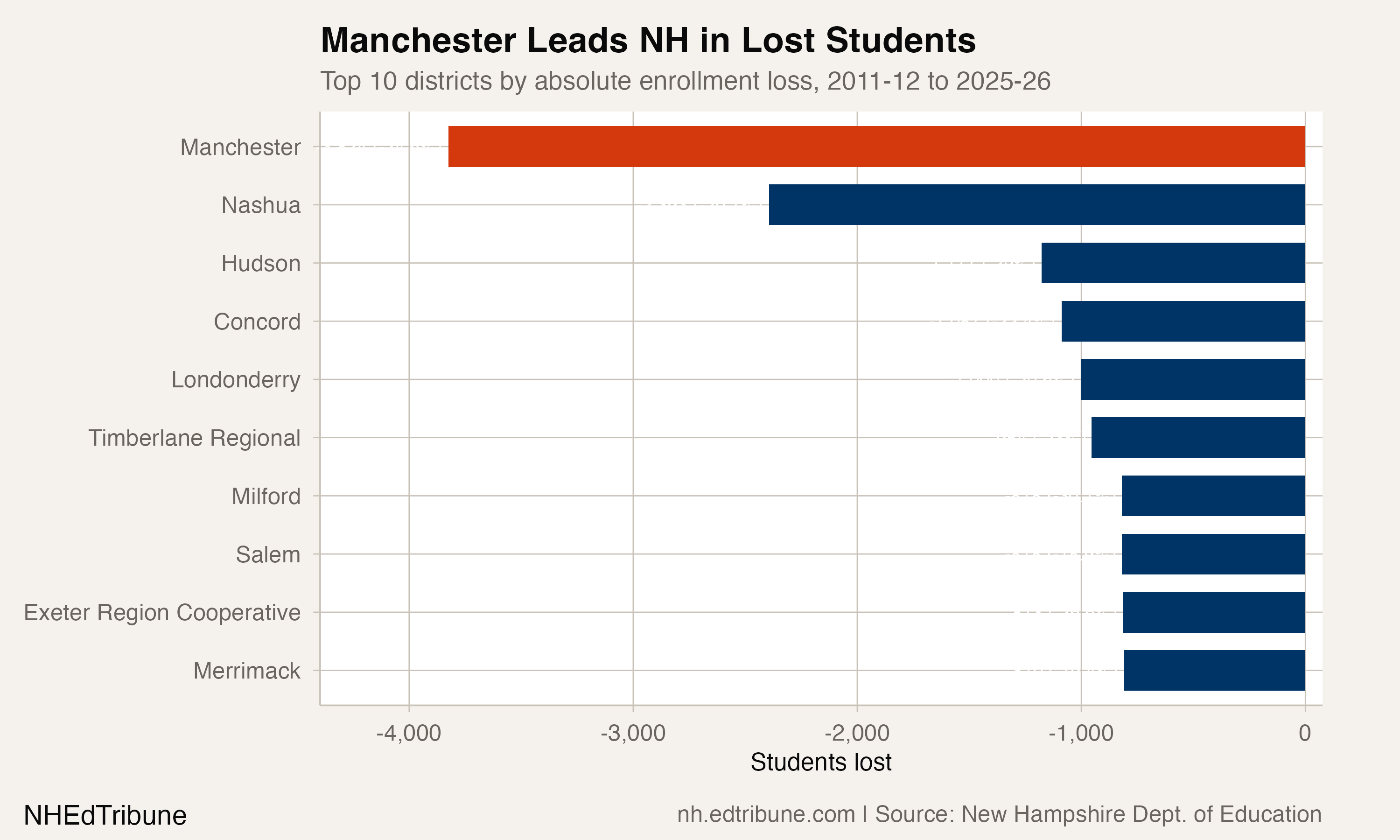
In 2011-12, Manchester↗ET enrolled 15,536 students. In fall 2025, 11,712 showed up. The district has lost 3,824 students, a 24.6% decline, in a state where every district but one with more than 2,000 students has also shrunk. Manchester's loss stands out for its scale: the district accounts for 12.5% of New Hampshire's total enrollment loss since 2012 while serving just 7.3% of students statewide.
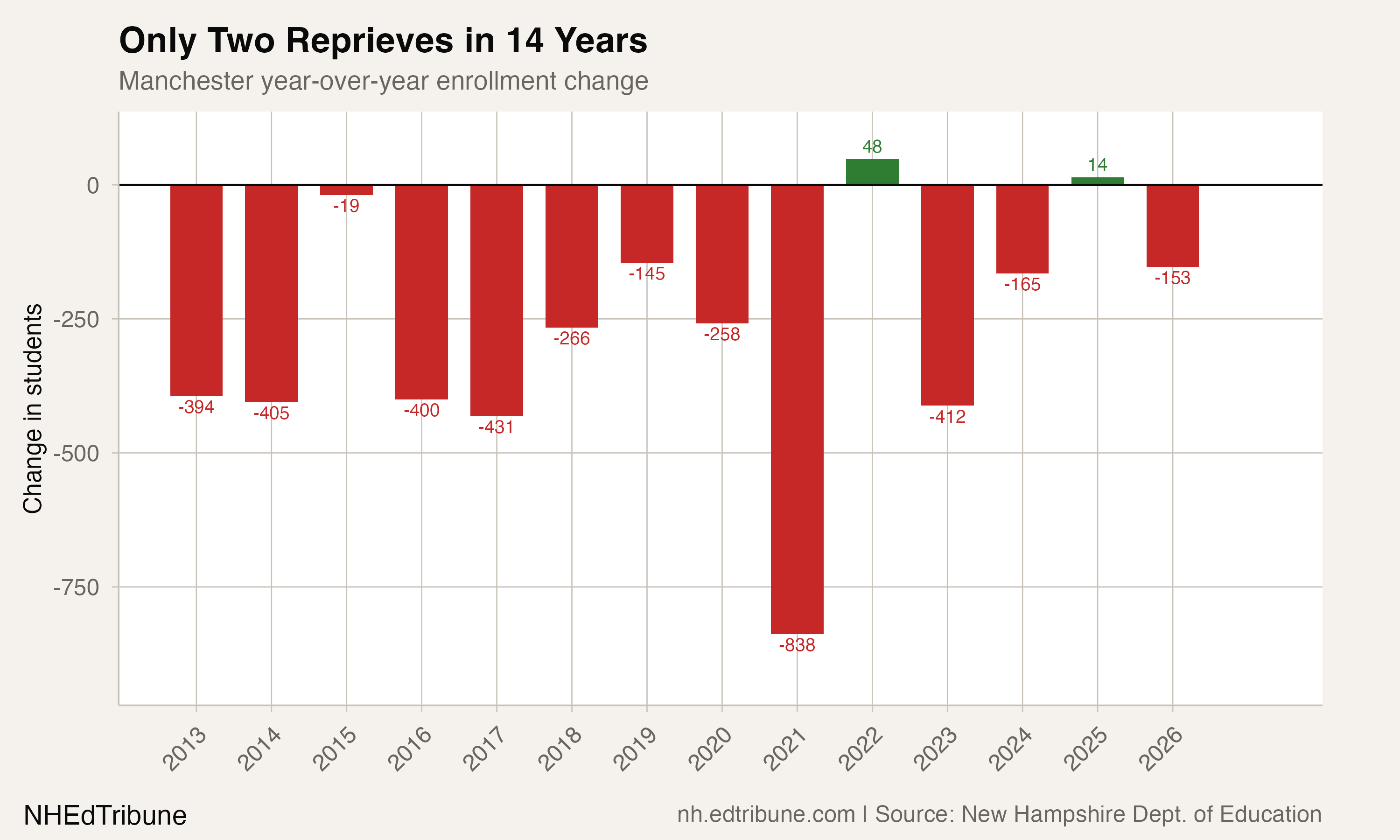
The loss has been relentless. Manchester has declined in 12 of 14 years. The two exceptions, 2021-22 (+48) and 2024-25 (+14), barely register as rounding errors against a 14-year cumulative loss that has redrawn the district's physical footprint, shuttered buildings, and pushed per-pupil spending from $11,894 to $20,323 in the current fiscal year.
The trajectory, year by year
Manchester's decline predates COVID by nearly a decade. From 2011-12 through 2019-20, the district lost an average of 290 students per year, a steady bleed that took enrollment from 15,536 to 13,218 before the pandemic hit. In 2020-21, 838 students disappeared, a 6.3% one-year decline compared to 4.7% statewide.
The post-COVID period brought no recovery. After a brief uptick of 48 students in 2021-22, Manchester lost another 716 students over the next four years. The post-COVID pace (averaging 179 lost per year since 2021-22) is slower than the pre-COVID pace (290 per year), but only because the base has shrunk so much. In percentage terms, the rate of decline has held steady at roughly 1% to 3% annually.
Where the students disappeared
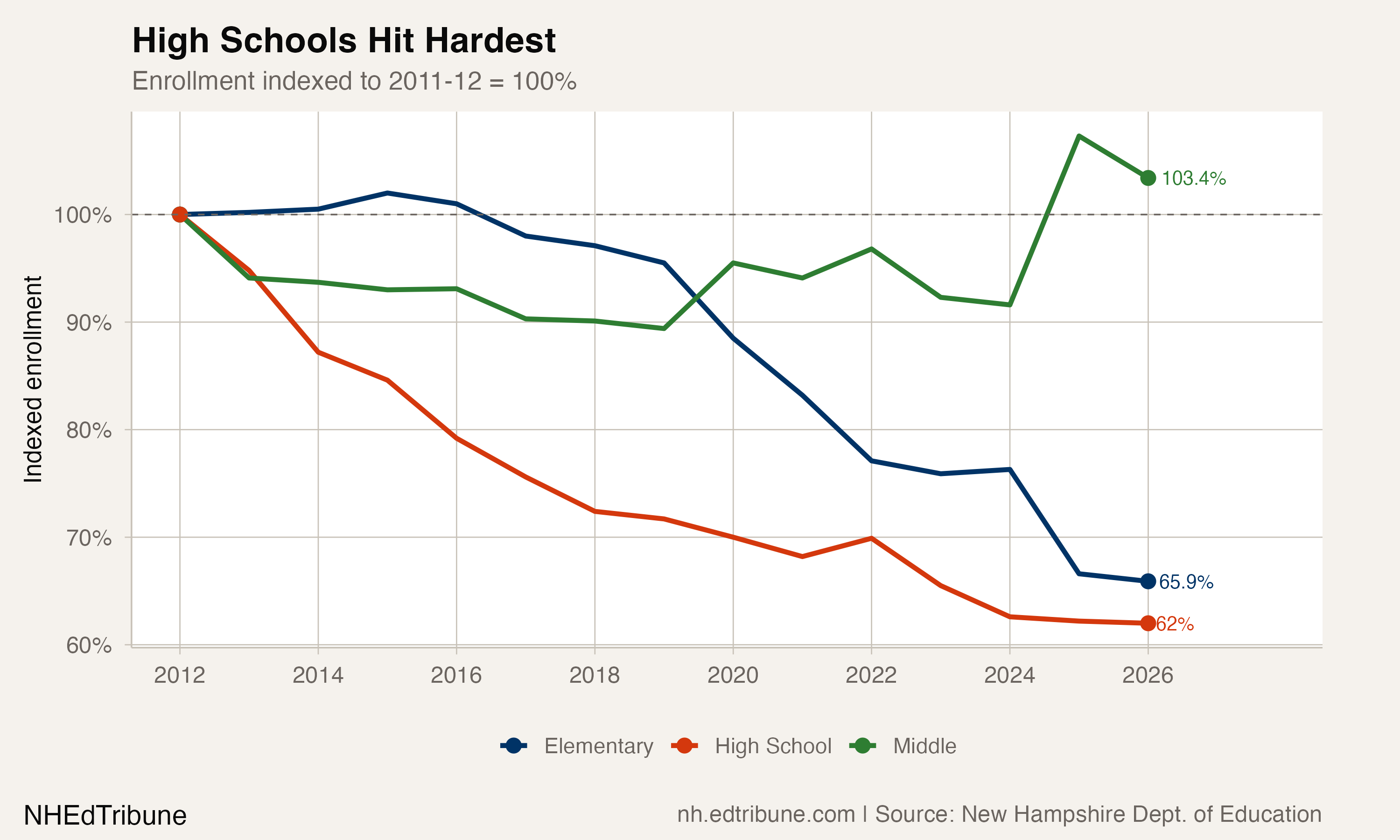
The losses landed unevenly. Manchester's high schools have been gutted: the HIGH grade band fell from 5,543 to 3,435 students, a 38.0% decline. Elementary grades dropped 34.1%, from 5,459 to 3,598. Middle school, by contrast, actually grew 3.4%, from 3,266 to 3,376, a pattern consistent with smaller elementary cohorts not yet having fully cycled through to the upper grades.
Among individual buildings, Manchester Central High School absorbed the largest single-school loss in the district. Central enrolled 2,235 students in 2011-12. In fall 2025 it enrolled 1,057, a 52.7% decline that has left the school operating at roughly half the capacity of a building designed for nearly 2,000. West High dropped 42.0% (1,296 to 752), and Memorial fell 33.6% (2,012 to 1,335).
Two elementary schools no longer appear in the enrollment data. Hallsville School, one of Manchester's oldest buildings, closed in 2021 amid budget shortfalls and infrastructure needs that would have cost millions to address. Henry Wilson Elementary followed, with its students split between Beech Street and McDonough Elementary while a new Beech Street building is constructed. One new school, Manchester School of Technology, opened during the period, enrolling 291 students in 2025-26 as a career and technical high school.
The spending paradox
School districts do not shed costs the way they shed students. A building that goes from 600 students to 400 still needs a principal, a custodial staff, heat, and a roof. Fixed costs spread across fewer students means per-pupil spending rises even when total budgets are held flat, and Manchester's total budget has not been held flat.
The city's school appropriation grew from $165.2 million in fiscal year 2017 to $238.0 million in fiscal year 2026, a 44.1% increase over a period when enrollment dropped 15.7%. Per-pupil spending rose 71%, from $11,894 to $20,323, not including federal Title funds that add another $2,135 per student.
The fiscal pressure is structural. Enrollment falls, but staffing ratios, contractual obligations, and building maintenance do not shrink in proportion. AFT-NH President Deb Howes captured the mismatch in a statewide context:
"Enrollment hasn't gone down in neat classroom units ... you can't reduce costs evenly." — Monadnock Ledger-Transcript, Dec. 2025
A facilities audit by MGT Consulting Group recommended closing Central High and four elementary schools, estimating $47.3 million in avoided deferred maintenance and $600,000 annually in utility savings. The school board opted against closures or mergers in January 2026, citing the costs of moving students and the lack of long-term savings once transportation and construction expenses were factored in. The district's 20 buildings average 70 years old.
A statewide pattern, amplified
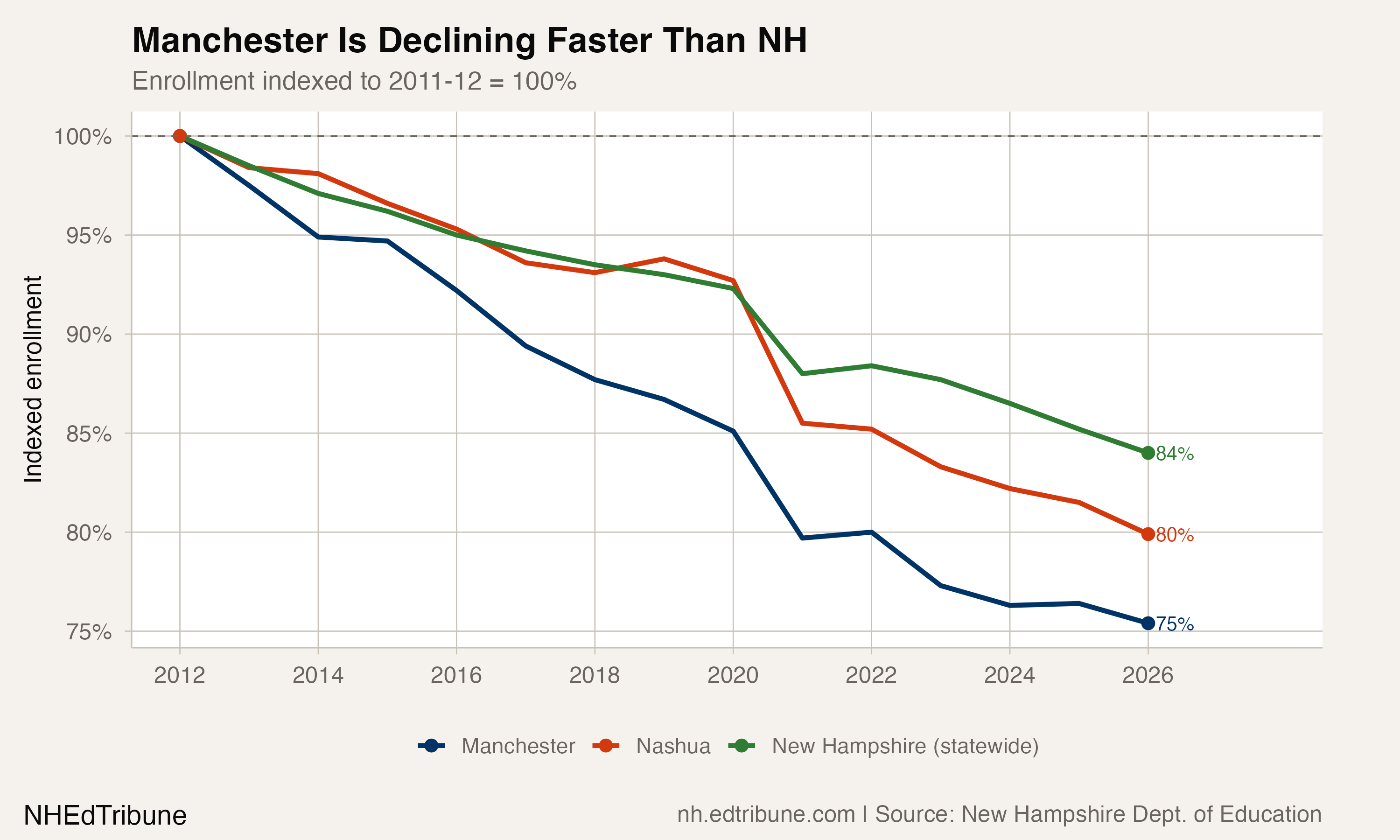
Manchester's direction is not unusual. Of the 24 New Hampshire districts that enrolled at least 2,000 students in 2011-12, all but one (Windham, +7.6%) were smaller in 2025-26. Nashua, the state's second-largest district, lost 2,393 students (-20.1%). Hudson lost 29.0%, Milford 30.1%. The entire state is down 30,483 students, a 16.0% decline.
The concentration is another matter. Its 3,824-student loss is 60% larger than Nashua's and more than triple the loss of any other district. The gap between the two largest districts has narrowed from 3,642 in 2012 to 2,211 in 2026, as Manchester has declined faster.
Birth rates provide one structural explanation. New Hampshire's annual births dropped from roughly 14,000 in the early 2000s to about 11,000-12,000 in recent years, and state officials project enrollment will continue falling about 1% per year for the next decade.
School choice is another factor, though its direct impact on public school enrollment is smaller than it might appear. New Hampshire's Education Freedom Account program doubled to 10,000 students in 2025-26, at a projected cost of roughly $50 million. Manchester has the largest number of EFA recipients in the state. But according to Reaching Higher NH, only 493 students statewide (about 0.3% of public school enrollment) actually switched from public schools to the voucher program in 2024-25. The rest were already in private or home school settings. The charter sector, meanwhile, grew from 5,001 students in 13 schools statewide in 2012 to 9,963 in 38 schools in 2026, nearly doubling, though not all of that growth came from Manchester families.
Half-empty high schools
The most visible consequence of Manchester's decline is its high school infrastructure. Phase II of the district's Long-Term Facilities Plan, presented in December 2024, estimated that renovating or replacing the existing high school buildings would cost between $911 million and $1.3 billion. Central High, designed for nearly 2,000 students, enrolled 1,057 in fall 2025. West, built for 1,636, enrolled 752. These are not buildings experiencing a temporary dip. Central has lost students in 12 of 14 years.
The board's December 2024 decision to maintain the status quo left the district in a holding pattern: buildings too old and too large for the student body they serve, but too expensive to replace or consolidate. Manchester will eventually reconfigure its high school footprint. The open question is timing, and how much smaller the 2025-26 elementary cohorts will shrink the headcount further by the time they reach ninth grade.
The arithmetic is already closing in. Central High was designed for nearly 2,000 students. It enrolled 1,057 in fall 2025, and the elementary cohorts that will fill its hallways in six years are smaller still. The consultant recommended closing it. The board said no. The buildings will keep aging, the student body will keep shrinking, and at some point the 20 buildings averaging 70 years old will make the decision for them.
Detailed code that reproduces the analysis and figures in this article is available exclusively to EdTribune subscribers.
Discussion
Sign in to join the discussion.
Loading comments...