For 14 years, Nashua↗ET was a five-digit school district. The state's second-largest, with nearly 12,000 students in 2012, it was the kind of system that could absorb a bad year and still fill its buildings. That ended in 2023, when October headcounts came in at 9,913. The district has not climbed back above 10,000 since. In 2025-26, Nashua enrolled 9,501 students, down 20.1% from its 2012 count of 11,894.
The round number matters less than what it signals about scale. A district of 12,000 can spread fixed costs across enough students to keep per-pupil spending manageable. A district of 9,500 cannot do the same math. Every bus route, every building's heating bill, every administrative position now serves fewer students than it did a decade ago.
A decline that predates COVID
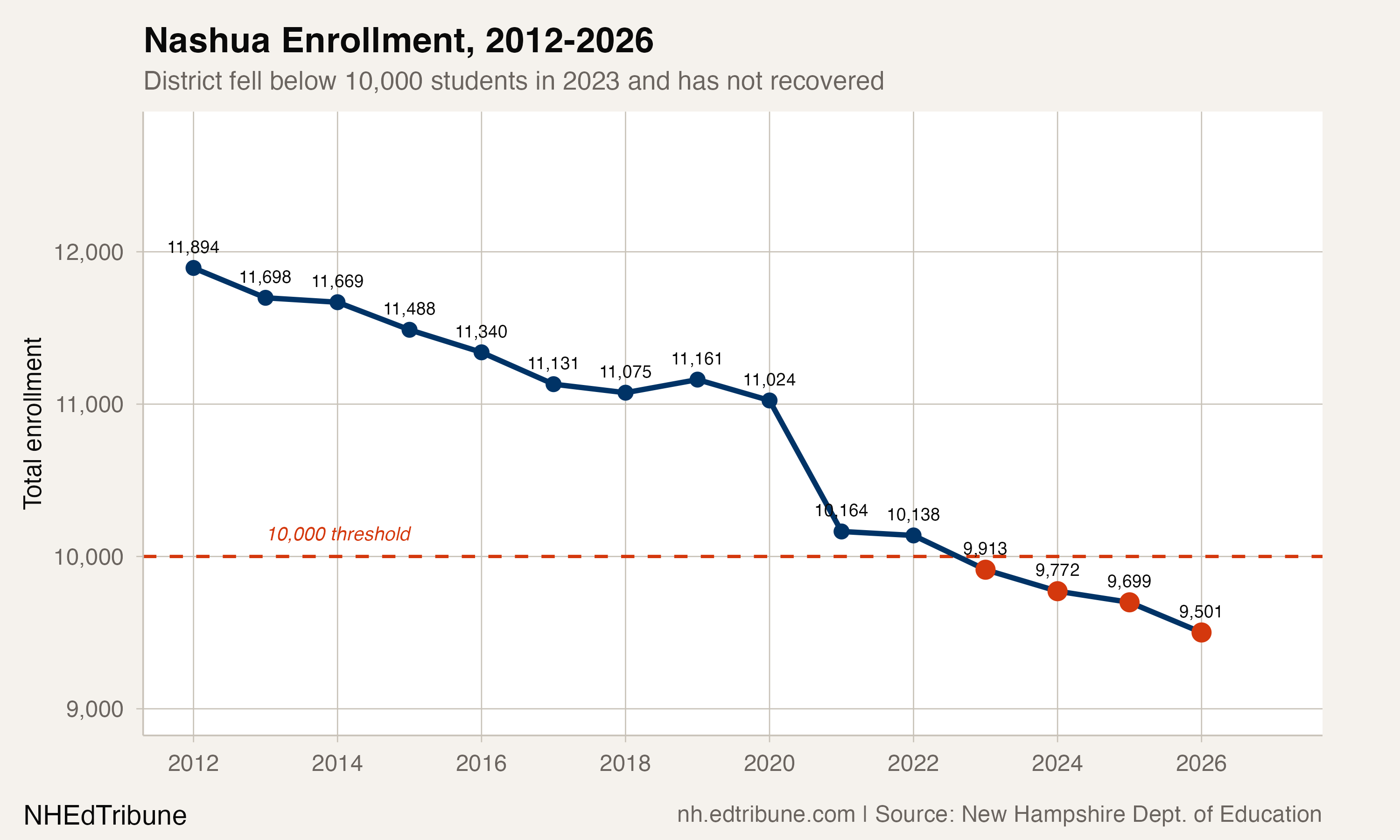
Nashua has declined in 13 of 14 year-over-year transitions since 2012. The lone exception was 2018-19, when the district added 86 students before resuming its slide. Before the pandemic, the trajectory was gradual: a 7.3% loss over eight years, roughly in line with the statewide rate of 7.7% over the same period. The district was shrinking, but no faster than New Hampshire as a whole.
Then COVID hit. Between October 2019 and October 2020, Nashua lost 860 students in a single year, a 7.8% drop. That was the largest absolute single-year loss of any district in the state, edging Manchester↗ET at 838. The statewide drop that year was 4.7%. Nashua's COVID shock was nearly double the state average.
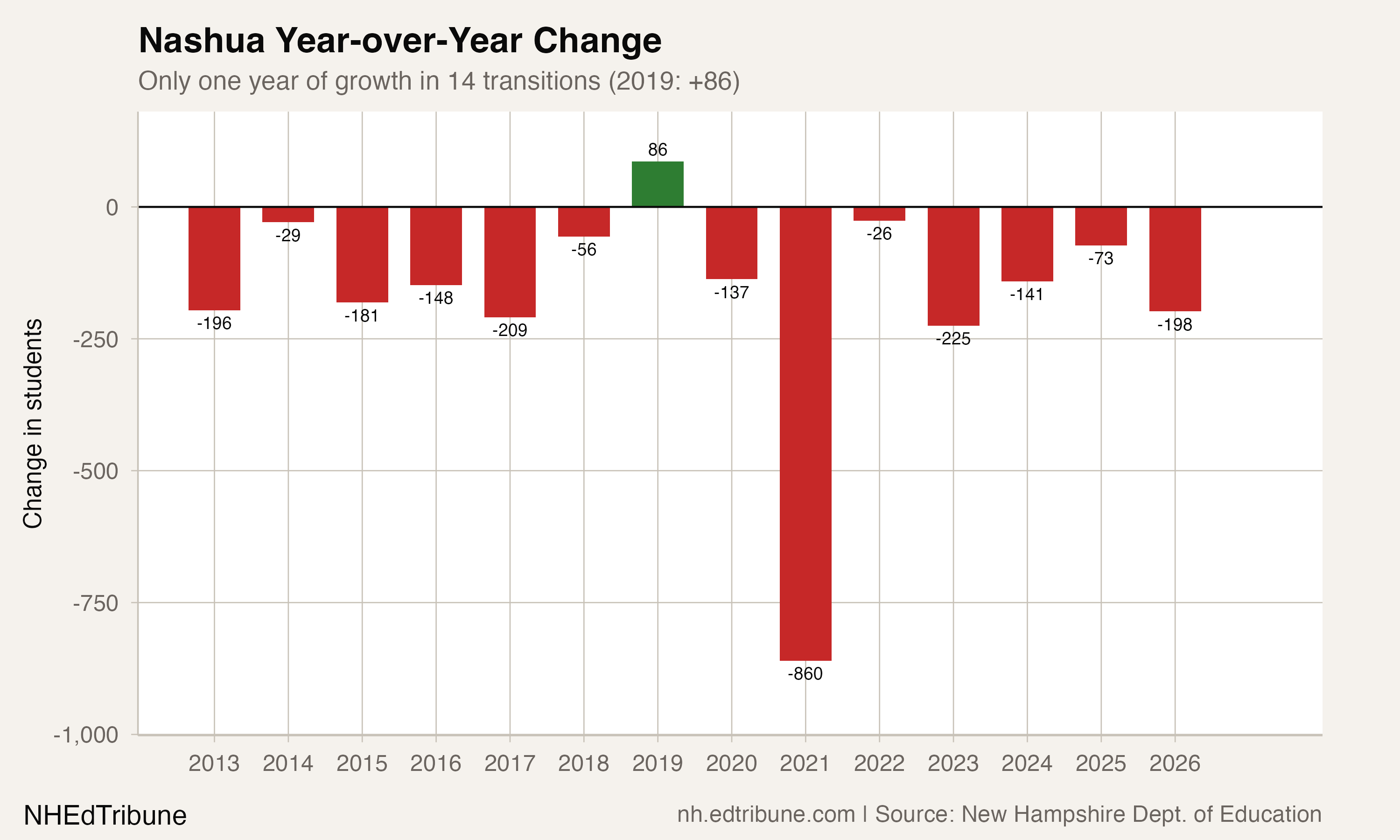
Recovery never came. From 2021 through 2026, Nashua lost another 663 students, a 6.5% post-COVID decline compared to 4.5% statewide. The 2025-26 loss of 198 students was the second-largest annual drop since COVID, suggesting no floor yet.
Where the students disappeared
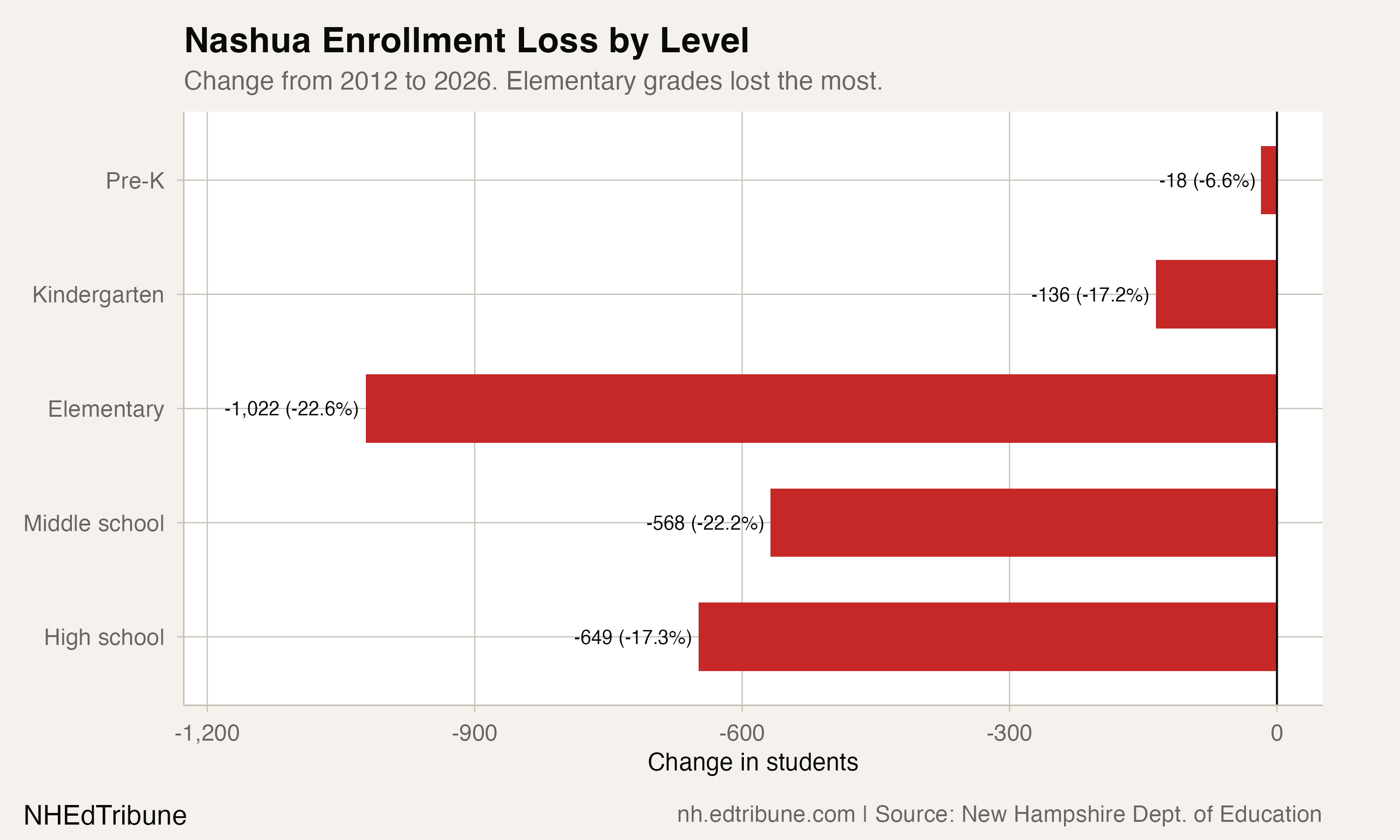
Elementary grades bore the heaviest losses. Nashua's elementary enrollment fell from 4,527 to 3,505 between 2012 and 2026, a loss of 1,022 students (22.6%). Middle school enrollment dropped 22.2%, from 2,556 to 1,988. High school grades, fed by larger cohorts that entered the pipeline years ago, declined 17.3%.
The kindergarten pipeline tells the sharpest version of this story. Nashua enrolled 789 kindergartners in 2012 and 653 in 2026, a 17.2% drop. But the year-to-year volatility is striking: kindergarten enrollment plunged to 563 during the pandemic year (2021), partially rebounded to 725 in 2023, then fell again to 631 in 2025 before ticking up to 653.
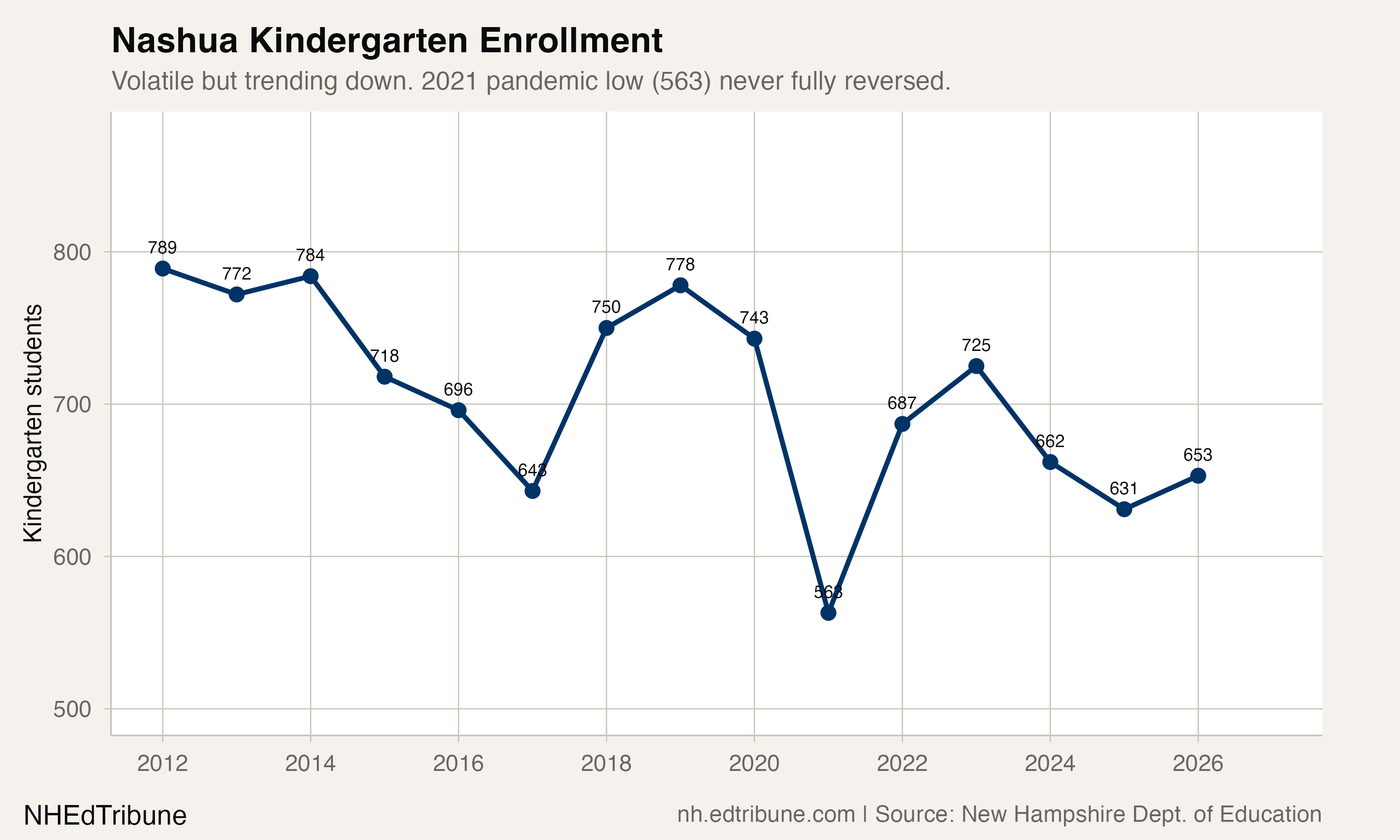
That volatility makes planning difficult. A kindergarten class of 563 one year and 725 two years later means staffing decisions are a guess. The overall direction, though, is clear: fewer children are entering Nashua's schools than a decade ago, and smaller incoming classes will continue to push total enrollment down as larger graduating classes cycle out.
Nashua's decline in context
Nashua has plenty of company. It is the second-largest absolute loser in the state behind Manchester, which shed 3,824 students (24.6%) over the same period. Every district in New Hampshire that enrolled 4,000 or more students in 2012 has since shrunk, with losses ranging from Bedford's 10.2% to Hudson's 29.0%.
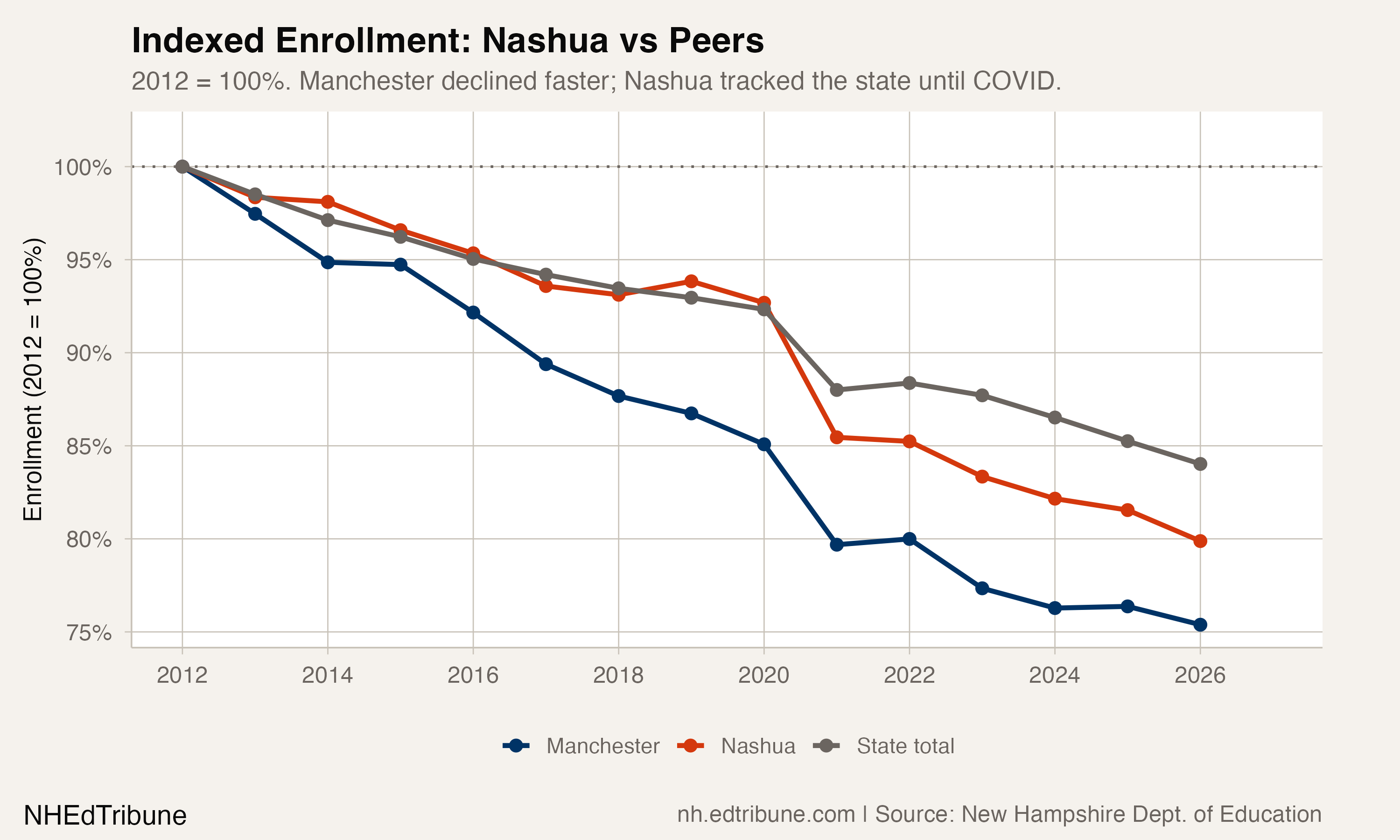
The indexed comparison shows a split. Before COVID, Nashua's trajectory closely tracked the statewide average. Both lost about 7% between 2012 and 2020. Manchester, by contrast, was already declining faster. The pandemic separated Nashua from the pack: its 7.8% COVID-year drop pushed it below the state trendline, and it has stayed there since. None of the 14 New Hampshire districts that enrolled 3,000 or more students in 2021 have recovered to their pre-COVID enrollment.
Nashua's share of statewide enrollment slipped from 6.2% in 2012 to 5.9% in 2026. The shift is modest, suggesting Nashua is shrinking roughly in proportion to the state. Families are not leaving Nashua for other New Hampshire districts. Nashua's problem is the state's problem.
Birth rates, housing, and the structural squeeze
New Hampshire's deaths have outpaced births every year since 2017, making the state entirely dependent on in-migration for population growth. The New Hampshire Fiscal Policy Institute has noted that "high costs of living, low housing inventory, and challenges accessing child care may limit young professionals and families from moving into New Hampshire." Nashua's total population grew by just 654 people (0.7%) between 2020 and 2024, per the same analysis. The city is growing, barely, but not with enough school-age children to reverse the enrollment trend.
The state's Education Freedom Account program, which expanded to universal eligibility in 2025, is a frequently cited factor in public school enrollment discussions. But the data suggests its direct impact has been small so far: statewide, only 493 students left public schools to take an EFA in 2024, representing 0.3% of total public enrollment. Over 65% of EFA recipients were already enrolled in private schools or homeschool programs. The program may accelerate at the margins as its enrollment cap rises to 10,000, but it does not explain the scale of Nashua's 2,393-student decline.
"About 162,000 students are enrolled in New Hampshire's K-12 public schools this year, down about 1% from last year ... driven in large part by the state's aging population and low birth rates." — NHPR, November 2022
The more likely driver is demographic. Smaller birth cohorts entering kindergarten, an aging population, and housing costs that discourage young families add up to a structural squeeze that no single policy lever can reverse. The FY2025 Nashua school budget of $131 million already eliminated seven elementary and 12 middle school teaching positions, adjustments that reflect a district recalibrating for fewer students.
Below 10,000 and still falling
Nashua's enrollment has declined in all but one of the last 14 years. The kindergarten pipeline shows no sign of widening. The district lost 1,523 students in the six years since 2020 alone.
The FY2025 budget already eliminated seven elementary and 12 middle school teaching positions. That kind of cut is what 130 fewer students per year looks like in practice: not a crisis headline, but a counselor who retires and is not replaced, a section of fourth grade that disappears because there are not enough nine-year-olds to fill it. Nashua's $131 million school budget was built for a district of 12,000. At 9,500 and falling, every line item is a negotiation between what the buildings need and what the headcount can justify.
Detailed code that reproduces the analysis and figures in this article is available exclusively to EdTribune subscribers.
Discussion
Sign in to join the discussion.
Loading comments...