The city of Concord has gained nearly 2,000 residents since 2014. Its school district has lost more than 1,000 students in roughly the same period. That divergence (a growing city with a shrinking school system) is the defining fiscal reality for New Hampshire's capital.
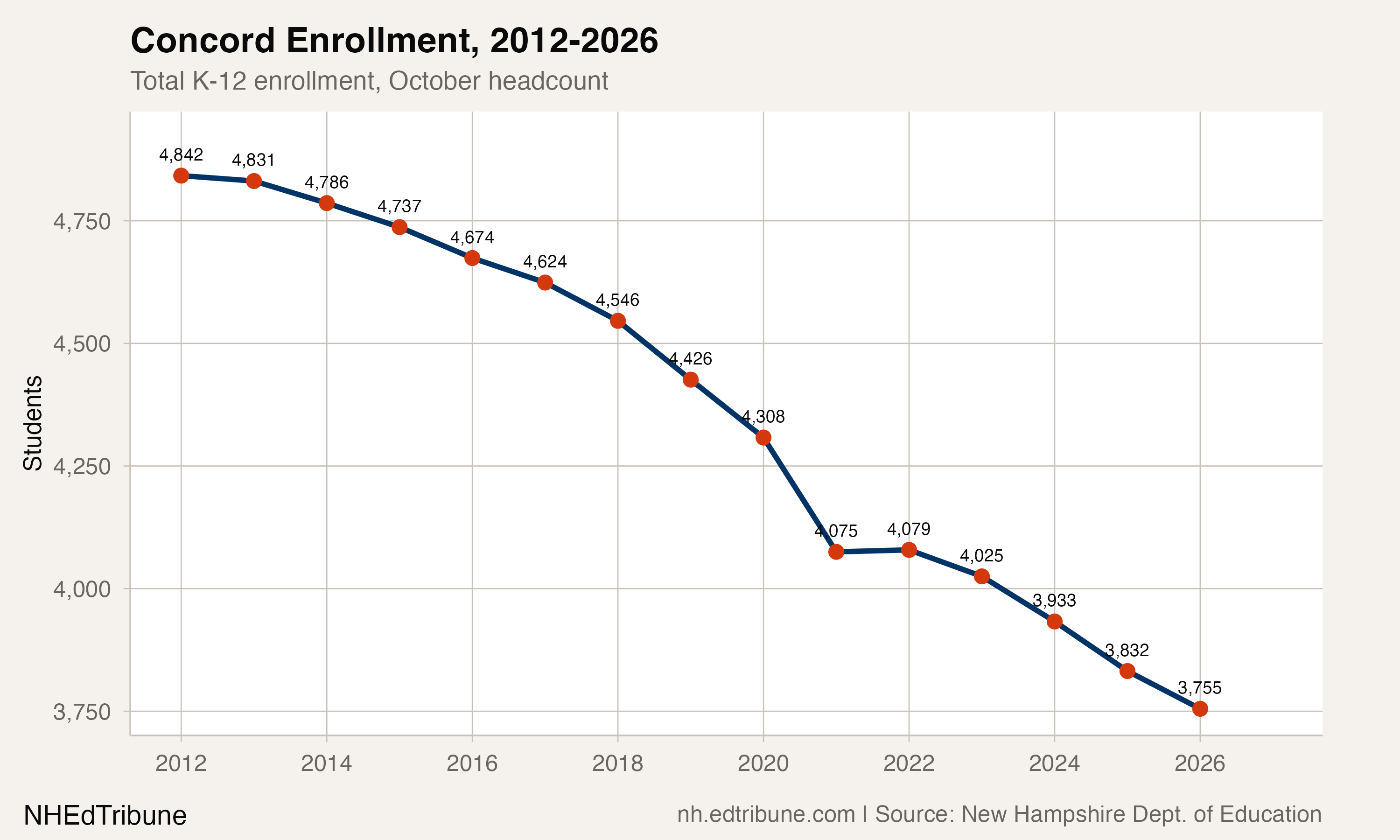
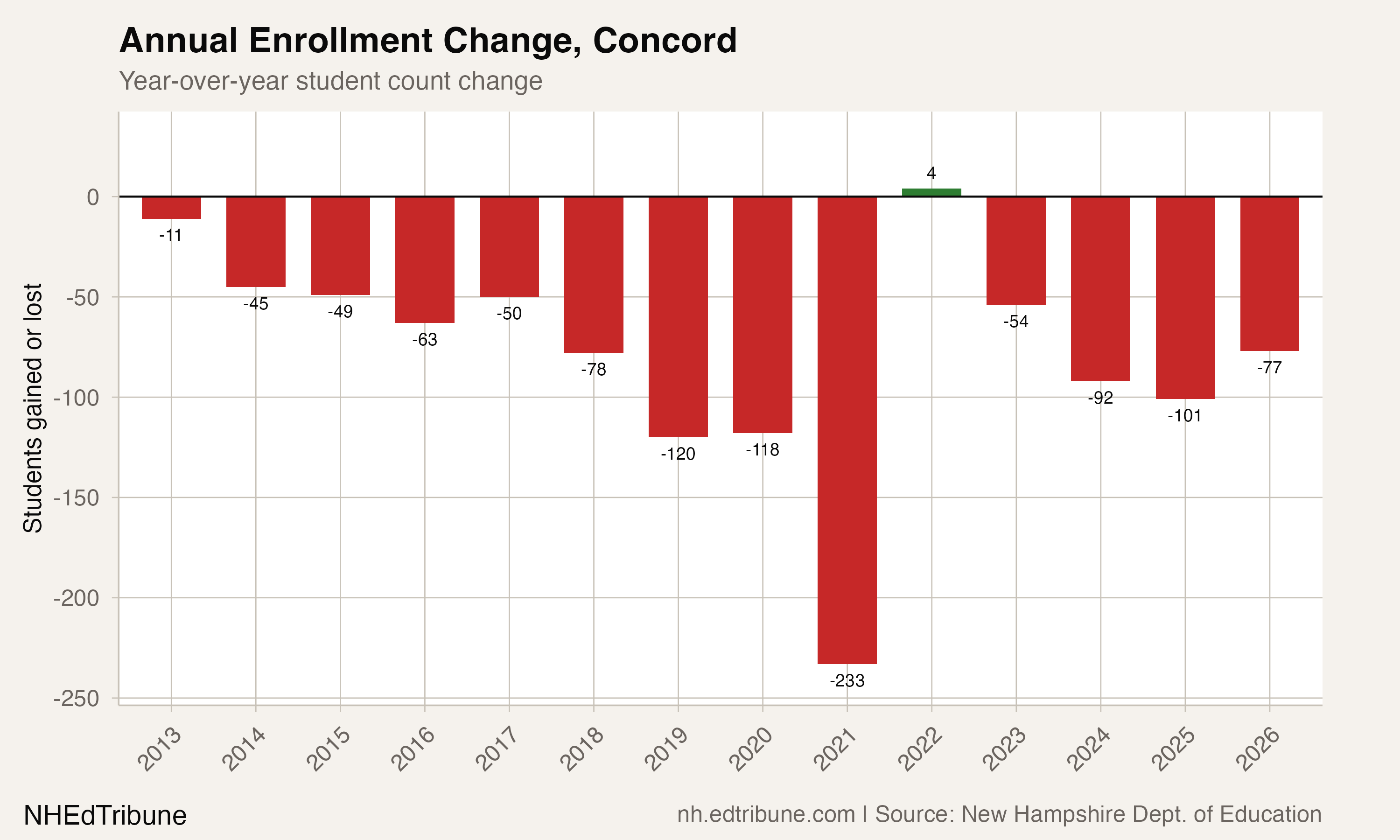
Concord↗ET enrolled 4,842 students in 2011-12. By fall 2025, the October headcount had fallen to 3,755, a loss of 1,087 students, or 22.4%. The district has declined in 13 of the past 14 years. The sole exception: a gain of four students in 2021-22, immediately after COVID's deepest losses, before the decline resumed.
Three phases of loss
The decline came in waves, each larger than the last.
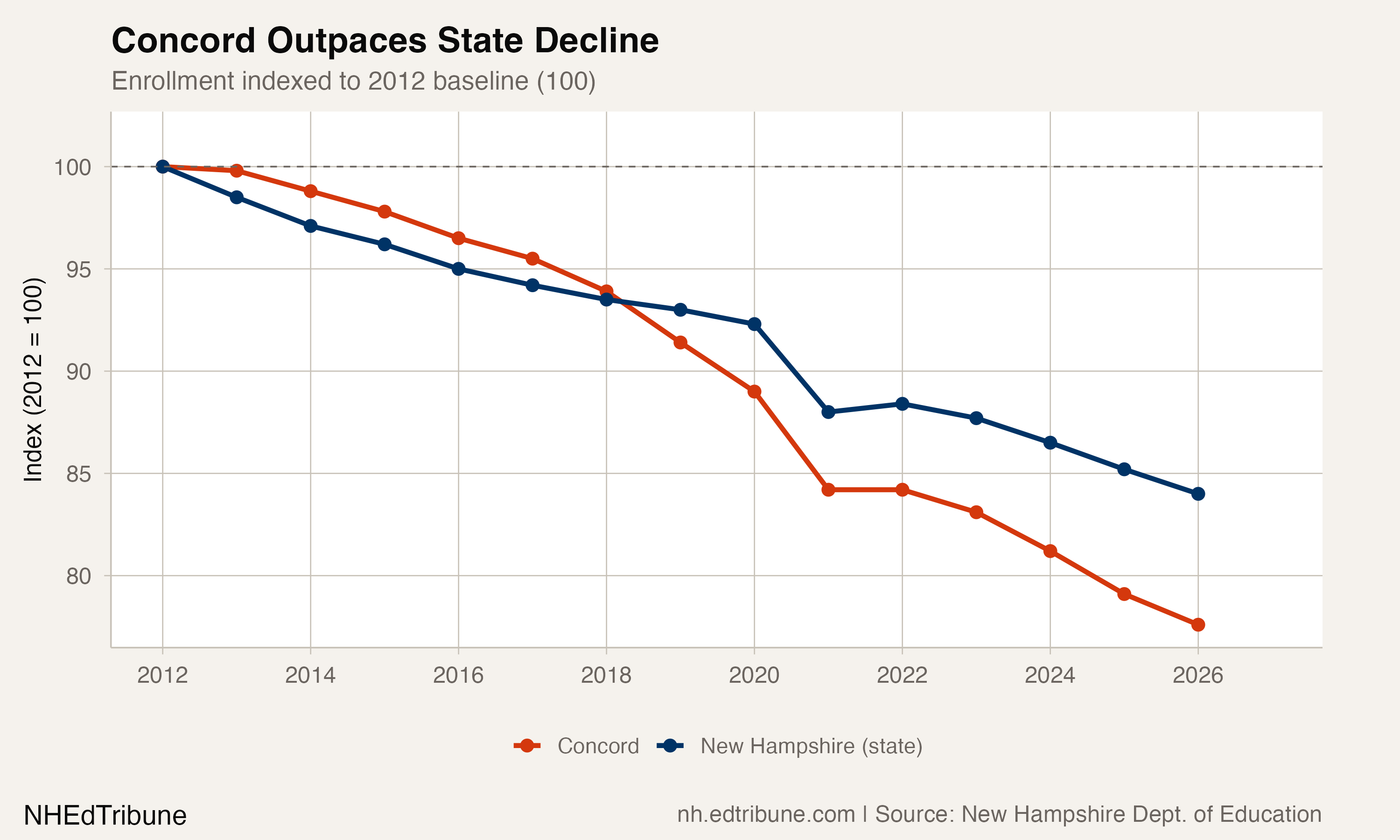
From 2012 to 2018, Concord lost an average of 49 students per year. The pace was noticeable but manageable, tracking modestly below the state's overall trajectory. New Hampshire as a whole fell 16.0% over the same 15-year window; Concord's 22.4% drop exceeded the statewide rate by more than six percentage points.
Then the losses tripled. From 2018 to 2021, Concord averaged 157 fewer students per year. Three consecutive years of accelerating losses, 120 in 2019, 118 in 2020, and 233 during the pandemic year of 2021, erased 471 students in a span when the district had no room to absorb them.
The post-COVID era brought no recovery. Concord sits 553 students below its pre-pandemic enrollment of 4,308, having lost an additional 324 students since the 2021-22 bounce. The average annual loss since 2022 is 81 students, slower than the crisis years but faster than the pre-2018 baseline.
Every grade band is contracting
Every grade band in Concord has shrunk since 2012, and the upper grades are falling fastest.
Concord High School enrolled 1,779 students in 2012. It enrolled 1,317 in 2026, a loss of 462, or 26.0%. Rundlett Middle School dropped from 1,014 to 756, a decline of 25.4%. The elementary schools, which feed the pipeline, fell 22.2%, from 1,694 to 1,318 across four buildings. Even kindergarten, the entry point, has slipped: average K enrollment in the most recent five years (253) is 13.4% below the 2012-2016 average of 292.
The only grade band that grew was pre-kindergarten, rising from 65 to 113 students, a 73.8% increase. That growth reflects expanded PK programming, not a demographic tailwind; the kindergarten numbers immediately downstream are falling.
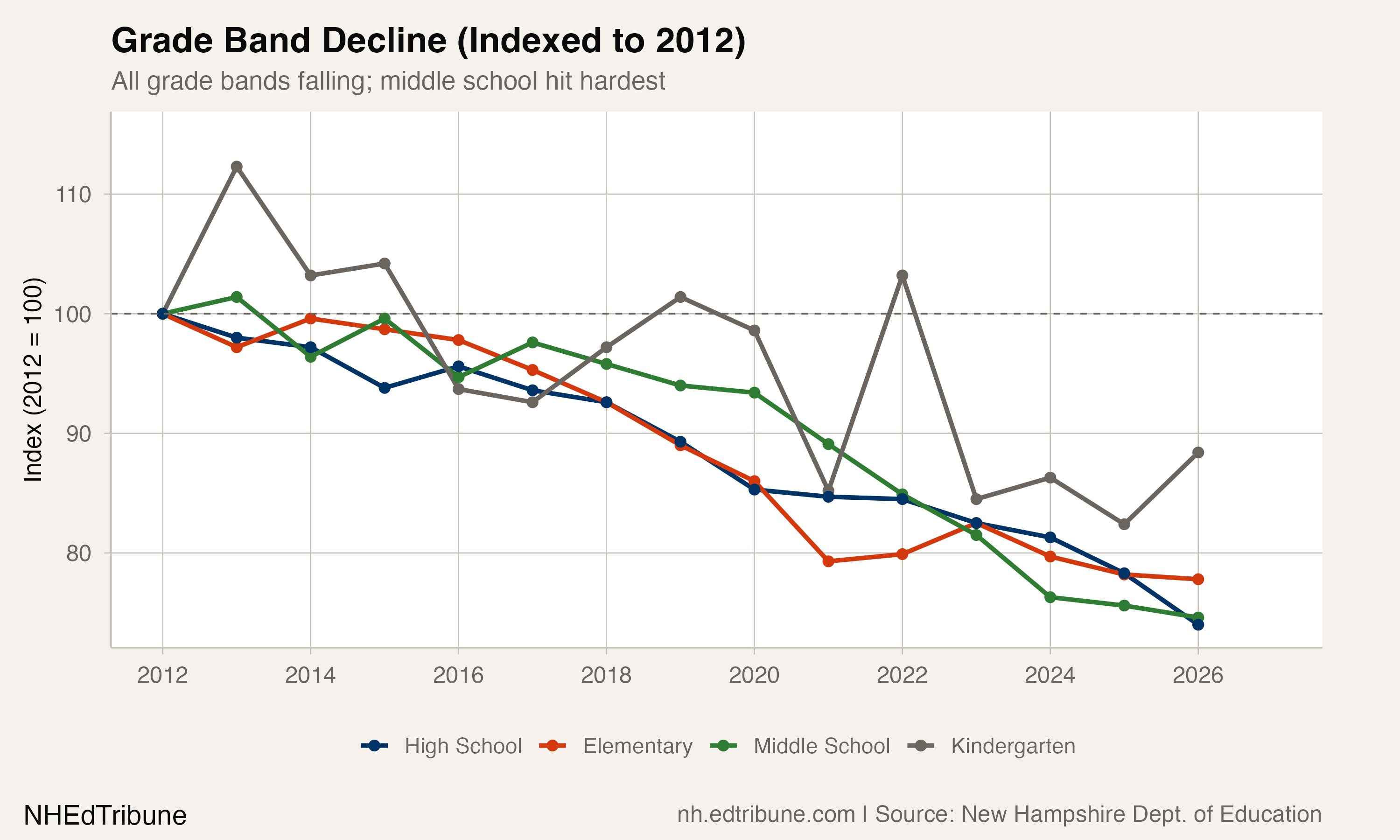
The high school's 2026 enrollment of 1,317 now matches the elementary total of 1,318. In 2012, the high school exceeded the elementary schools by 85 students, with 1,779 to 1,694. The pipeline has been narrowing from the bottom up for over a decade, and smaller entering cohorts are now reaching the upper grades.
What is driving the decline
Demographics come first: New Hampshire has one of the lowest birth rates in the nation, ranking 49th out of 50, with 48.2 births per 1,000 women aged 15-44. Annual births in the state have fallen from roughly 14,000 in the early 2000s to around 12,000 in recent years. Fewer children born means fewer children enrolling five years later.
But Concord's 22.4% decline is steeper than the 16.0% statewide loss, so demographics alone do not explain the gap. School choice plays a role. The Concord Monitor reported that more Concord-area families have shifted to charter schools, homeschooling, and private institutions. Concord Christian Academy, located in the city, has grown 23% since the Education Freedom Account program launched in 2021. The statewide EFA program, which provides public funds for private school tuition, doubled from 5,321 to over 10,000 participants in 2025-26 alone.
A third factor is unique to Concord. Deerfield residents voted to end their tuition agreement with Concord High School, adopting school choice instead. While some Deerfield students may still attend Concord, the guaranteed pipeline of roughly 160 tuition students is no longer assured.
A growing city, shrinking classrooms
Concord itself is not emptying out. The overall population has risen, driven by adults and retirees moving to the capital region.
"We are becoming grayer. I'm new to the state, but a lot of our high school and college graduates don't stay, so the population as a whole is older." -- John Goldhardt, Manchester superintendent, quoted in The 74
Goldhardt was describing Manchester, but the dynamic is the same across New Hampshire's urban centers. Concord's population grows because adults move in. Its schools shrink because those adults have fewer children, or none, and because the families already there are smaller than the generation they replaced.
Falling faster than its peers
Concord's 22.4% decline ranks eighth-worst among the 24 New Hampshire districts that enrolled at least 2,000 students in 2012. Only Manchester↗ET (-24.6%), Hudson (-29.0%), Milford (-30.1%), and a handful of others have fared worse in percentage terms.
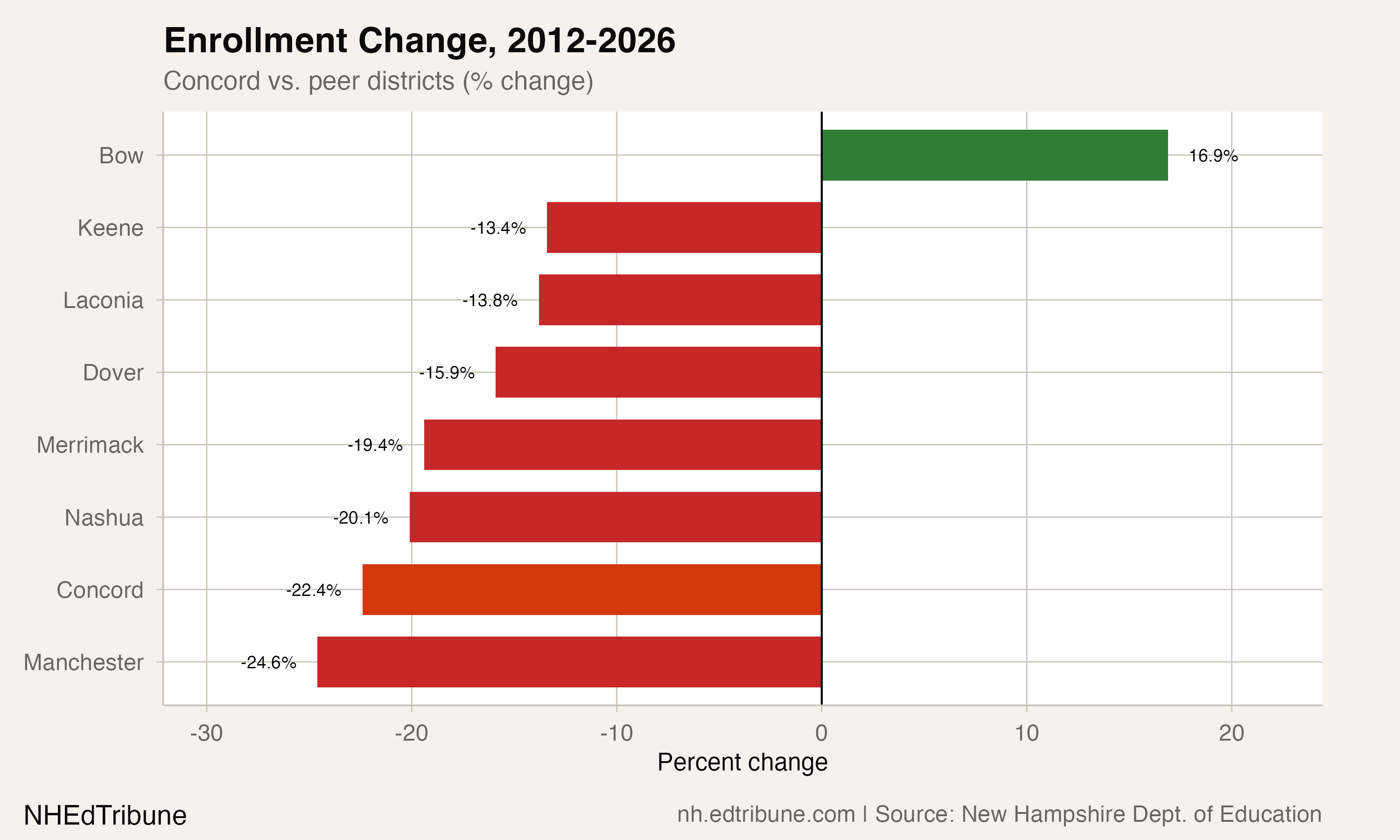
The sharpest comparison is with Bow, a suburban district 10 minutes south of the capital. Bow↗ET grew 16.9% over the same period, from 1,442 to 1,686. The two districts are separated by a town line, not a border. A 39-percentage-point gap between a state capital and its immediate suburb. Statewide, 147 of 173 districts declined since 2012. Most of the 25 that grew are small suburban or charter-affiliated entities.
Budget pressure with no lever to pull
Losing students does not produce proportional cost savings. As Concord school board vice president Brenda Hastings told the Concord Monitor: "We need to make some cuts somewhere. But I have to say I would not want to start with teachers."
Salaries and benefits account for more than three-quarters of the district's general fund expenses. Losing 77 students in a single year, as Concord did in 2025-26, does not eliminate the need for a physics teacher or a school counselor. Meanwhile, fewer students means less per-pupil state adequacy aid. The district expected state aid to drop $1.9 million for the 2024-25 budget, roughly 8%.
New Hampshire provides only 33% of K-12 funding statewide, the lowest state share in the country, with 61% coming from local property taxpayers. For a district losing students and state aid simultaneously, the remaining option is to ask property taxpayers to cover the gap, in a state with no income or sales tax.
The pipeline question
Rundlett Middle School's enrollment of 756 is the lowest since the dataset begins. The school board is weighing a new middle school building designed for 900 students, a capacity bet that rests on the assumption that migration will eventually replenish what birth rates cannot.
"Many of the people moving to New Hampshire are families mostly in their 30s and 40s. Depending on whether migration picks up, slows down, that's going to be a big factor." -- Ken Johnson, UNH demographics professor, quoted in the Concord Monitor
Kindergarten enrollment offers the nearest leading indicator. Concord enrolled 251 kindergartners in fall 2025. Those 251 children will fill the elementary pipeline through 2032 and the high school through 2038. If kindergarten cohorts continue averaging 253 rather than the 292 of a decade ago, the district's current trajectory does not bend upward. It flattens, at best, at a lower level.
Concord has institutional gravity that most New Hampshire cities lack: state government, hospitals, a university. Whether that can attract enough young families to offset the forces pulling enrollment down is an open question. Fifteen years of data suggest the answer has been no.
Detailed code that reproduces the analysis and figures in this article is available exclusively to EdTribune subscribers.
Discussion
Sign in to join the discussion.
Loading comments...